
I’m a science journalist and researcher at The Watchers, contributing to the Epicenter edition, where I cover peer-reviewed scientific research and emerging discoveries across Earth and space sciences. With a background in astronomy and a passion for environmental science, I’ve worked in shark and coral conservation in Fiji, conducting reef and shark-behavior research, contributing to mangrove restoration, and earning PADI Open Water and Coral Reef Certifications. I bring a blend of scientific rigor and storytelling to illuminate the discoveries shaping our planet and beyond.

  • Aseismic slip and seismic swarms preceding Taiwan’s 2024 M7.3 Hualien earthquake

    Years before the ground shook across eastern Taiwan, the faults beneath Hualien were already in motion. A new study in Nature Communications shows that deep aseismic slip and migrating fluids quietly increased stress by about 30 kilopascals before the April 3, 2024 M7.3 Hualien earthquake, revealing how silent deformation can set the stage for disaster.
  • Earth’s continents forged in furnace-like heat, new study reveals how stability was born

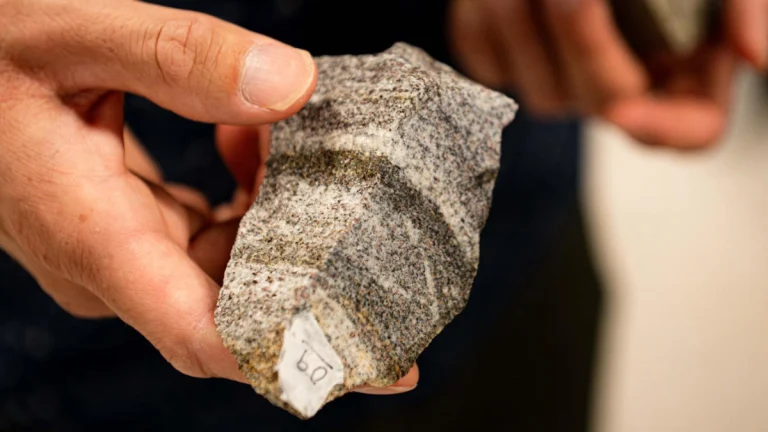
    Researchers at Penn State and Columbia University have found that Earth’s continents became stable through extreme heat exceeding 900 °C (1 650 °F) in the planet’s lower crust, according to a study published in Nature Geoscience on October 13, 2025.

  • What a runaway black hole did to a galaxy 31 million light-years away

    Astronomers using the James Webb Space Telescope (JWST) and ALMA have identified a 20 000 light-year (6 kiloparsec) scar of gas and dust slicing through the spiral galaxy NGC 3627. The feature was likely created by a massive black hole or the nucleus of a dwarf galaxy that passed through the galactic disk about 20 million years ago.

  • South Atlantic Anomaly, weak spot in Earth’s magnetic field, expanding steadily since 2014

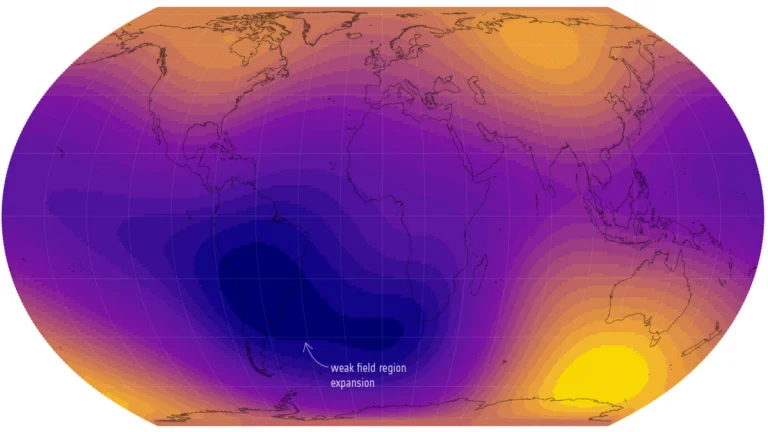
    New data from the European Space Agency’s Swarm mission show that the South Atlantic Anomaly, a weak region in Earth’s magnetic field over the South Atlantic Ocean, has expanded steadily since 2014, now covering nearly 1 % of the planet’s surface. The 11-year record marks the most detailed satellite observation of the field’s uneven weakening to date.

  • NASA telescopes detect unusual chemistry in interstellar comet 3I/ATLAS

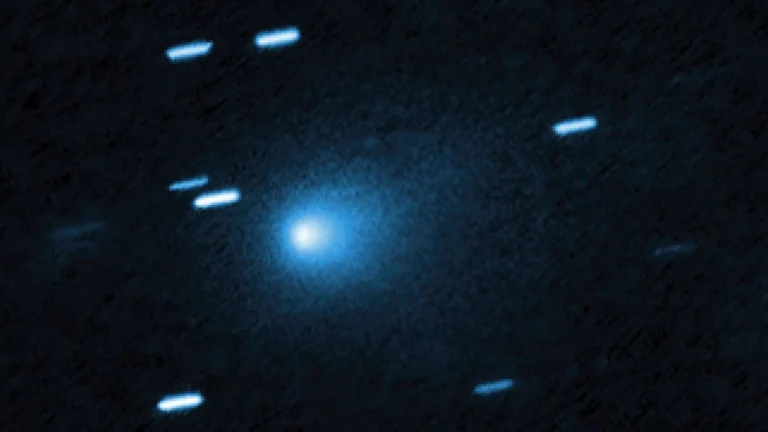
    NASA released the first results of James Webb Space Telescope (JWST) observations of interstellar comet 3I/ATLAS on August 25, 2025, showing a coma dominated by carbon dioxide. The comet was observed on August 6, and complementary data from Hubble and SPHEREx confirm unusual volatile ratios.