
State of emergency declared as Hawk Fire injures six near Reno, Nevada
Six people were injured and approximately 42 000 remained in GO NOW evacuation zones after the Hawk Fire expanded across the Peavine Peak area northwest of Reno, Nevada, on August 22–23, 2026. Nevada declared a State of Emergency in Washoe County, while the latest available mapping placed the fire at approximately 6 086 ha (15 040 acres) with 0% containment late on August 23.

Hawk Fire burning in Nevada on August 23, 2026. Credit: Truckee Meadows Fire & Rescue
The Hawk Fire had burned through 6 086 ha (15 040 acres) at 16:17 PDT (23:17 UTC) on August 23, since it was first reported on August 22.
Approximately 13 700 residences were located within the designated evacuation area. The figure represented properties exposed to evacuation measures and did not constitute a confirmed damage total.
Three civilians and three first responders were injured. No deaths had been reported by late August 23.
Officials confirmed structural losses, but unsafe conditions prevented assessment teams from entering some burned areas. No authoritative total of destroyed or damaged homes and other buildings was available.

The fire was classified as human-caused, but the specific ignition mechanism remained under investigation. Authorities had not identified a responsible person.
It was first reported at approximately 11:25 PDT (18:25 UTC) on August 22 near Hawk Meadow Trail, about 1.6 km (1 mile) north of Cold Creek Trail in the Peavine Peak area. Strong winds, low humidity, and dry grass and brush supported its rapid initial growth.
Approximately 800 personnel were assigned to the incident by late August 23. Aircraft worked the western and southern flanks, while ground crews and bulldozers constructed and improved fuel breaks along the southern and eastern sides.
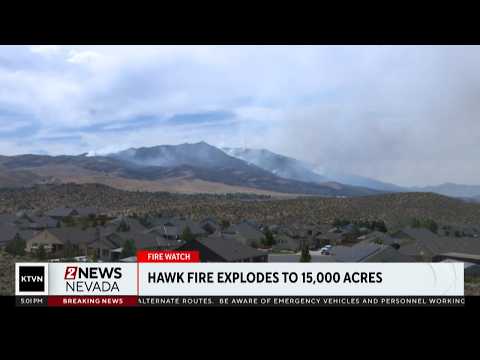
Fire managers reported extreme, wind-driven behavior through light fuels and said additional northeastward spread could threaten roads, structures, businesses and infrastructure around Stead. Railway and communications infrastructure were among the assets identified as being at risk, but no confirmed railroad closure or damage total was available.
The fire crossed U.S. Route 395 during its initial expansion. At 09:00 PDT (16:00 UTC) on August 23, northbound U.S. Route 395 was closed between Parr Boulevard and Red Rock Road, while southbound traffic at Bordertown was being turned around before White Lake.
Southbound U.S. Route 395 remained open from Red Rock Road south into Reno at that time. Additional restrictions affected North Virginia Street, Stead Boulevard, Lemmon Valley Drive and roads around Somersett and Golden Valley.
Evacuation warnings were also in effect for Long Valley in Sierra County, California, including zones SIE-E024 and SIE-E061. Residents in those zones were told to prepare to leave, but the warnings did not establish that the mapped fire perimeter had entered California.
The Reno-Sparks Convention Center remained open as the principal evacuation shelter. The American Red Cross reported that 465 evacuees stayed inside during the first night, while approximately 200 others remained in vehicles and recreational vehicles outside.
Small animals were being directed to Washoe County Regional Animal Services, while the Ironwood Event Center was accepting large animals. More than 900 cots could be made available at the convention-center shelter if required.
Northwest Specialty Hospital evacuated its patients as a precaution on August 23, transporting them to other facilities for continued care. The North Valleys emergency department temporarily closed because of the evacuation conditions.
All Washoe County School District schools except Gerlach K-12 School were closed on August 24. Truckee Meadows Community College sites and Coral Academy’s Reno campuses were also closed, while the University of Nevada, Reno, remained outside the evacuation zones and continued regular operations.

Approximately 10 000 Northern Nevada electricity customers remained without service on August 23 after emergency de-energization measures and fire damage affected transmission lines, poles and other equipment. Natural gas service was shut off to approximately 250 customers as a safety measure.
The August 22 transmission shutdown also interrupted electricity for approximately 37 000 customers across the Truckee and North Lake Tahoe region. The total included nearly 14 800 Truckee Donner Public Utility District customers and approximately 22 000 Liberty Utilities customers.
Service was restored to all Truckee Donner customers by 16:13 PDT (23:13 UTC) on August 23. Switching work by regional utilities prevented another anticipated Truckee outage that evening, although additional safety shutoffs remained possible if transmission infrastructure was again threatened.
Reno-Stead Airport remained closed to general aviation but open to firefighting and military aircraft. Reno-Tahoe International Airport remained outside the evacuation area, and commercial operations continued.

Nevada Governor Joe Lombardo declared a State of Emergency in Washoe County and authorized one CH-47 Chinook, one UH-60 Black Hawk and 72 National Guard security personnel. The helicopters supported aerial firefighting, while security personnel assisted law enforcement in evacuated areas.
FEMA approved a Fire Management Assistance Grant on August 22, providing federal cost-sharing for eligible firefighting expenses. Nevada’s emergency operations center was at full activation, while FEMA Region 9 Incident Management Assistance Team 1 was scheduled to arrive on August 24.
Nevada Task Force 1 was deployed to support canine-assisted searches beginning on August 24. No deaths had been reported, and the deployment did not establish that fatalities had occurred.
An emergency closure order covered National Forest lands in the Peavine area to protect the public during firefighting operations. The Reno-Sparks Indian Colony also restricted public access through Hungry Valley Tribal lands into Lemmon Valley, allowing people to leave affected areas while preventing unauthorized re-entry.

For August 24, patchy smoke, minimum relative humidity of 11–21%, and southwest wind gusts reaching approximately 40 km/h (25 mph) were forecast around the northern Sierra Front. The forecast listed a 10% thunderstorm probability and a 5% chance of wetting rain, while thunderstorms that developed could produce gusty and erratic winds.
Stronger afternoon winds were forecast from August 25 through August 27, with gusts of approximately 55 km/h (35 mph) and up to 65 km/h (40 mph) in wind-prone areas. Elevated to locally critical fire-weather conditions were possible, although no Red Flag Warning was active in the cited August 23 forecast.
Updates
07:55 UTC, August 27
The Hawk Fire near Reno has reached 93% containment after burning approximately 6 105 ha (15 085 acres) in Washoe County, according to the latest incident update issued on the evening of August 26. About 570 firefighters remained assigned to the fire.
Damage assessments confirmed that 47 homes and one commercial building were destroyed, while eight additional homes sustained major damage. No fatalities have been reported.
At least seven people were injured during the fire, including civilians and first responders. The injuries were reported as minor, including burn injuries among firefighters.
Evacuation restrictions have been substantially reduced as containment improved. Authorities allowed approximately 9 300 residents east of U.S. Route 395 to return home on August 25, although about 5 000 people remained within evacuation zones at that time. Residents were advised to continue following the official evacuation map as additional zones were downgraded.
The fire’s cause remains under investigation. Earlier reporting indicated that authorities considered the ignition human-caused, but no specific ignition mechanism or responsible person has been identified.
References:
1 Daily Update for the Hawk Fire – Emergency Washoe – August 23, 2026
2 NV Energy Provides Update on Emergency De-Energization – Emergency Washoe – August 23, 2026
3 Hawk Fire Closure, Carson Ranger District – Humboldt-Toiyabe National Forest – August 22, 2026
4 Tens of thousands ordered to evacuate in Nevada as fire threatens Reno – Reuters – August 23, 2026

Rishav Kothari is Editor-in-Chief of The Watchers, where he runs the newsroom and covers earthquakes, volcanoes, severe weather and space weather.
Published in the last 24 hours
- In September 1859, a solar storm lit up the night sky so brightly that gold miners in the Rocky Mountains woke up after midnight and started cooking breakfast, convinced the aurora glowing over their camp was the sunrise Epicenter
- A patch of warm Pacific water that could become the strongest El Niño in more than 70 years sits thousands of miles from any American town, yet it is already the main reason NOAA expects a wetter winter across the South and a milder one across the North
