
CME impacts Earth, sparking G3 – Strong geomagnetic storm and widespread red aurora
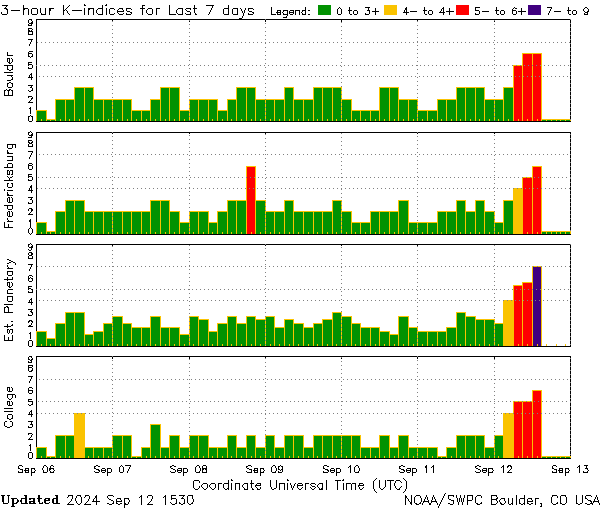
Coronal mass ejection (CME) produced by a filament eruption early Sunday, September 8, 2024, hit Earth at around 03:50 UTC on September 12. The impact sparked G3 – Strong geomagnetic storming and widespread red aurora.

Image credit: Garry Walker/SpaceWeather
A coronal mass ejection (CME) produced by a filament eruption early Sunday, September 8, 2024, hit Earth on September 12, sparking G3 – Strong geomagnetic storming and widespread red aurora.
G1 – Minor geomagnetic storm threshold was reached at 07:55 UTC followed by G2 – Moderate at 11:28 UTC and G3 – Strong at 14:43 UTC.
“Infrastructure operators have been notified to mitigate any possible impacts,” SWPC said.
G3 – Strong geomagnetic storm primarily impacts areas poleward of 50 degrees Geomagnetic Latitude. Power systems in these regions may experience voltage irregularities, potentially causing false alarms in some protection devices due to induced currents.
Spacecraft may face surface charging, increased drag on low Earth orbit satellites, and orientation challenges. Satellite navigation (GPS) systems can be intermittently affected, leading to loss of lock and increased range errors.
High-frequency (HF) radio communications may also become unreliable, while auroras may be visible as far south as Pennsylvania, Iowa, and Oregon.


Dr. Tony Phillips of SpaceWeather.com is reporting widespread red aurora deep inside the United States as a result of this storm.
From Owens Valley Radio Observatory near Bishop, California, Ross Stone captured these magnificent images:
Anyone else in the SF Bay Area see the #Aurora tonight? #AuroraBorealis #CME #spacewx pic.twitter.com/m2DcAiCMq1
— jenii ☭ (@garnetstar28) September 12, 2024
Northern Lights over #WestVan early this morning. #NorthVan #NorthernLights #Aurora #AuroraBorealis #Vancouver #Liongate #ProspectPoint #StanleyPark @RyanVoutilainen Your weather tips tonight really helped out Thank You So Much! 🙂 I have a ton to edit for tomorrow. #GreatNight pic.twitter.com/hnarrY5vVq
— Mark Teasdale ★ (@MarksGonePublic) September 12, 2024
Adding to the global impact of this storm, the following image was captured from Strezhevoy in Russia’s Tomsk Oblast:
Service post. Our member @MBerto7 warned us of a G7 storm. Indeed Silent Spring sent us Aurora pics taken from Starvisor Project. Right now. #Aurora #Aurora_alert #Russia pic.twitter.com/7NMH5Lef1G
— Telegram Group Smartphone Astrophotography (@smartphone_astr) September 12, 2024
Solar activity was at high levels over the past 36 hours, with several notable solar flares, including M5.0, X1.3, and M6.8.

WSA Enlil model shows two CMEs still heading toward Earth, with impact expected on September 13 and 14.

Solar activity is expected to continue at moderate to high levels, with a 60% chance of M-class solar flares on September 12, 13, and 14. Additionally, there is a 15% chance of X-class flares occurring on each of these days.


Teo Blašković founded The Watchers in 2011 and edited it until 2026, covering seismic and volcanic activity, extreme weather, space weather and near-Earth objects. Articles on this page are his archive.
Earlier reporting
Nothing on Watchers was published in the last 24 hours. These are older articles.
- G1 geomagnetic storm watch remains in effect as NOAA forecasts Kp 4.67 late on November 17 and early on November 18
- On October 22, 2017, a single flash of lightning stretched 515 miles from eastern Texas to near Kansas City, a distance that takes eight hours to drive, and nobody realized how far it had gone until scientists went back through the satellite data years later Epicenter
- CPC posts a slight risk of heavy rain from the Gulf Coast to the Northeast urban corridor November 25-29, and a moderate risk of West Coast wind and Sierra snow on November 25
- Florida's east coast faces a moderate flash flood risk Wednesday through Friday, with 4 to 8 inches of rain forecast and the St. Johns River near Cocoa already in major flood at 17.13 feet
