
Gati is the strongest tropical cyclone to make landfall in Somalia and the strongest ever recorded in this part of the world

Featured image: Tropical Cyclone "Gati" on November 22, 2020. Credit: NASA/NOAA Suomi NPP/VIIRS
Tropical Cyclone "Gati" made landfall over Cape Hafun, Puntland, Somalia at around 15:00 UTC on November 22, 2020, with a maximum 3-minute average wind speed of 130 – 140 km/h (80 – 87 mph) — Very Severe Cyclonic Storm / equivalent to a Category 2 hurricane on the Saffir-Simpson scale. According to the JTWC, 1-minute maximum sustained winds at the time of landfall were 167 km/h (103 mph).
Gati is the strongest known tropical cyclone to make landfall in Somalia and the strongest ever recorded in this part of the planet — further south than any category 3 equivalent cyclone in the North Indian Ocean, according to Sam Lillo, a researcher with the National Oceanic and Atmospheric Administration's Physical Sciences Laboratory.
In addition, its rapid intensification from 65 km/h (40 mph) to 185 km/h (115 mph) in just 12 hours is the largest on record in the entire basin.
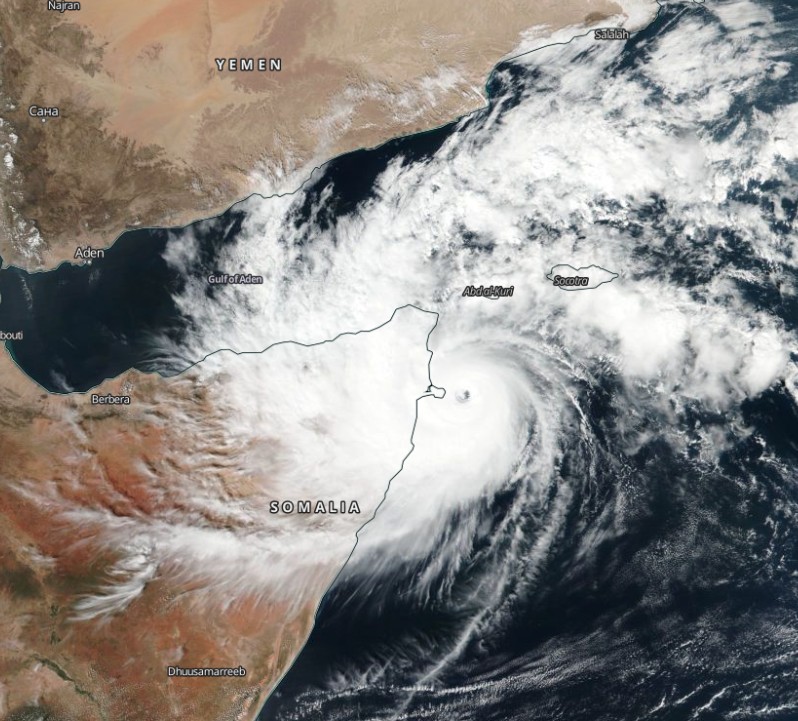
Tropical Cyclone "Gati" on November 22, 2020. Credit: NASA/NOAA Suomi NPP/VIIRS
Puntland state authorities are reporting 8 casualties, as of early Monday morning (UTC), severe flooding, collapsed homes, communications cut off and fishing boats capsized.
At least 5 Yemeni fishermen were killed on Sunday evening in the coastal strip of the state.
The center of Gati has now exited land and its maximum sustained winds, according to the JTWC, have weakened from peak 185 km/h (115 mph) at 06:00 UTC on November 22 to 75 km/h (45 mph) at 06:00 UTC on November 23. The storm is moving WNW at 15 km/h (9 mph).
W to WSW motion is expected over the next 24 hours along the northern coast of Somalia.
Meteorologists warned parts of the state might receive two years' worth of rain or more in just 48 hours. Northern Somalia's average annual rainfall is 102 mm (4 inches).
Gati formed early November 22 in the Arabian Sea, just east of Somalia, as the 3rd named storm of the below-average 2020 North Indian Ocean cyclone season.

#Puntland:8 qof oo kalluumeysato Yemeniyiin ah oo meyd ah ayaa ku soo caariday xeebta #Xaafuun, guryo badan ayaa dumay, sidoo kale #Hurdiya oo aan ka fogayn badda ayaa ku soo caariday – @RadioErgo . pic.twitter.com/LM3vqTtz5H
— Mohamed Salh (@MohamedSelh) November 23, 2020
PHOTOS: Electric poles crash to the ground leading to blackouts in the #Somalia town of Bosaso following heavy rains as cyclone #Gati hits coastal areas of #Puntland semi-autonomous region. A number of deaths reported of which 8 are fishermen from #Yemen. pic.twitter.com/eHpgpsZscz
— Somaliguardian (@SomaliGuardian) November 23, 2020
The death toll has risen to eight after Tropical Cyclone Gati battered #Puntland coastal areas on Sunday, Puntland government officials told Puntland Mirror, adding that there are other casualties such as houses collapsed, fishing boats capsized, and communications were cut. pic.twitter.com/2dyUWrB2Bd
— Puntland Mirror (@Puntlandmirror) November 23, 2020
At least 5 people feared dead after Tropical Cyclone #Gati lashed coastal areas of #Puntland.
No official communication from the Gov't nor response from the disaster Operation Coordination Centre despite early warnings.
Somalia has a weak emergency management agency. pic.twitter.com/4NYDapAr1s— Abdinassir Hassan (@abdinassir_h) November 23, 2020

Teo Blašković founded The Watchers in 2011 and edited it until 2026, covering seismic and volcanic activity, extreme weather, space weather and near-Earth objects. Articles on this page are his archive.
Published in the last 24 hours
- In 1954, a grapefruit-sized meteorite crashed through a roof in Sylacauga, Alabama, and struck Ann Hodges as she napped on her couch Epicenter
- A meteorite blew a crater beside a village near Lake Titicaca in 2007, and dozens of villagers who went to see it got headaches and nausea, though tests found nothing the rock had added to the water Epicenter
- The people who pay closest attention to the weather are the ones storms have already cost the most, a study of 946 students found, with one damaging storm making little difference to how much attention a student paid, but two or more making a clear one Epicenter
- The sea is falling in Juneau, Alaska, because land freed from melted glaciers is rising about 0.6 inches a year Epicenter

Can you say Space Force? Sure you can……. Anything to cull the population and wreck their economy……………