
A ‘big flame in the sky’ over South Island, New Zealand

Image credit: Ralph Pfister - July 19, 2016.
A 'big flame in the sky' was observed over New Zealand's South Island at 06:30 UTC (18:30 local time) on July 19, 2016. The object was initially considered a 'fist-sized" meteor, but, after further analyses, some experts now believe it was a re-entry debris, most likely the upper stage from the Russian Soyuz rocket launched towards the ISS on July 16.
Witnesses reported colorful flashing across the sky lasting for about 15 to 30 seconds before the object exploded into pieces. Some people described it as an object on fire or a "big flame in the sky".
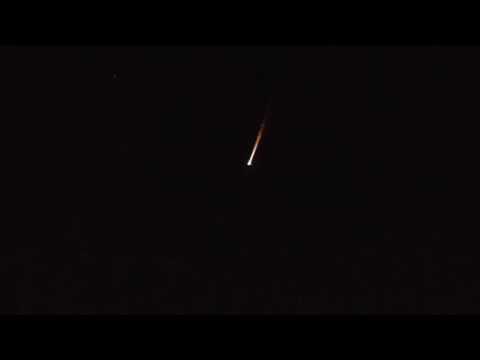
Video credit Ralph Pfister
"We saw it soaring across the sky and then it exploded and went in four different directions," said astronomer Natasha Gardiner at the Mount John University Observatory, New Zealand's premier astronomical research observatory. "We have been up here on Mt John for years and we have never seen one this big. We were a little bit concerned initially, to be honest," she said.
Former resident superintendent of Mount John Observatory, astronomer Alan Gilmore, said the object was not a meteor. "I'm certain of that. It took too long to go across the sky."
According to the NZ Heralz, Gilmore said the flash had all the characteristics of a re-entry of debris. Gilmore added the only other such case in Southern skies he knew of happened about 10 years ago.
Philip Duncan, WeatherWatch head analyst, said after viewing video footage, he too no longer thought it was a meteor. "At first, we thought it was a meteor," WeatherWatch writes.
"But just after 7:30 pm we contacted the media to let them know we thought this may have been a spacecraft or satellite. Why? Because it appeared to be traveling far too slow in a video posted on the NZ Herald website. Meteors can't usually be captured with an iPhone camera unless you're already rolling – as they flash by very quickly. Man-made space debris, however, travels far more slowly when entering Earth's atmosphere (spacecraft and satellites, space debris, etc. orbit the Earth much slower than a meteor coming into the atmosphere)."
Video credit Otago Daily Times

Video credit Otago Daily Times

Video credit Otago Daily Times

The Watchers team and our contributors bring the latest on extreme weather, earthquakes, volcanic eruptions, space weather, and all things science. We're all about making sense of the natural world and keeping you informed on what’s happening. Got a tip or a question? Hit us up using the form at newstips!
Earlier reporting
Nothing on Watchers was published in the last 24 hours. These are older articles.
- On October 22, 2017, a single flash of lightning stretched 515 miles from eastern Texas to near Kansas City, a distance that takes eight hours to drive, and nobody realized how far it had gone until scientists went back through the satellite data years later Epicenter
- CPC posts a slight risk of heavy rain from the Gulf Coast to the Northeast urban corridor November 25-29, and a moderate risk of West Coast wind and Sierra snow on November 25
- Florida's east coast faces a moderate flash flood risk Wednesday through Friday, with 4 to 8 inches of rain forecast and the St. Johns River near Cocoa already in major flood at 17.13 feet
- Cyclone Akvan to make landfall between Nellore and Visakhapatnam around noon on November 20, IMD forecasts 120-130 km/h winds gusting to 145
