
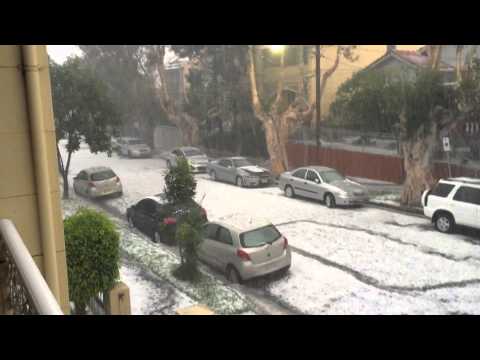
More than 50 cm of hail fall on Sydney, Australia

Featured image: View of Lake Coulson St, Erskineville. Credit: SydneySINK (via Twitter)
A booming cold system which formed over the southwest slopes and the Blue Mountains hit Sydney, Australia with destructive winds and devastating hail on April 25, 2015.
Seven factories collapsed under more than 50 cm (20 inches) of hail while roads turned into rivers. Power was cut to at least 700 homes and businesses, The Daily Telegraph reports.
“I couldn’t believe it, it was like we were walking through snow,” NSW Fire and Rescue’s Supt Paul Johnstone said.
“I’ve never seen so much hail fall in one location. The factories just collapsed under the weight of the hail."

Australia's State Emergency Service received more than 600 calls for assistance after 16:00 local time, and were expecting many more as wild winds and rain lashed the city.
Bureau of Meteorology forecaster Francois Geffroy said a there has been some very heavy rainfalls within 10-minute windows, which led to heavy localized flooding. "
“A large portion of the metro was hit, with most the storms were out in the west and south. It mostly missed the north and eastern parts of the metropolitan region. The largest hail stones were 2 cm or slightly bigger than that, but most hail was about 1 cm."
"A sharp drop in temperatures aloft allowed much of the hail to fall to the ground," Geffroy explained.
Some more photos from yesterday's Sydney Hail Storm. #Islam #Albayan #Sydney #SydneyHail #WildWeather #Snow pic.twitter.com/Cs1mjapQKn
— Albayan Radio (@albayanradio) April 26, 2015
This is #SydneyHail and it fell from the sky a short while ago pic.twitter.com/JsGpbLwT9g
— Eamonn Fitzpatrick (@EamonnFitz) April 25, 2015
View of Lake Coulson St, Erskineville #SydneyStorm #sydneyhailstorm #hail #sydneyweather pic.twitter.com/yWZ20VJf2p
— SydneySINK (@SydneySINK) April 25, 2015

Teo Blašković founded The Watchers in 2011 and edited it until 2026, covering seismic and volcanic activity, extreme weather, space weather and near-Earth objects. Articles on this page are his archive.
Published in the last 24 hours
- A broad low over southeastern Florida and the northwestern Bahamas has a 30 percent chance of subtropical or tropical development within 48 hours and a 50 percent chance within 7 days, the National Hurricane Center says
- Male toads abandoned a pond in Italy five days before a deadly 2009 earthquake, while a scientist was counting them Epicenter
- An asteroid was spotted 19 hours before it exploded over Sudan in 2008, and students picked its pieces off the desert Epicenter
- A wave up to 3 m (10 feet) high rose out of Lake Michigan on a sunny June morning in 1954 and swept fishermen off Chicago’s piers, and when a second came 10 days later, warnings had cleared the shore Epicenter

This is similar to the massive storm we had here in Melbourne, Australia, some years ago. We are getting (Australia) some severe storm systems rolling through some of our states, with the kick in these systems being influenced by the Antarctic blasts which circulate up from the south. Some of the systems are influenced by other weather extremes. The ice chunks we got here in Melbourne were up to the the size of footballs, hitting like bombs and exploding on impact, and many houses were destroyed. When I saw Sydney copping these storms, it brought back memories of the super storm we endured here.
Dam global warming dust balls. Wild jet streams climate change global cooling.