
Typhoon “Higos” formed over Northwestern Pacific Ocean
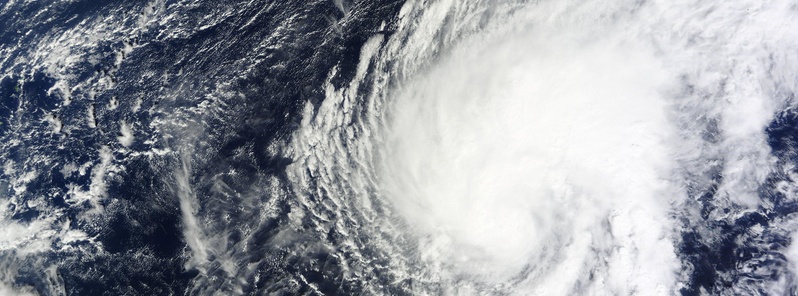
Featured image: Typhoon "Higos" on February 8, 2015. Image credit: NASA Terra/MODIS
Typhoon "Higos", which started organizing late last week, continues to strengthen over open waters of Northwestern Pacific Ocean. The system is now located about 1 200 km (760 miles) east of Guam and is moving to the WNW at 7.4 km/h (4.6 mph).
At 06:00 UTC today, Higos had maximum sustained winds of 140 km/h (92 mph), and wind gusts of 185 km/h (115 mph), according to JTWC. This makes it a Category 2 storm on the Saffir-Simpson Hurricane Wind Scale.
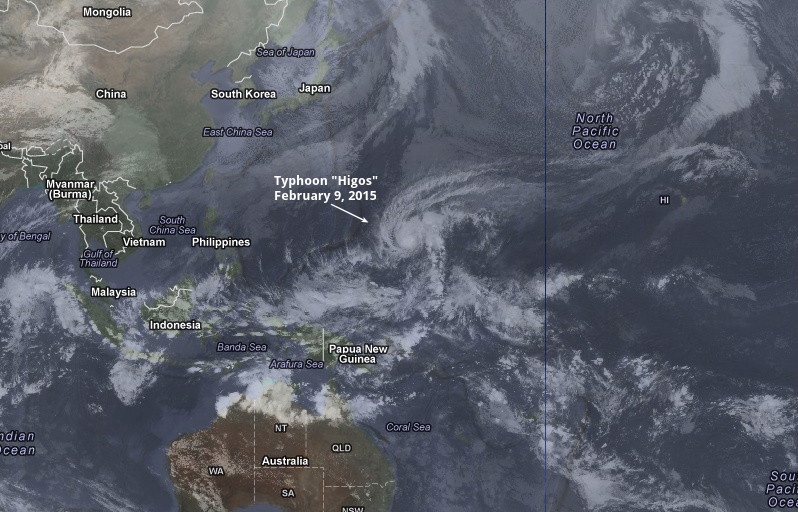
Typhoon "Higos" on February 9, 2015. Image credit: UW-CIMSS/Google(NASA/Terrametrics). Annotation: The Watchers
Higos is expected to further intensify during the next 24 hours, but is not expected to have any direct impact on land areas. The NWS in Guam has issued high surf advisories for eastern and north eastern facing coastlines where up to 3 meter high waves can be expected through Tuesday.
By Thursday morning (February 12), Higos is forecasted to be a dissipating tropical depression about 700 km (440 miles) ENE of Saipan.
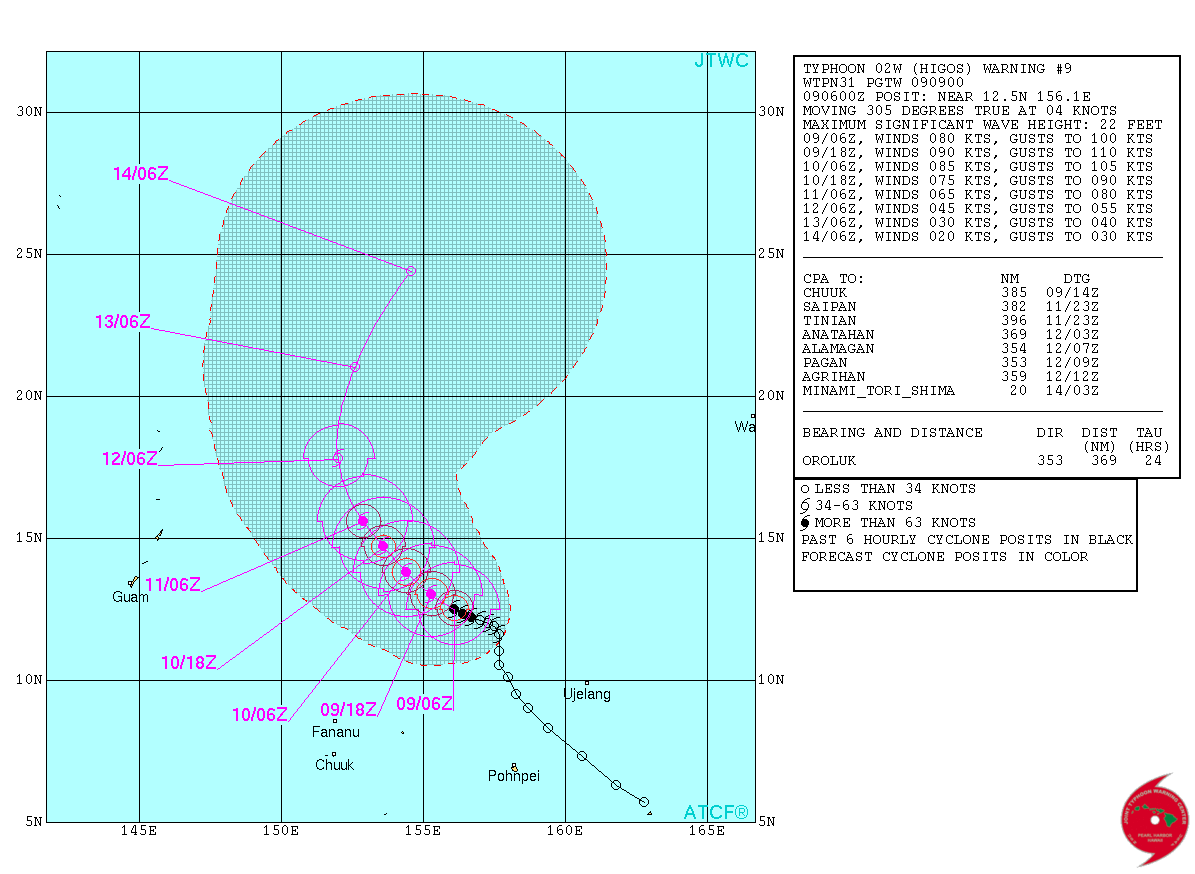
Typhoon "Higos" forecast track by JTWC on February 9, 2015.
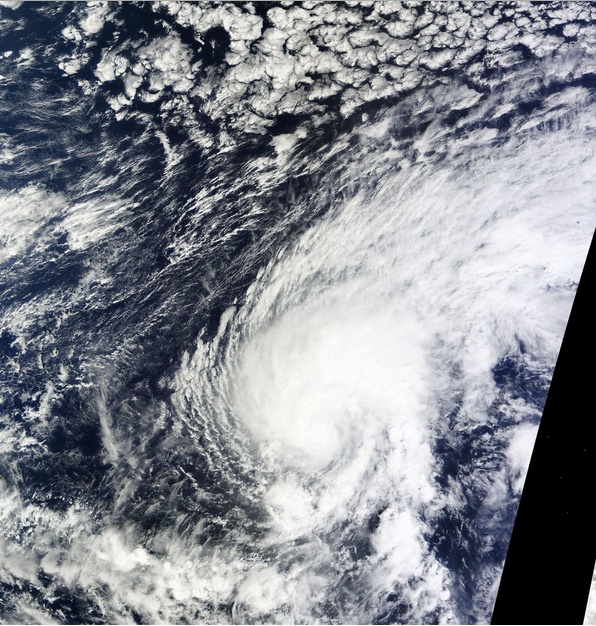
Typhoon "Higos" on February 8, 2015. Image credit: NASA Terra/MODIS
Infrared image captured by the VIIRS instrument aboard the Suomi NPP satellite at 14:51 UTC yesterday showed some very high, powerful thunderstorms with cold cloud top temperatures (yellow) around the center of circulation.
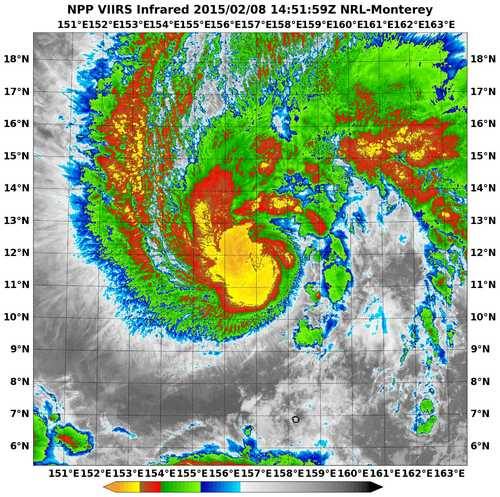
Image credit: NRL/NOAA/NASA
Satellite animations
- Storm-Centered Infrared (MTSAT; NOAA/SSD)
- Storm-Centered Infrared (Aviation Color Enhancement) (MTSAT; NOAA/SSD)
- Storm-Centered Water Vapor (MTSAT; NOAA/SSD)
- Storm-Centered Visible (MTSAT; NOAA/SSD)
- Storm-Centered Visible (Colorized) (MTSAT; NOAA/SSD)
- Storm-Centered Infrared (MTSAT2; CIMSS)
- Storm-Centered Enhanced Infrared (MTSAT2; CIMSS)
- Storm-Centered Water Vapor (MTSAT2; CIMSS)
- Storm-Centered Visible (MTSAT2; CIMSS)
- Tropical West Pacific Infrared (MTSAT2; NOAA)
- Tropical West Pacific Enhanced Infrared (MTSAT2; NOAA)
- Tropical West Pacific Water Vapor (MTSAT2; NOAA)
- Tropical West Pacific Visible (MTSAT2; NOAA)

Teo Blašković founded The Watchers in 2011 and edited it until 2026, covering seismic and volcanic activity, extreme weather, space weather and near-Earth objects. Articles on this page are his archive.
Published in the last 24 hours
- Cyclone Akvan weakens after landfall near Gopalpur; more than 300 000 evacuated in Odisha, India
- High Risk of excessive rainfall covers Florida’s Space Coast as St. Johns River near Cocoa reaches 5.67 m
- Four small asteroids will pass close to Earth from November 21 to 23
- A broad low over southeastern Florida and the northwestern Bahamas has a 30 percent chance of subtropical or tropical development within 48 hours and a 50 percent chance within 7 days, the National Hurricane Center says



