
Large quantities of gases emitted to the atmosphere associated with the Holuhraun eruption
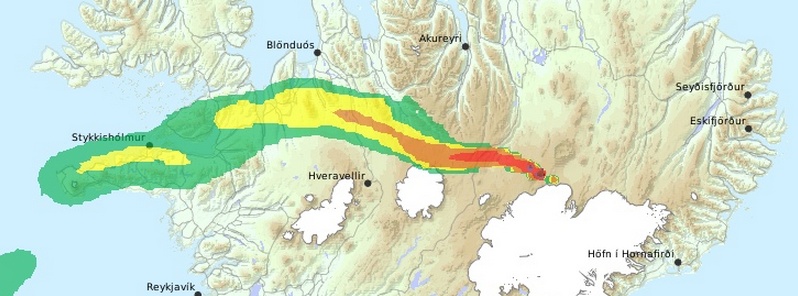
Featured image: Gas dispersion model for Friday, November 14, 2014. Image credit: IMO
Large quantities of gases are emitted to the atmosphere associated with the Holuhraun eruption, Icelandic Met Office (IMO) reported on Thursday, November 13, 2014. Among the gases are SO2 that can convert to sulfuric acid causing acid rain.
Rainwater samples have been collected and analyzed at weekly bases at 18 locations across all the country since September 19, 2014. The sampling and analysis have been carried out by Veðurstofan and Háskóli Íslands.
The pH of unpolluted rainwater in Iceland is ~5.6. Rainwater with lower pH is referred to as acid rain and rainwater with higher pH may have interacted with dust in the air and the rain collectors.
The pH of rainwater in Iceland, after the start of the Holuhraun eruption, is ranging from pH 3.2 to 7.5 with an average value of pH 5.8. About 40% of the rain is defined as acid rain whereas 60% can be regarded as unpolluted rain. Less than 1% of the acid rain is however very acid with pH below 4. Stations at Borgir, Reykjahlíð, Írafoss, Hitardalur and Hjarðarland, are among those showing acid rain periodically, IMO said.
It is important to consider that several factors affect the pH of rainwater in addition to the volcanic eruption, the main factors being seaspray, geothermal activity, evaporation and fine rock dust.
The analysis will continue as soon as new samples will be available and the updates will be published on IMO's web-site.
Source: IMO

Teo Blašković founded The Watchers in 2011 and edited it until 2026, covering seismic and volcanic activity, extreme weather, space weather and near-Earth objects. Articles on this page are his archive.
Published in the last 24 hours
- High Risk of excessive rainfall covers Florida’s Space Coast as St. Johns River near Cocoa reaches 5.67 m
- Four small asteroids will pass close to Earth from November 21 to 23
- Cyclone Akvan weakens after landfall near Gopalpur; more than 300 000 evacuated in Odisha, India
- A broad low over southeastern Florida and the northwestern Bahamas has a 30 percent chance of subtropical or tropical development within 48 hours and a 50 percent chance within 7 days, the National Hurricane Center says
