
Strong G3 geomagnetic storm in progress (June 29, 2013)
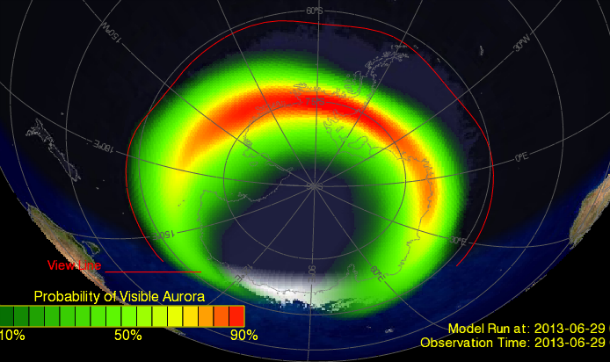
Featured image: Aurora forecast map for South Pole, June 29, 2013 (Credit: OVATION/NOAA/SWPC)
As Earth passes through a new coronal hole high speed stream, backed by unidentified CME shock, a prolonged interval of south-pointing magnetism (southward Bz) is having a strong impact on Earth's geomagnetic field. On June 29, 2013 Planetary K-index reached Kp=7 and NOAA/SWPC issued G3 (Strong) Geomagnetic Storm Level Alert.

Space Weather Message Code: ALTK07
Serial Number: 87
Issue Time: 2013 Jun 29 0602 UTC
ALERT: Geomagnetic K-index of 7
Threshold Reached: 2013 Jun 29 0559 UTC
Synoptic Period: 0300-0600 UTC
At this level voltage corrections may be required, false alarms could be triggered on some protection devices. Surface charging may occur on satellite components while drag may increase on low-Earth-orbit satellites, and corrections may be needed for orientation problems. At G3 level intermittent satellite navigation and low-frequency radio navigation problems may occur, HF radio may be intermittent, and aurora has been seen as low as Illinois and Oregon, US.

Aurora forecast OVATION Prime model for June 29, 2013 (Credit: OVATION/NOAA/SWPC)
CURRENT ACTIVITY (06:30 UTC, June 29, 2013)
Planetary K-index
Now: Kp= 7 strong
24-hr max: Kp= 7 strong
Interplanetary Mag. Field
Btotal: 11.6 nT
Bz: 11.4 nT south
The Radio Sun
10.7 cm flux: 100 sfu
Watch the space weather conditions in real-time via Space Weather Station!
Solar activity has been at low levels in the past 24 hours, featuring three C flares, from AR 1777 and 1778. The brightest flare was a C7.3 flare released by AR 1778 with peak time at 03:37 UTC on June 28, 2013. AR 1777 released two CMEs (observed by LASCO C2 at 20:37 UTC on June 27 and 02:00 UTC on June 28). The first CME is not expected to be geo-effective, while there is a slight chance for a glancing blow from the second CME on July 1, 2013.

Earlier reporting
Nothing on Watchers was published in the last 24 hours. These are older articles.
- G1 geomagnetic storm watch remains in effect as NOAA forecasts Kp 4.67 late on November 17 and early on November 18
- On October 22, 2017, a single flash of lightning stretched 515 miles from eastern Texas to near Kansas City, a distance that takes eight hours to drive, and nobody realized how far it had gone until scientists went back through the satellite data years later Epicenter
- CPC posts a slight risk of heavy rain from the Gulf Coast to the Northeast urban corridor November 25-29, and a moderate risk of West Coast wind and Sierra snow on November 25
- Florida's east coast faces a moderate flash flood risk Wednesday through Friday, with 4 to 8 inches of rain forecast and the St. Johns River near Cocoa already in major flood at 17.13 feet

Commenting rules and guidelines
We value the thoughts and opinions of our readers and welcome healthy discussions on our website. In order to maintain a respectful and positive community, we ask that all commenters follow these rules.