
Study shows Main Marmara Fault is rupturing eastward toward Istanbul
Researchers revealed that the Main Marmara fault in northwestern Türkiye has been rupturing progressively eastward for more than a decade, culminating into the strongest earthquake in over 60 years beneath the Sea of Marmara, a MW 6.2 quake on April 23, 2025. New findings raise concern that a locked fault segment south of Istanbul could generate a M7.0 earthquake in the future, rattling the city of 18 million people.

Satellite image of Istanbul, Turkey acquired April 21, 2025. Credit: Copernicus EU/Sentinel-2, EO Browser, The Watchers
The Main Marmara Fault (MMF) forms the submerged westernmost section of the North Anatolian Fault Zone (NAFZ), a right-lateral transform boundary between the Anatolian and Eurasian plates. It slips at approximately 17–29 mm/yr (0.7–1.1 in/yr), making it one of the most active seismic zones in Europe.
The study led by Patricia Martínez-Garzón (GFZ Potsdam) shows that since 2011, the MMF has produced a sequence of M > 5 earthquakes migrating steadily eastward. Each rupture advanced toward Istanbul, increasing in size and energy from M5.1–M5.2 events in 2011–2012, through M5.8 in 2019, to M6.2 in 2025.
This pattern mimics the fault’s structural transition from creeping segments in the west, where motion occurs gradually without large quakes, toward locked or transitional segments near Istanbul. The creeping portions slowly transfer stress eastward, priming the locked sections for eventual rupture.
An M6.2 earthquake struck beneath the central Sea of Marmara at around 15:37 local time (12:37 UTC) on April 23, 2025, about 25 km (15 miles) south of Istanbul. It ruptured a 10–20 km (6–12 miles) stretch of the central MMF, making it the strongest event along the fault since the 1963 Çınarcık earthquake.
The quake showed strike-slip kinematics, consistent with the fault’s east-west orientation. Aftershocks mapped a clear linear trend, terminating near a 15 km (9 mile) seismic gap between the Kumburgaz Basin and Princes Islands segment, a locked section known to have ruptured in 1766.
The 2025 rupture overlapped with part of the 2019 MW 5.8 Silivri earthquake, suggesting a shared transition zone between creeping and locked behavior. Researchers estimate that the 2025 event released only around 20 cm (8 inches) of co-seismic slip, a small fraction of the around 6 m (20 feet) slip deficit accumulated since the 18th century.
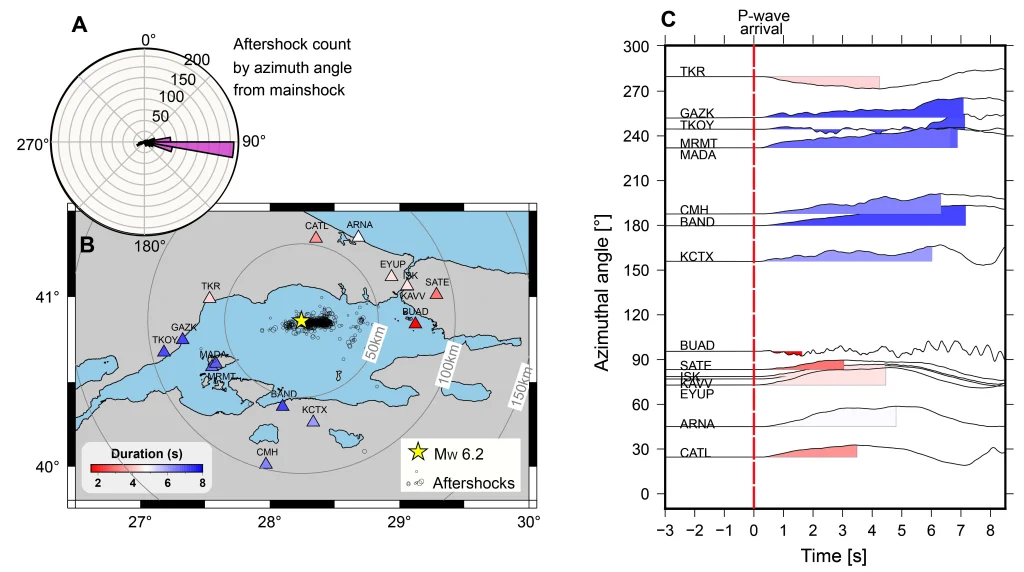
Analysis of seismic waveforms shows that the 2019 and 2025 earthquakes ruptured eastward, producing stronger ground motion in that direction. Stations east of each epicenter recorded shorter P-wave durations and higher peak accelerations, confirming rupture directivity toward Istanbul.
Such directivity amplifies shaking in the rupture-propagation direction, an effect also documented along the San Andreas Fault and in the 2009 L’Aquila sequence. This means that future earthquakes propagating eastward along the MMF could deliver more intense shaking to Istanbul than quakes of comparable magnitude centered farther west.
Aftershock distributions mirrored this asymmetry, with seismic clusters extending roughly 25 km (15 miles) east of the 2025 epicenter during the first week, compared with 10 km (6 miles) to the west, a pattern typical of directional rupture.
Stress modeling shows that both the 2019 and 2025 earthquakes increased Coulomb stress by up to 0.2 MPa on adjacent sections of the MMF, particularly at the western edge of the Princes Islands segment, located just south of Istanbul.
This segment has remained locked since the 18th century, with no detectable surface creep in modern seafloor geodetic measurements. The newly added stress, combined with continuous tectonic loading, suggests that this 15–20 km (9–12 miles) silent stretch could be the next rupture candidate along the fault.
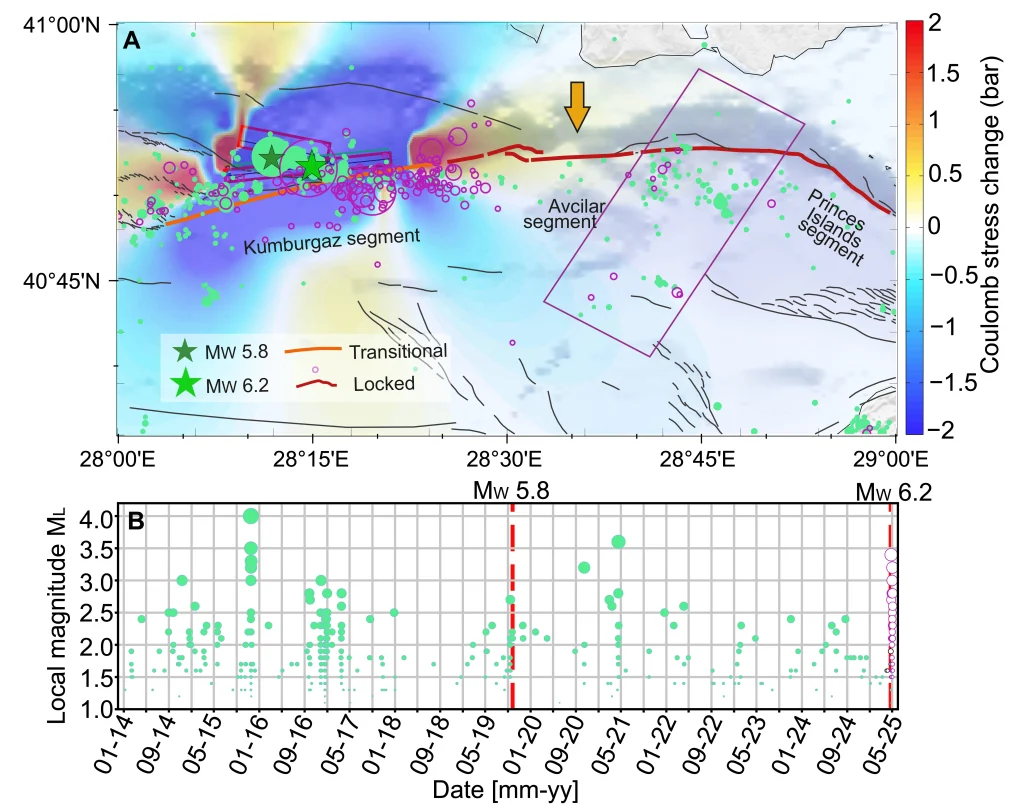
Researchers note that the same pattern preceded the 2019 Silivri event: a period of seismic quiet, then renewed activity as stress reached a threshold. If the trend continues, another M ≥ 6 earthquake could occur along the transition between the Kumburgaz and Princes Islands segments, a zone already showing moderate microseismic activity.
Historical records show at least three major earthquakes near Istanbul over the last five centuries: the 1509 “Little Doomsday,” 1766 Princes Islands event, and the 1894 Gulf of İzmit quake. Each produced widespread damage and local tsunamis within the Sea of Marmara.
Modern probabilistic models estimate a 30-year likelihood of an M ≥ 7.3 earthquake near Istanbul of 35% rising to 47% when stress transfer from the 1999 Izmit earthquake was included.
Each moderate-magnitude event migrating eastward accumulates stress in the locked Princes Islands segment. If the rupture propagates through it toward Istanbul, ground-motion modeling suggests that shaking intensity could be amplified by directivity effects, focusing seismic energy toward the city.
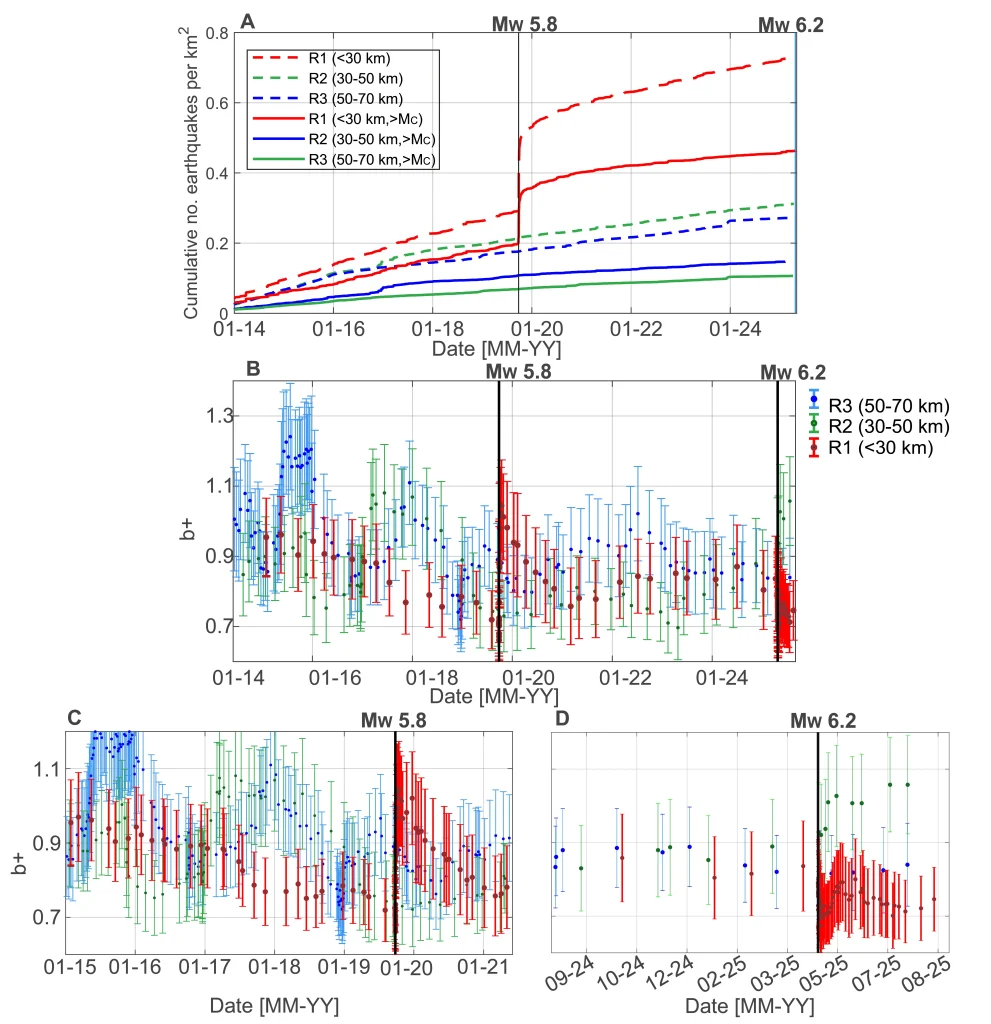
While the precise timing cannot be predicted, the absence of stress-relaxation indicators (such as elevated b-values) following the 2025 event suggests that local shear stress remains high. This, combined with the remaining slip deficit, adds to the continuous strain accumulation directly offshore of Istanbul.
The authors call for expanding real-time monitoring systems, including additional borehole seismometers, ocean-bottom sensors, and fiber-optic strain arrays across the MMF. Such installations are already in place at the GONAF borehole observatory network and are essential for tracking evolving stress and detecting subtle creep before larger ruptures.
Improved geodetic coverage would also help researchers better understand the link between creeping and locked segments, and how the strain propagates toward Istanbul.
References:
1 Progressive eastward rupture of the Main Marmara fault toward Istanbul – Martínez-Garzón P. et al. – Science – December 11, 2025 – DOI: 10.1126/science.adz0072

I am an Assistant Editor and Severe Weather & Science Journalist at The Watchers, specializing in real-time severe weather coverage, geophysical event reporting, and research-driven scientific analysis. You can reach me at rishav(at)watchers(.)news.

Commenting rules and guidelines
We value the thoughts and opinions of our readers and welcome healthy discussions on our website. In order to maintain a respectful and positive community, we ask that all commenters follow these rules.