
Magnetic tail connecting Earth’s atmosphere and Moon
New 3D magnetohydrodynamic simulations show that Earth’s magnetic field has, for billions of years, funneled charged atmospheric particles toward the Moon through the planet’s magnetotail, gradually embedding traces of terrestrial gases into lunar soil. The findings, published in Nature Communications Earth and Environment, suggest that the lunar regolith holds a geochemical record of Earth’s evolving atmosphere.
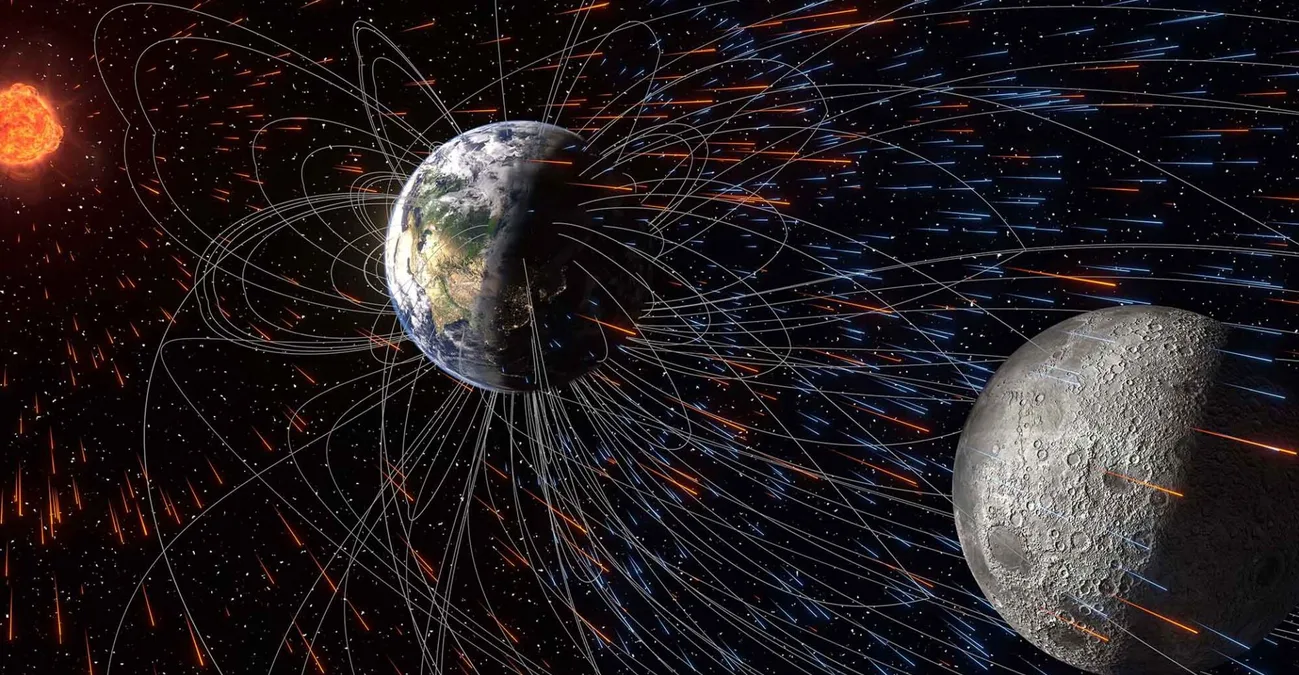
Solar wind (yellow-orange trails) strips ions from Earth’s upper atmosphere (sky-blue trails). Some of these particles travel along Earth’s magnetic field lines (solid white curves) and settle on the Moon’s surface. This process may leave lunar soil with a record of Earth’s atmosphere. Credit: University of Rochester illustration/Shubhonkar Paramanick
The study, led by physicists from the University of Rochester, demonstrates that Earth’s magnetic field, long thought to protect the atmosphere from loss, also acts as a conduit for charged ions to escape into space.
These ions, stripped from the upper atmosphere by the solar wind, are guided along magnetic field lines that extend tens of Earth radii into the magnetotail. When the Moon passes through this region during its orbit, some of the escaping particles settle onto the lunar surface.
The mechanism provides a persistent transfer channel operating over geological time. While individual fluxes are extremely small, the cumulative effect over billions of years could account for measurable enrichments of nitrogen and noble gases found in Apollo regolith samples. Earlier models assumed that such a transfer required an unmagnetized Earth, but the new results indicate that a functioning geodynamo can actually enhance the outflow by extending the reach of the atmosphere into space.
Earth’s present magnetosphere stretches about 8–11 Earth radii on the dayside and roughly 100 Earth radii downstream in the nightside magnetotail. At the Moon’s orbital distance of 60 Earth radii, around 384 000 km (239 000 miles), the lunar surface periodically enters this tail, where it becomes exposed to both solar and terrestrial ion flows.
According to the team’s calculations, the efficiency of implantation peaks when the Moon is fully immersed in the magnetotail during the full-Moon phase.
Simulating an atmosphere in motion
To test the efficiency of this transfer, the researchers ran high-resolution, three-dimensional magnetohydrodynamic (MHD) simulations using the AstroBEAR adaptive-mesh code. The model represented both the solar wind and the Earth’s upper atmosphere as interacting plasmas within a domain extending to the Moon’s orbit.
Two end-member scenarios were compared: an unmagnetized early Earth under a stronger young Sun, and a magnetized modern Earth exposed to the current solar wind.
The results were striking. Despite the magnetic field’s partial shielding, the “modern Earth” scenario produced more stable and sustained atmospheric leakage toward the Moon. The field lines acted as guides, not barriers, directing atmospheric ions, especially nitrogen (N), helium (He), and argon (Ar), downstream along the tail where the Moon intermittently intersects the flow.
The team introduced passive tracers in the simulations to distinguish solar-wind and Earth-origin particles. They found that the number flux of terrestrial ions reaching the Moon varied with orbital phase, forming a characteristic “double-horned” pattern peaking near ± π / 5 radians. These peaks correspond to the Moon’s transit through dense plasma near the magnetopause boundaries, where mixing between solar and terrestrial components is greatest.
Such fine-scale modeling required resolving spatial features of just a few hundred kilometers, comparable to the pressure scale height of the thermosphere. Each simulation ran until a quasi-steady state was achieved, when atmospheric loss timescales far exceeded computational run times, ensuring that the derived fluxes represented stable, long-term behavior rather than transient events.
Reading Earth’s atmosphere in lunar soil
The evidence for this process lies in the volatile content of lunar regolith returned by the Apollo missions. Analyses of ilmenite-rich soil grains have long revealed elevated concentrations of nitrogen and noble gases inconsistent with purely solar-wind implantation. Their isotopic ratios, particularly 15N/14N and 3He/4He, suggest an additional, non-solar component.
Earlier interpretations attributed this component to either ancient cometary impacts or brief epochs when Earth lacked a magnetic field. However, the new modeling reconciles these data with continuous implantation during Earth’s magnetized phase.
By combining their MHD simulations with a semi-analytic ionization model of the upper atmosphere, the authors calculated the altitude, known as the hydrodynamic escape boundary, where solar radiation and magnetic interaction extract ions effectively. For nitrogen and noble gases, this boundary occurs near 190–300 km (118–186 miles) altitude.
When these predicted escape fluxes are mixed with solar-wind contributions in theoretical isotopic diagrams, the resulting curves match Apollo sample data far better than models requiring an unmagnetized Earth. The findings imply that the lunar soil records a nearly continuous atmospheric fingerprint spanning at least 3.5 billion years.
Re-evaluating the Moon’s volatile inventory
Because the exchange occurs only when the Moon lies within Earth’s magnetotail, about 5 days each month, the total deposition rate is modest. Yet over geologic time, even a flux of 10⁸ ions per square meter per second could accumulate measurable masses of volatiles.
The researchers estimate that the lunar near-side regolith, particularly regions corresponding to the Apollo landing sites, contains a detectable fraction of terrestrial gases implanted during these passages.
This reinterpretation has implications for lunar resource mapping. Water, nitrogen, and carbon species implanted from Earth could supplement solar-wind-derived hydrogen in explaining local variations in volatile abundance. The discovery also refines models of surface hydration cycles, which depend on the Moon’s exposure to both solar and terrestrial plasma environments.
Furthermore, the study clarifies why the Moon’s far side, which spends less time in the magnetotail, shows comparatively lower volatile concentrations. The asymmetry supports the hypothesis that terrestrial implantation dominates the non-solar component observed in near-side samples.
A planetary system’s shared evolution
Beyond its immediate lunar context, the research reframes how magnetic fields influence planetary habitability. Magnetic protection has long been viewed as essential for retaining an atmosphere. Yet Earth’s example shows that a magnetic field can simultaneously confine and release atmospheric material. The extended magnetotail increases the surface area available for escape while guiding outflowing ions along predictable trajectories.
This dual role may explain why planets with and without magnetic fields, such as Earth, Venus, and Mars, exhibit broadly similar atmospheric mass-loss rates when normalized for composition and solar exposure. What differs is the pathway of escape. For magnetized worlds, loss occurs through the structured tail; for unmagnetized ones, it proceeds more diffusely across the dayside boundary.
The results also bear on the early history of Mars. Geological evidence suggests that Mars once possessed a global magnetic field that later decayed, coinciding with major atmospheric loss. By comparing lunar records of terrestrial escape with Martian isotopic ratios, scientists may eventually reconstruct a broader chronology of solar-wind interaction across the inner Solar System.
Technical modeling and magnetotail dynamics
The Rochester team modeled the magnetic field as a dipole with a moment of 8.07 × 10¹⁵ Tm3 and computed pressure balance at the magnetopause by equating solar-wind dynamic pressure with geomagnetic and atmospheric thermal pressures. The resulting standoff distance, about 10 Earth radii, matches modern satellite measurements. Inside this cavity, field lines reconnect on the nightside to form the plasma sheet that accelerates ions Earthward and tailward.
In the simulations, the so-called Earth wind, a mixture of oxygen, nitrogen, and noble-gas ions, was carried anti-sunward at average speeds of 260–280 km/s (160–174 miles/s). These ions then encountered the Moon, whose lack of a global magnetic field allowed direct implantation into surface grains. The implantation depth, typically 100–500 nm, ensures long-term preservation even under micrometeorite gardening.
The numerical experiments also explored ancient conditions, when the Moon orbited closer, about 40 Earth radii, or 255 000 km (158 000 miles), and the young Sun’s wind was denser and faster. Under those circumstances, solar-wind pressure dominated, suppressing terrestrial outflow. The results suggest that significant implantation began only after Earth’s magnetic field stabilized and the Moon receded to its present orbit.
Implications for paleoclimate and planetary archives
If confirmed by future sample analyses, the terrestrial signature in lunar regolith would provide a unique archive of Earth’s atmospheric evolution beyond the reach of terrestrial geology. Erosion and plate tectonics have erased most direct records older than 4 billion years, but lunar soils may have quietly stored isotopic snapshots from those epochs.
By measuring nitrogen, argon, and helium isotopes at nanometer scales, researchers could reconstruct variations in Earth’s upper-atmosphere composition and solar-wind intensity over time. This would extend the known record of Earth’s climate and magnetic dynamo far beyond what terrestrial rocks can offer.
The concept also raises possibilities for other planetary systems. Exomoons orbiting magnetized exoplanets could similarly accumulate atmospheric material from their hosts, preserving chemical traces long after primary atmospheres are lost. Detecting such “atmospheric fossils” might eventually help identify planets that once sustained habitable conditions.
The long view of a magnetic partnership
Ultimately, the study reframes the Earth–Moon relationship not merely as one of gravitational coupling but as a slow, continuous exchange of matter mediated by magnetism. Over billions of years, the same magnetic field that shields life has quietly seeded the Moon with traces of the air we breathe.
Future lunar missions equipped with advanced mass spectrometers could test this hypothesis by sampling deeper, older regolith layers away from disturbed Apollo sites. If those layers preserve isotopic gradients matching the model’s predictions, they could confirm that the Moon carries a time-resolved archive of Earth’s atmosphere, an extraterrestrial record of our planet’s long magnetic history.
References:
1 Terrestrial atmospheric ion implantation occurred in the nearside lunar regolith during the history of Earth’s dynamo – Shubhonkar Paramanick et al. – Nature – December 11, 2025 – https://doi.org/10.1038/s43247-025-02960-4 – OPEN ACCESS
2 Earth’s atmosphere may help support human life on the moon – University of Rochester – December 11, 2025

I’m a science journalist and researcher at The Watchers, contributing to the Epicenter edition, where I cover peer-reviewed scientific research and emerging discoveries across Earth and space sciences. With a background in astronomy and a passion for environmental science, I’ve worked in shark and coral conservation in Fiji, conducting reef and shark-behavior research, contributing to mangrove restoration, and earning PADI Open Water and Coral Reef Certifications. I bring a blend of scientific rigor and storytelling to illuminate the discoveries shaping our planet and beyond.

Commenting rules and guidelines
We value the thoughts and opinions of our readers and welcome healthy discussions on our website. In order to maintain a respectful and positive community, we ask that all commenters follow these rules.