
Magma pulses beneath Santorini revealed as the true cause of intense 2025 earthquake swarm
A massive swarm of earthquakes that rattled the Aegean Sea between January and March 2025 was not caused by fault movement, as scientists first feared, but by waves of magma slicing through the crust beneath Santorini. The finding, published in Science on November 20, offers a detailed look at how Earth’s interior pulses and shifts beneath volcanic regions.
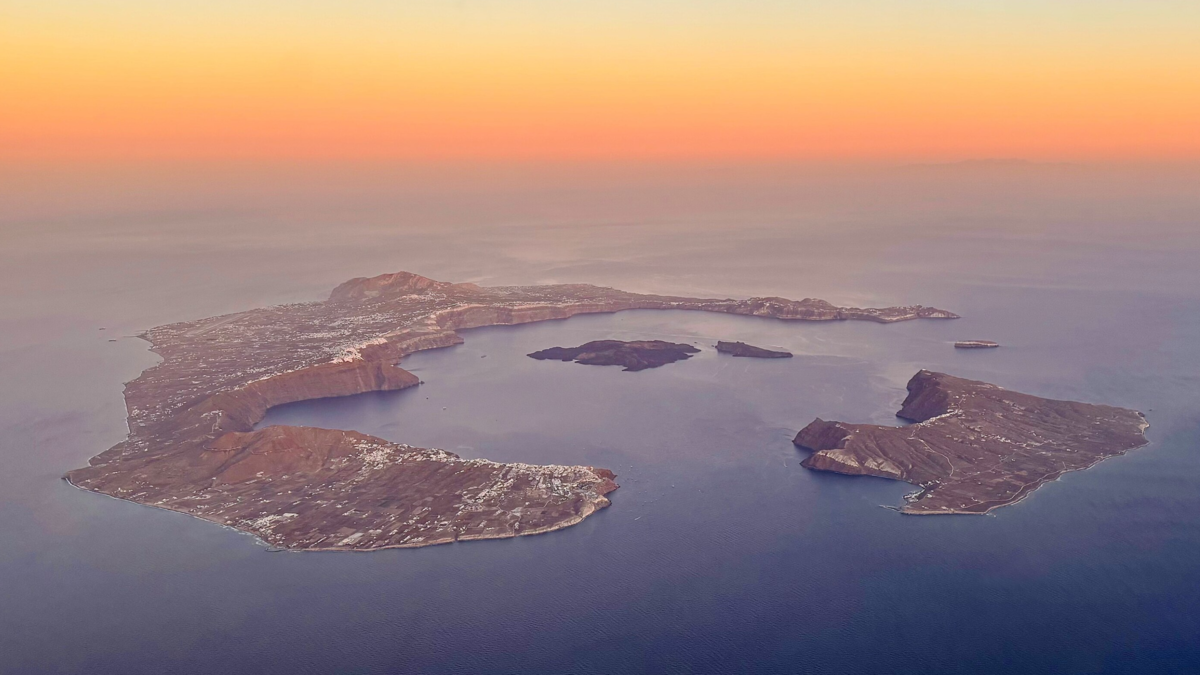
Photograph of Santorini caldera from the air. Credit: kallerna
Over a span of eight weeks, more than 25 000 earthquakes struck between Santorini and Amorgos Islands, with hundreds strong enough to be felt by residents and tourists.
Magnitudes frequently exceeded 4.5, forcing school closures and prompting local authorities to declare a state of emergency. For weeks, scientists debated whether this activity signaled a rising eruption at Santorini or Kolumbo, the nearby underwater volcano.
When researchers from University College London and Aristotle University of Thessaloniki reanalyzed the seismic data, they found that the earthquakes came not from faults slipping but from dikes—thin vertical sheets of magma—cutting horizontally through the crust about 10–15 km (6–9 miles) below ground. These dikes advanced in pulses, slicing through rock in bursts rather than moving smoothly.
Each pulse of magma created local stress shifts, triggering thousands of small quakes that propagated across a 20–30 km (12–19 miles) stretch of crust. The team estimates the intruded magma’s volume at roughly 500 million m3 (17.6 billion feet3), enough to fill 200 000 Olympic swimming pools.
The intrusions shot outward from a magma reservoir connecting Santorini’s caldera to Kolumbo volcano. Yet, despite its force, the magma lacked the buoyancy to break through the surface. This discovery reassured volcanologists and local residents that an eruption was never imminent.
Imaging magma movement in unprecedented detail
The study used advanced machine learning to analyze and relocate more than 25 000 earthquakes recorded by regional seismometers. Each quake acted as a “virtual stress meter,” allowing scientists to track subtle changes underground. Dr. Stephen Hicks of UCL’s Department of Earth Sciences explained that this approach revealed how the crust flexed and cracked as magma surged through it.
By comparing seismic data with GPS satellite measurements, the researchers confirmed that the ground had bulged slightly upward, consistent with magma forcing its way through the crust. These combined data offered one of the most detailed views ever obtained of a magmatic intrusion in real time.
Lead author Anthony Lomax described the magma flow as a “rebounding pump,” noting that it oscillated in waves, opening new fractures, closing others, and building pressure before releasing it in bursts. This pattern created a feedback loop where stress changes themselves generated new earthquake swarms.
Eleftheria Papadimitriou of Aristotle University added that such pulsating intrusions might not be unique to Santorini. Similar processes could occur beneath volcanoes around the world, influencing both how crust grows and how eruptions are triggered.
Machine learning reshapes volcanic science
This research marks one of the most sophisticated applications of artificial intelligence in volcanology to date. By training algorithms to identify and precisely relocate earthquake signals, scientists could reconstruct the subsurface magma pathways with remarkable accuracy—resolving features smaller than 100 meters (328 feet) across within a region spanning 50 km (31 miles).
Hicks said that the same approach could soon allow scientists to monitor swarms as they happen, providing early warnings when magma starts moving beneath volcanoes. Because the method relies only on seismic data, it is particularly useful for underwater systems like Kolumbo, where GPS and satellite imaging cannot easily detect ground deformation.
The researchers believe this machine learning framework could distinguish between tectonic and magmatic causes of seismic swarms, improving forecasts and helping authorities respond faster to signs of unrest.
Santorini’s restless geological past
Santorini lies within the Hellenic volcanic arc, where the African plate dives beneath the Eurasian plate. This zone has produced some of Europe’s most powerful eruptions and earthquakes. Around 1620 BCE, the island’s Minoan eruption reshaped the caldera and left behind layers of ash across the eastern Mediterranean.
The 2025 swarm occurred southwest of the fault that ruptured during the 1956 Amorgos earthquake, a magnitude 7.7 event that devastated parts of the region. Although the recent unrest did not lead to an eruption, it highlighted the constant tension within the Aegean crust, where tectonic and volcanic forces interact on a massive scale.
Santorini’s history makes it one of the most closely watched volcanic systems in the world. The new findings reaffirm the need for high-resolution monitoring and rapid data analysis to distinguish between harmless intrusions and precursors to eruptions.
Why this discovery matters
The Santorini study changes how scientists think about magma transport. Rather than moving smoothly upward or sideways, magma can rebound within the crust, pushing forward in a series of pulses. Each pulse alters the stress around it, triggering small earthquakes that can cascade into swarms.
Understanding this feedback between magma pressure and crustal stress will improve forecasts not only for volcanic eruptions but also for earthquake hazards in regions where magmatic and tectonic systems overlap.
These results also show that magma intrusions, though hidden deep underground, continuously reshape the planet’s surface from below. For the Aegean, it is a reminder that Santorini’s spectacular beauty sits above one of Earth’s most dynamic geological engines.
References:
1 Cause of Santorini earthquake swarm uncovered – UCL – November 20, 2025
2 The 2025 Santorini unrest unveiled: Rebounding magmatic dike intrusion with triggered seismicity – Anthony Lomax et al. – Science – November 20, 2025 – DOI: 10.1126/science.adz8538

I’m a science journalist and researcher at The Watchers, contributing to the Epicenter edition, where I cover peer-reviewed scientific research and emerging discoveries across Earth and space sciences. With a background in astronomy and a passion for environmental science, I’ve worked in shark and coral conservation in Fiji, conducting reef and shark-behavior research, contributing to mangrove restoration, and earning PADI Open Water and Coral Reef Certifications. I bring a blend of scientific rigor and storytelling to illuminate the discoveries shaping our planet and beyond.

Commenting rules and guidelines
We value the thoughts and opinions of our readers and welcome healthy discussions on our website. In order to maintain a respectful and positive community, we ask that all commenters follow these rules.