
Inside Earth’s signals of tectonic and volcanic earthquakes
Tectonic earthquakes come from fault slips deep within the crust, while volcanic earthquakes form as magma and gas shift under a volcano. Agencies such as the USGS use signal shape, depth, and frequency to tell them apart, guiding both seismic hazard and eruption forecasting.
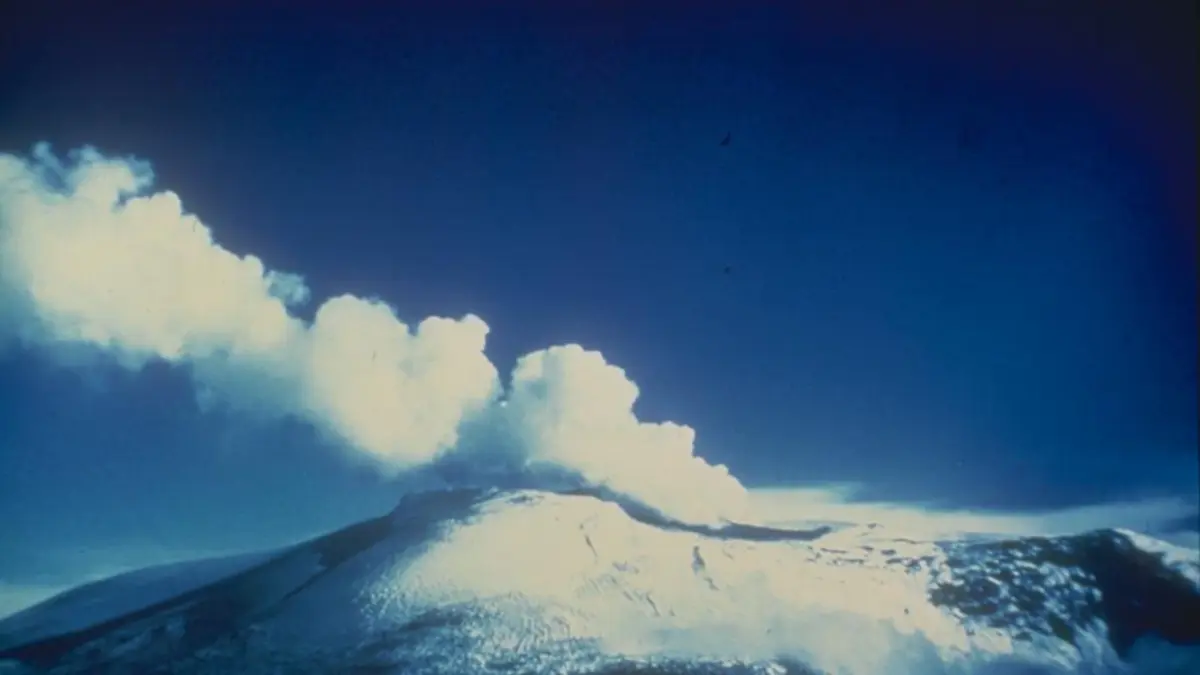
Nevado del Ruiz during the 1985 eruption. This eruption was one where seismic activity was monitored in order to determine that an eruption was imminent. Credit: U.S. Geological Survey
Tectonic earthquakes start when stress builds up along a fault until the rock suddenly breaks. The release of that energy sends out seismic waves that travel through the crust and mantle. The USGS explains that this process occurs wherever Earth’s plates collide, pull apart, or slide past each other. These events power most of the planet’s shaking and can happen anywhere faults exist.
Volcanic earthquakes form under very different conditions. Instead of large tectonic forces, they arise from magma pushing its way through rock or from gas and fluids moving inside volcanic conduits. When pressure changes open cracks or cause resonance in a cavity, seismic waves radiate outward. These smaller but complex vibrations often carry clues about a volcano’s internal plumbing.
Within a volcano, several signal types appear repeatedly. Volcano-tectonic events are brittle fractures near magma bodies. Long-period and very-long-period quakes come from oscillations in magma or gas channels. Continuous tremor occurs when fluids move steadily through cracks. Each one corresponds to a specific process inside the volcanic system, from pressurization to degassing.
Although both types of earthquakes shake the ground, their driving forces differ fundamentally. Fault rupture releases stored mechanical strain, while volcanic quakes express the behavior of pressurized fluids inside the crust. Recognizing that difference lets scientists link a signal to its cause rather than its effect.
What the signals look and sound like
Seismographs record every quake as a line of motion, and the patterns are strikingly distinct. A tectonic quake begins abruptly with a clear P-wave, followed by an S-wave and a quick decay. The waveforms rise sharply, peak, and fade within seconds. This impulsive character reflects the speed of fault rupture, which can move several kilometres per second.
Volcanic earthquakes rarely start that way. Their onsets are gradual, often building over several seconds. Long-period events display rounded pulses instead of sharp spikes, showing the resonance of magma or gas in a crack. Very-long-period signals can last half a minute or more, reflecting slower pressure changes in deeper chambers. Tremor appears as a near-continuous vibration that may persist for minutes or hours.
Frequency content provides another fingerprint. Tectonic events produce broadband energy that includes both low and high frequencies. Volcanic events concentrate energy at lower frequencies, typically between 0.5 and 5 hertz, depending on rock conditions. That difference lets observatories use spectrograms to sort one from another even when hundreds of small quakes occur every day.
Spectrograms visualize the signal as time versus frequency. A tectonic quake shows a short, bright burst across a wide frequency range, while volcanic tremor forms stable, horizontal bands of low-frequency energy that remain constant through time. Hybrid events combine both: an initial sharp burst followed by a sustained low-frequency tone. Observers rely on these patterns as much as on numerical data.
Because every volcano behaves differently, scientists treat these features as guides, not guarantees. An emergent low-frequency event does not always signal an eruption, but changes in the pattern or intensity can reveal that magma or gas is on the move.
Depth tells another story
Depth offers a powerful clue to earthquake origin. Tectonic earthquakes span nearly the whole lithosphere. Shallow crustal events usually occur between 5–20 km (3–12 miles) deep, while the deepest subduction-zone earthquakes may reach 700 km (435 miles) below the surface. These deeper events rarely cause surface damage but transmit energy across large areas.
Volcanic earthquakes occur much closer to the surface. Most originate within the volcano’s edifice or the upper crust, typically within 0–15 km (0–9 miles) depth. Their concentration beneath a single vent or caldera helps scientists map magma pathways. At some volcanoes, like Kīlauea or Mount Etna, shifting quake clusters trace magma as it migrates upward through conduits.
Shallow depth also explains why volcanic swarms can be felt locally even when magnitudes are small. The energy does not need to travel far to reach the surface. In contrast, deep tectonic quakes can shake wide regions without local damage because their energy spreads over a distance.
Occasionally, the two interact. A regional tectonic earthquake can alter stress around a volcano and trigger new volcanic seismicity. The opposite can happen too: inflation of a magma chamber can slightly increase regional fault stress. Monitoring both depths together gives a fuller picture of what the crust is doing.
Reading Earth’s language in motion
Agencies like the USGS Volcano Hazards Program and the Pacific Northwest Seismic Network constantly translate seismic signals into real-time interpretations. Their observatories use dense arrays of broadband seismometers to catch even faint changes in frequency or amplitude. Data flows into automatic classifiers that sort events into categories such as volcano-tectonic, long-period, or tremor.
The shape and rhythm of the signal help determine what is happening underground. A burst of VT events may suggest fracturing rock as magma intrudes into new areas. Increasing LP and tremor energy may indicate gas release or rising magma. Consistent low-frequency energy without deformation changes can point to degassing rather than eruption.
To refine these interpretations, analysts compare seismic activity with other measurements such as ground deformation and gas emissions. When all parameters rise together, an alert level may increase. When seismicity quiets or shifts deeper, the volcano may be relaxing. This integration ensures that decisions depend on converging evidence rather than any single indicator.
USGS observatories emphasize that most eruptions are preceded by clusters of shallow earthquakes, but not every cluster ends in eruption. The patterns, duration, and combination of events carry more meaning than any one tremor on its own. Long-term monitoring remains the most reliable way to understand these subtle signals.
Why these differences matter globally
Distinguishing between tectonic and volcanic earthquakes is essential for hazard planning. A tectonic earthquake in a populated region requires a rapid assessment of shaking intensity, aftershocks, and potential tsunami risk. A swarm of volcanic events, by contrast, demands close observation of the nearest volcano’s behavior and communication with local authorities.
Understanding the type of earthquake also refines geological models. Tectonic data reveal how stress accumulates along plate boundaries, while volcanic seismicity exposes the internal architecture of magma systems. Together they describe how Earth constantly redistributes energy, sometimes violently, sometimes quietly.
Public agencies rely on these classifications to issue accurate warnings. Misreading a tectonic quake as volcanic could delay earthquake preparedness. Misreading volcanic tremor as ordinary noise might miss a crucial eruption warning. Clarity in classification protects both lives and infrastructure.
At the global scale, these observations feed into international databases managed by groups like the Smithsonian Global Volcanism Program. Consistent signal interpretation allows scientists worldwide to compare events and improve early-warning models for both earthquake and volcanic hazards.
References:
1 The Science of Earthquakes – USGS – Accessed December 10, 2025
2 Monitoring Volcano Seismicity Provides Insight to Volcanic Structure – USGS – Accessed December 10, 2025

I’m a science journalist and researcher at The Watchers, contributing to the Epicenter edition, where I cover peer-reviewed scientific research and emerging discoveries across Earth and space sciences. With a background in astronomy and a passion for environmental science, I’ve worked in shark and coral conservation in Fiji, conducting reef and shark-behavior research, contributing to mangrove restoration, and earning PADI Open Water and Coral Reef Certifications. I bring a blend of scientific rigor and storytelling to illuminate the discoveries shaping our planet and beyond.

Commenting rules and guidelines
We value the thoughts and opinions of our readers and welcome healthy discussions on our website. In order to maintain a respectful and positive community, we ask that all commenters follow these rules.