
HKU researchers uncover new tectonic regime reshaping our understanding of Earth and Venus
Scientists at the University of Hong Kong (HKU) have identified a previously unknown tectonic regime, the “episodic-squishy lid”, redefining how terrestrial planets evolve and offering new insights into the tectonic histories of Earth and Venus.
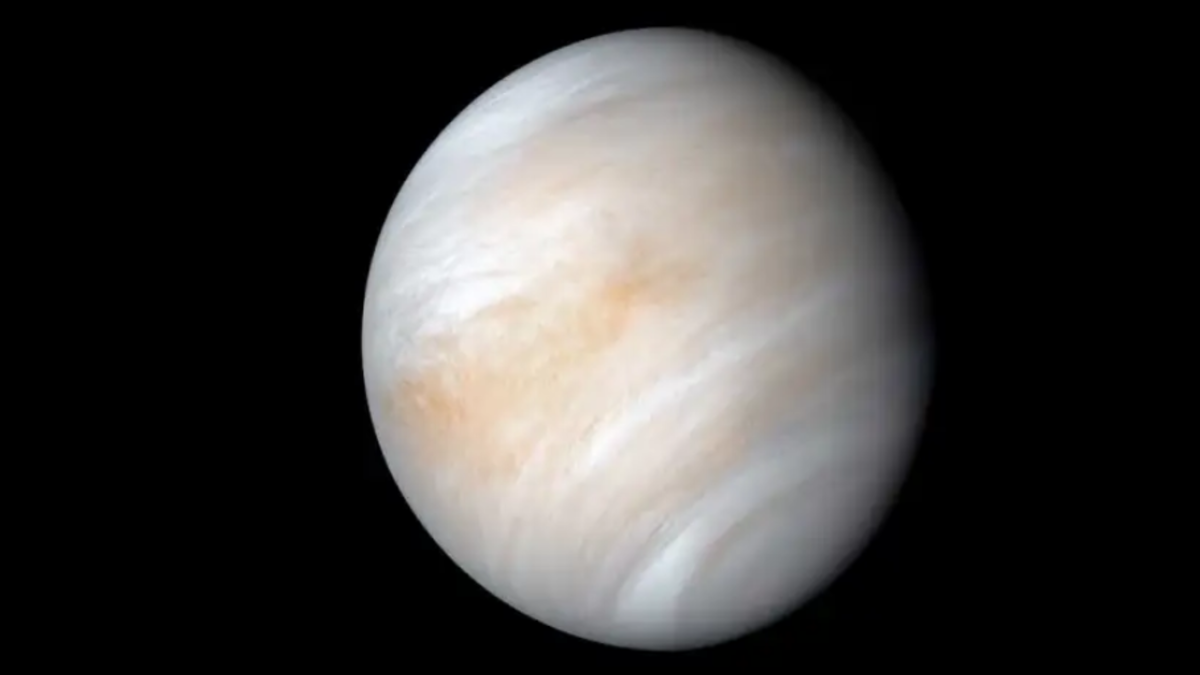
As it sped away, NASA's Mariner 10 spacecraft captured this view of Venus. Credit: NASA/JPL-Caltech
An international research team from the Department of Earth and Planetary Sciences at The University of Hong Kong (HKU) has discovered a previously unknown tectonic regime that could rewrite how scientists understand the evolution of rocky planets. The team included postdoctoral fellow Dr. Tianyang Lyu, Professor Man Hoi Lee, also from the Department of Physics, and Professor Guochun Zhao, Mok Sau-King. Their findings were published in Nature Communications on November 24, 2025.
Using advanced two-dimensional mantle convection models, the researchers simulated planetary interiors over a period of 10 billion years, incorporating mantle melting, crustal differentiation, and magmatic intrusion.
The result was the identification of six distinct tectonic regimes, each representing a unique way planets release internal heat and deform their surfaces.
“Through statistical analysis of vast amounts of model data, we were able to identify six tectonic regimes for the first time quantitatively,” said Dr. Lyu. “These include the mobile lid, the stagnant lid, and our newly discovered ‘episodic-squishy lid’. This new regime is characterised by an alternation between two modes of activity, offering a fresh perspective on how planets transition from an inactive to an active state.”
The six regimes, mobile lid, stagnant lid, sluggish lid, episodic lid, plutonic-squishy lid, and episodic-squishy lid, capture different levels of surface mobility and internal convection. Earth operates in the mobile lid regime, dominated by plate tectonics, while Mars remains locked in a stagnant lid, preserving ancient impact scars. The newly defined episodic-squishy lid lies between these extremes, alternating between partial motion and quiescence, bridging a long-standing gap in planetary dynamics.
This new classification also offers insight into how planetary heat loss shapes surface and interior evolution. The models reveal that even minor changes in lithospheric strength can shift a planet from one tectonic mode to another, determining whether it remains geologically active or becomes permanently stagnant.
Decoding the planetary “memory effect”
One of the most intriguing aspects of the study concerns what scientists call the “memory effect,” where a planet’s tectonic state depends not only on its current conditions but also on its long-term history. In previous models, this effect introduced unpredictability, suggesting that two planets with similar physical properties could follow very different tectonic paths.
“Our models reveal that this ‘memory effect’ is not insurmountable,” said Professor Man Hoi Lee. “Especially on an evolutionary path where the lithosphere weakens over time, as is the case for Earth, the transition between tectonic regimes can be surprisingly predictable.”
The team’s simulations demonstrated that as a planet cools, its lithosphere, the rigid outer layer, can gradually weaken, allowing for smooth transitions between tectonic states. This finding challenges the assumption that tectonic shifts are random or chaotic and instead suggests they follow thermodynamic rules that can be mapped.
To visualize these transitions, the researchers created a comprehensive regime diagram that shows how planets move between tectonic states as mantle temperature and lithospheric strength evolve. This diagram offers a predictive tool for identifying which planets are likely to sustain plate tectonics and which will remain locked in stagnant configurations.
The discovery transforms how planetary scientists view tectonic evolution. It implies that planets with weakening lithospheres, such as Earth, naturally progress toward active plate behavior, while those with strengthening crusts, like Venus, tend to lose mobility over time.
Tracing early Earth’s shifting tectonic identity
The geological record of early Earth indicates that plate tectonics did not always operate as it does today. Ancient rocks dating back more than 3 billion years show signs of limited horizontal movement but intense vertical deformation, suggesting an intermittent tectonic style that fits the new episodic-squishy lid regime.
“Geological records suggest that tectonic activity on early Earth aligns with the characteristics of our newly identified regime,” said Professor Guochun Zhao, who is also an Academician of the Chinese Academy of Sciences. “As Earth gradually cooled, its lithosphere became more prone to fracturing under specific physical mechanisms, eventually leading to today’s plate tectonics. This provides a key piece of the puzzle in explaining how Earth became a habitable planet.”
In the episodic-squishy lid regime, bursts of magmatic activity periodically weaken the lithosphere, allowing short-lived episodes of subduction and crustal recycling. These events are followed by long periods of quiescence during which the crust stabilizes again. Such behavior could explain early Earth’s dome-and-keel formations and the widespread occurrence of tonalite-trondhjemite-granodiorite (TTG) rocks found in Archean cratons.
These findings also provide new insight into how early tectonic activity helped regulate atmospheric carbon dioxide. Subduction cycles, even if intermittent, bury carbon-rich sediments into the mantle, balancing long-term climate processes. This cycling likely played a crucial role in maintaining the conditions necessary for life’s emergence on Earth.
As the planet cooled further, weakening mechanisms such as grain-size reduction and brittle fracturing allowed Earth to transition fully into the mobile lid regime. The discovery of the episodic-squishy lid helps explain this gradual shift from localized, intermittent tectonic activity to the global, continuous plate tectonics that shape the planet today.
Venus and the case of the frozen tectonic dance
While Earth evolved into a dynamic world of moving plates, Venus followed a different path. Despite its similar size and internal structure, Venus lacks the system of subducting and spreading plates that defines Earth. Instead, its surface is dominated by vast circular features called coronae, each exceeding 1 000 km (620 miles) in diameter.
The new study offers a compelling explanation for these structures. According to the HKU team’s models, Venus’s coronae are consistent with the plutonic-squishy or episodic-squishy lid regimes, where the lithosphere weakens locally due to intense magmatic intrusion but remains globally immobile. This intermittent, regional deformation could explain why Venus appears geologically active yet lacks plate boundaries.
“It is exciting to compare our model results with geological observations of Venus,” said Professor Zhong-Hai Li of the University of Chinese Academy of Sciences. “This provides important theoretical references and observational targets for future Venus missions.”
The models also suggest that Venus’s high surface temperature, around 460°C (860°F), may have prevented the progressive lithospheric weakening that enabled Earth’s tectonic evolution. Instead of moving toward mobility, Venus may have followed an opposite path, becoming increasingly rigid and trapped in a state of intermittent tectonic release.
This episodic-squishy behavior could explain Venus’s relatively young surface age, estimated between 300 and 500 million years, implying periodic resurfacing events caused by internal overturns. Such activity would allow for short bursts of motion followed by long periods of stillness, consistent with the planet’s observed crater distribution.
Linking Earth, Venus, and worlds beyond
“Our models intimately link mantle convection with magmatic activity,” said Dr. Maxim D. Ballmer of University College London, a co-author of the study. “This allows us to view the long geological history of Earth and the current state of Venus within a unified theoretical framework, and it provides a crucial theoretical basis for the search for potentially habitable Earth analogs and super-Earths outside our solar system.”
By integrating mantle convection, melting, and lithospheric deformation into a single physical model, the HKU-led research connects the geological evolution of Earth, Venus, and potentially other rocky planets. The episodic-squishy lid acts as a bridge between planetary states, explaining how some worlds transition toward mobility while others stagnate.
The framework also applies to exoplanets, as planets with moderate internal heat and evolving lithospheres might experience similar alternating tectonic phases, influencing their ability to maintain stable climates. Understanding these cycles could become key in identifying exoplanets capable of long-term habitability.
This discovery shows how the physics of planetary interiors determine whether a planet can recycle volatiles like water and carbon dioxide, maintain magnetic shielding, and sustain conditions suitable for life. The episodic-squishy lid model thus not only redefines our understanding of Earth and Venus but also provides a predictive tool for interpreting the geological states of distant worlds.
References:
1 HKU Researchers Discover New Tectonic Regime of Terrestrial Planets, Offering New Insights into the Evolution of Earth and Venus – The University of Hong Kong – November 24, 2025
2 Dissecting the puzzle of tectonic lid regimes in terrestrial planets – Lyu, T., Ballmer, M.D., Li, ZH. et al. – Nature Communications – November 24, 2025 – https://doi.org/10.1038/s41467-025-65943-1 – OPEN ACCESS

I’m a science journalist and researcher at The Watchers, contributing to the Epicenter edition, where I cover peer-reviewed scientific research and emerging discoveries across Earth and space sciences. With a background in astronomy and a passion for environmental science, I’ve worked in shark and coral conservation in Fiji, conducting reef and shark-behavior research, contributing to mangrove restoration, and earning PADI Open Water and Coral Reef Certifications. I bring a blend of scientific rigor and storytelling to illuminate the discoveries shaping our planet and beyond.

Commenting rules and guidelines
We value the thoughts and opinions of our readers and welcome healthy discussions on our website. In order to maintain a respectful and positive community, we ask that all commenters follow these rules.