
Hidden mantle anomalies detected using full-waveform inversion
An analysis of Earth’s lower mantle showed the presence of previously undetected positive wave speed anomalies.
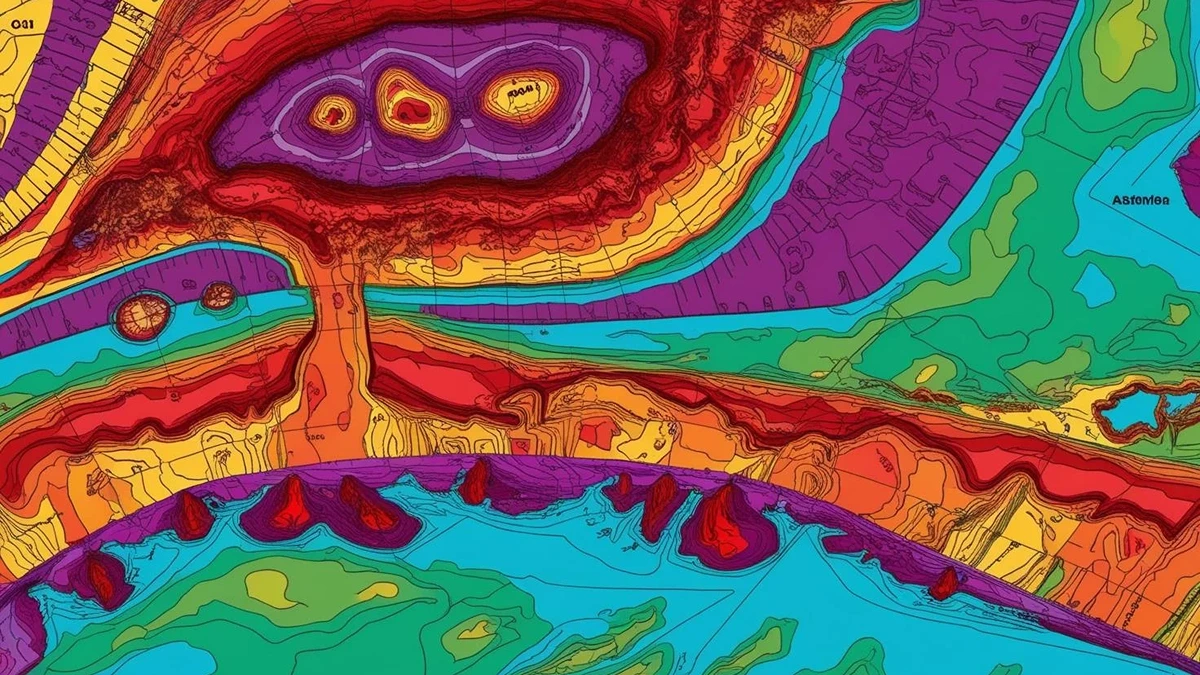
Image credit: The Watchers
- Full-waveform inversion (FWI) unveils numerous lower mantle anomalies which are distinct from traditional seismic tomography findings.
- Research shows no correlation between the anomalies and historical subduction zones.
- The study introduces new methods and challenges assumptions about mantle processes.
Researchers from institutions including ETH Zurich and Utrecht University used advanced full-waveform inversion (FWI) techniques to reveal positive wave speed anomalies in the lower mantle.
FWI captures the complete wavefield and offers data into previously undetected regions, unlike traditional travel-time tomography which relies on a limited number of identifiable wave phases.
“Global full-waveform inversion is less sensitive to source-receiver geometry and reveals numerous previously undetected positive wave speed anomalies in the lower mantle,” Thomas L. A. Schouten, the lead author stated.
Advanced imaging with FWI
The FWI approach uses the entire seismogram to improve resolution. Researchers identified anomalies at depths ranging from 900 to 1 200 km (560 to 750 miles) beneath major oceans and continental interiors by simulating global wave propagation with tools like SALVUS.
The anomalies are absent in traditional models because they rely on direct wave paths that favor regions with dense seismic station networks. The western Pacific Ocean was a notable area of focus which reveals substantial anomalies despite sparse source-receiver coverage.
Absence of correlation with subduction zones
The anomalies identified through FWI did not exhibit statistical correlations with reconstructed subduction zones over the past 200 million years. The findings contradict earlier interpretations that linked such anomalies exclusively to cold-subducted slabs.
The study posits alternative origins such as thermochemical heterogeneities, basalt enrichment, and delaminated lithospheric material.
The analysis revealed distinct anomalies in several regions.
In the Western Pacific Ocean, an anomaly extends from depths of 900 to 1 200 km (560 to 750 miles), which researchers believe may result from thermochemical variations rather than subduction remnants.
In South America, vertically oriented anomalies west of the continent suggest complex mantle processes unrelated to surface tectonic activity.
Smaller anomalies were also found beneath other major oceans indicating mantle heterogeneity on a global scale.
Revisiting previous assumptions
Traditional interpretations linked positive wave speed anomalies to the thermal effects of subducted slabs. The new findings challenge this view by introducing multiple potential sources for these features:
- Chemical heterogeneity: Variations in material composition, such as basalt-rich regions, could explain observed anomalies.
- Delamination processes: Dense lithospheric roots detaching and sinking into the mantle are potential contributors.
Advances in seismic exploration
FWI’s ability to detect subtle variations proved its transformative role in mantle research. FWI reduces biases introduced by uneven seismic station distribution in remote or oceanic regions as compared to travel-time tomography.
“These results suggest more diverse origins for these anomalies in Earth’s lower mantle, unlocking full-waveform inversion as an indispensable tool for mantle exploration,” Schouten added.
Statistical analysis and verification
Researchers conducted simulations comparing seismograms with and without the anomalies to validate the findings. The synthetic wavefield simulations confirmed FWI’s ability to resolve complex structures beneath poorly sampled regions.
Independent tests corroborated the anomalies by ensuring their accuracy was not influenced by data noise.
Broader scientific context
The study aligns with previous geochemical and geodynamic predictions suggesting persistent mantle heterogeneity.
Earlier works indicated a poorly mixed “marble cake” mantle structure, enriched in basalt and other high-density materials. The new data reinforces these hypotheses by offering refined insights into mantle convection and thermal history.
References:
1 Full-waveform inversion reveals diverse origins of lower mantle positive wave speed anomalies, Thomas L. A. Schouten, Lars Gebraad, Sebastian Noe, Anna J. P. Gülcher, Solvi Thrastarson, Dirk-Philip van Herwaarden & Andreas Fichtner, Nature – November 4, 2024 – https://doi.org/10.1038/s41598-024-77399-2 – OPEN ACCESS

Rishika holds a Master’s in International Studies from Stella Maris College, Chennai, India, where she earned a gold medal, and an MCA from the University of Mysore, Karnataka, India. Previously, she served as a Research Assistant at the National Institute of Advanced Studies, Indian Institute of Science, Bengaluru, India. During her tenure, she contributed as a Junior Writer for Europe Monitor on the Global Politics website and as an Assistant Editor for The World This Week. Her work has also been published in The Hindu newspaper, showing her expertise in global affairs. Rishika is also a recipient of the Women Empowerment Award at the district level in Haryana, India, in 2022.

Commenting rules and guidelines
We value the thoughts and opinions of our readers and welcome healthy discussions on our website. In order to maintain a respectful and positive community, we ask that all commenters follow these rules.