
Hidden faults beneath Seattle may rupture more frequently than previously recognized, study finds
Secondary faults beneath the Seattle metropolitan area may rupture more frequently than previously recognized and could represent an underappreciated source of seismic hazard, according to a new study published in GSA Bulletin on January 27, 2026.
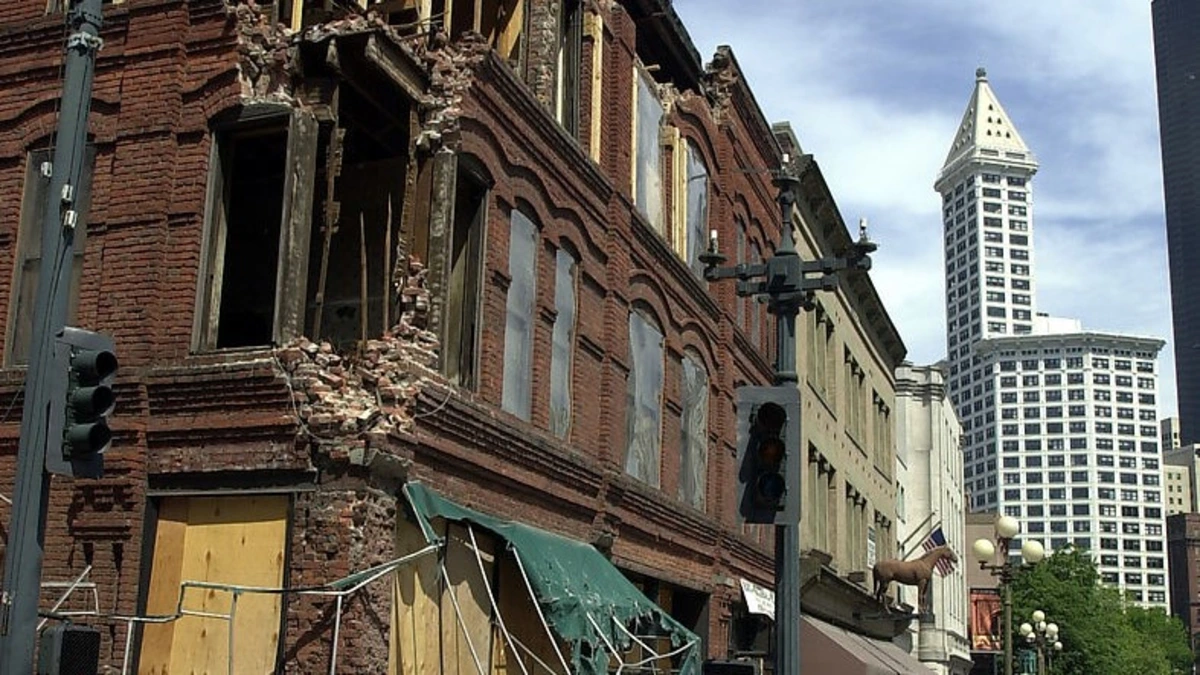
Damage to a masonry building (Cadillac Hotel) in Seattle, from the 2001 Nisqually earthquake. Credit: Erik Stuhaug via Seattle Municipal Archives
Researchers investigating two little-studied faults within the Seattle Fault Zone found evidence of repeated earthquake activity spanning more than 10 000 years, including a rupture that likely occurred during the early nineteenth century. The findings suggest that much of the surface faulting recorded within the fault zone during the past roughly 2 500 years has occurred on secondary faults rather than on the main Seattle fault itself.
The results have implications for seismic hazard assessment in the Pacific Northwest. Because these secondary faults are relatively short, they are generally excluded from the U.S. National Seismic Hazard Model. However, the study indicates that they rupture more frequently than the main fault system and are located directly beneath parts of the Seattle metropolitan region, home to roughly 4 million people.
The Seattle Fault Zone is an east-west-trending system of reverse faults that extends beneath Seattle, Bainbridge Island, and the surrounding areas of Puget Sound. The fault zone accommodates part of the north-south crustal compression affecting western Washington and is considered one of the most significant crustal fault systems in the Pacific Northwest.
Previous studies documented evidence of a major earthquake in 923 CE that produced widespread uplift, tsunami deposits, landslides, and strong ground shaking across the region. That earthquake is thought to have occurred on one of the primary faults within the Seattle Fault Zone and had an estimated magnitude of about Mw 7.5.
The new study focuses instead on smaller secondary faults associated with folding above the deeper fault system. These faults do not extend to the surface over long distances and leave comparatively subtle geological evidence, making them more difficult to identify and investigate.
To reconstruct their earthquake history, researchers combined trench excavations, lidar mapping, magnetic surveys, radiocarbon dating, and tree-ring analysis at two locations: the Lytle Beach fault on Bainbridge Island and the Vasa Park fault near Lake Sammamish.
At the Lytle Beach fault, trench exposures revealed evidence for two separate surface-rupturing earthquakes. The younger event, designated RH2 by the authors, is interpreted to have occurred during the early nineteenth century.
One of the strongest lines of evidence comes from Mill Pond, near the eastern end of the fault. There, researchers examined drowned western red cedar trees preserved within wetland sediments. Tree-ring analysis and radiocarbon dating indicate a sudden environmental change occurred around the 1830s and early 1840s, consistent with earthquake-related deformation that altered local drainage conditions.
The study’s modelling places the most recent rupture between 1712 and 1853 CE, while the tree-ring evidence narrows the likely timing to approximately 1833–1843 CE.
Researchers also identified evidence of an older earthquake on the Vasa Park fault. Geological evidence indicates that event occurred more than 10 000 years ago, near the end of the last ice age, demonstrating that earthquake activity on these secondary faults extends deep into the geological history of the region.
Looking across the broader Seattle Fault Zone, the study found that surface-faulting earthquakes during the past approximately 2 500 years have been dominated by activity on secondary faults. Combining the new results with previous paleoseismic investigations yields an average recurrence interval of roughly 350 years between documented surface-faulting earthquakes somewhere within the secondary fault network.
The authors stress that this recurrence interval applies to the broader network of secondary faults within the Seattle Fault Zone and should not be interpreted as a recurrence interval for any individual fault.
The study also highlights how much remains unknown about fault behaviour beneath the Seattle region. While evidence shows that secondary faults have ruptured repeatedly and independently, their relationship to larger structures at depth remains incompletely understood.
The findings indicate that earthquake hazard within the Seattle Fault Zone may be more complex than previously recognized. Although the largest earthquakes are still expected to occur on the primary fault system, the geological record suggests that smaller, shallower faults beneath the metropolitan region have generated repeated surface-rupturing earthquakes throughout the late Holocene and may represent a more significant component of regional seismic hazard than previously appreciated.
References:
1 Latest Pleistocene to nineteenth-century earthquakes on bending-moment reverse faults of the Seattle fault zone, Washington – Stephen J. Angster et al. – GSA Bulletin – https://doi.org/10.1130/B38333.1 – January 27, 2026

I’m a science journalist and researcher at The Watchers, contributing to the Epicenter edition, where I cover peer-reviewed scientific research and emerging discoveries across Earth and space sciences. With a background in astronomy and a passion for environmental science, I’ve worked in shark and coral conservation in Fiji, conducting reef and shark-behavior research, contributing to mangrove restoration, and earning PADI Open Water and Coral Reef Certifications. I bring a blend of scientific rigor and storytelling to illuminate the discoveries shaping our planet and beyond.

Commenting rules and guidelines
We value the thoughts and opinions of our readers and welcome healthy discussions on our website. In order to maintain a respectful and positive community, we ask that all commenters follow these rules.