
2025 Antarctic ozone hole recorded fourth-smallest ozone mass deficit since 1992
The 2025 Antarctic ozone hole recorded the fourth-smallest average ozone mass deficit since 1992, according to the 2026 Antarctic assessment. The World Meteorological Organization (WMO) reported a maximum ozone mass deficit of 36.7 million tons on September 29, more than 25% below the 1990–2010 mean of 50.1 million tons. The weak season fits the long-term ozone recovery trend, while year-to-year atmospheric variability remains large.
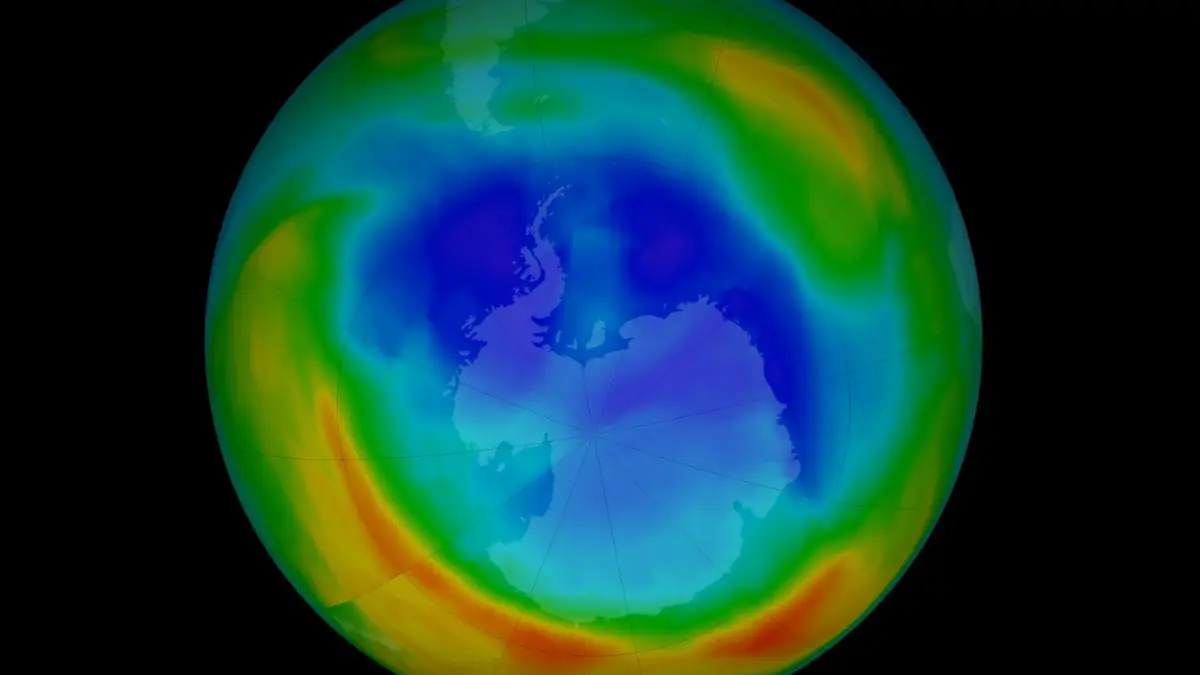
Antarctic ozone hole on August 17, 2025. Credit: NASA/GSFC
The 2025 ozone-hole cycle began normally in mid-July before a relatively early onset of ozone depletion in late August. The World Meteorological Organization (WMO) reported that depletion rates peaked around the beginning of September, earlier in the season than in recent years. Ozone mass deficit values during October, when seasonal maxima are usually observed, remained well below the 1990–2010 historical range.
The 2026 Antarctic assessment found that the average ozone mass deficit from September 21 to October 13 was 16 million tons, the fourth smallest during the mature ozone-hole period beginning in 1992. The same assessment placed the average ozone-hole area at 18.7 million km2 (7.2 million mi2) from September 7 to October 13, the fifth smallest over the same period.
The ozone hole reached its largest daily area of 22.9 million km2 (8.8 million mi2) on September 9. The September 21–October 16 average polar ozone-column minimum was 138.3 Dobson units, the fifth highest since 1992, while the polar-cap average from September 13–October 5 reached 246.4 Dobson units, the fourth highest.
The 16-million-ton average ozone mass deficit and WMO’s maximum value of 36.7 million tons describe different parts of the season and should, therefore, not be treated as competing measurements. Ozone mass deficit estimates how much ozone is missing relative to the conventional 220-Dobson-unit ozone-hole threshold. A period average describes depletion across a defined interval, while the maximum records the largest deficit reached on an individual day.
Atmospheric conditions restricted further ozone loss after the early part of the season. In the ozone-hole subsection of Raphael et al. (2026), Paul A. Newman and colleagues reported that lower-stratospheric temperatures rose rapidly from mid-September as a series of planetary-scale wave events affected the Antarctic atmosphere. The warming impeded further growth of the ozone hole.

Chlorine monoxide concentrations within the polar vortex were also below average through much of the season and had fallen to near zero by mid-October, marking the end of the main chemical depletion period. Five significant planetary-wave events affected the Antarctic stratosphere during spring 2025, warming and decelerating the polar vortex and mixing ozone-rich air into the polar region.
The ozone hole broke up on November 30, 11 days earlier than the 1992–2024 average. A planetary-wave event beginning on November 25 accelerated its final decline.
The relatively weak 2025 season occurred against a chemical background that has been changing for decades. Long-lived ozone-depleting substances such as chlorofluorocarbons reach the stratosphere, where they release chlorine and bromine capable of destroying ozone. The Montreal Protocol, signed in 1987 and strengthened by subsequent amendments, initiated the global phaseout of these substances, while stratospheric halogen concentrations began declining in the mid-1990s.
Weber et al. (2022) analyzed five merged satellite and ground-based total-ozone datasets spanning 1979–2020. After accounting for atmospheric circulation and other sources of variability, the researchers derived a near-global ozone-depleting-substance-related recovery trend of 0.4 ± 0.2% per decade (2σ) after 1995. That rate was about one-third of the −1.5 ± 0.6% per decade decline calculated for 1978–1995.
The relationship between the ozone trends and declining equivalent effective stratospheric chlorine supported attribution of part of the observed recovery to reductions in ozone-depleting substances. Atmospheric circulation and ozone transport, however, continue to produce substantial differences from year to year and can obscure the smaller underlying chemical recovery signal.
The 2025 Antarctic ozone hole is consistent with that long-term recovery, but one weak season does not establish that recovery is complete or that the ozone hole will become progressively smaller every year.
WMO continues to distinguish annual fluctuations from the multi-decadal recovery trend, while the 2025 observations show how declining ozone-depleting chlorine and bromine interact with Antarctic stratospheric conditions to determine the severity of each season.
References
1 World Meteorological Organization. (2026, September 16) – WMO Ozone and UV Bulletin No. 4 – September 2026
2 Raphael, M. N., Clem, K. R., Adjou, M., Adusumilli, S., Amory, C., Bahrami, M., Baiman, R., Banwell, A. F., Barreira, S., Beadling, R. L., Black, T., Brown, M., Colwell, S., Coy, L., Cullis, P., Datta, R. T., de Laat, J., Dell, R. L., du Plessis, M., Fogt, R. L., Fricker, H. A., Glen, E., Hancock, A. M., Jackson, P., Johnson, B., Josey, S. A., Kaufman, Z., Keller, L. M., Kittel, C., Kramarova, N. A., Lait, L. R., Lazzara, M. A., Lieser, J. L., MacFerrin, M., MacLennan, M. L., Massom, R. A., Mikolajczyk, D. E., Milward, J., Mote, T. L., Newman, P. A., Norton, T., Petropavlovskikh, I., Pezzi, L. P., Reid, P., Ryan-Keogh, T. J., Santee, M. L., Scambos, T., Schulz, C., Shi, J.-R., Souza, E., Stammerjohn, S., Thomalla, S., Trusel, L., Wille, J. D., & Ziegler, T. (2026). Antarctica and the Southern Ocean. Bulletin of the American Meteorological Society, 107(8), S352-S400. https://doi.org/10.1175/BAMS-D-26-0127.1
3 Weber, M., Arosio, C., Coldewey-Egbers, M., Fioletov, V. E., Frith, S. M., Wild, J. D., Tourpali, K., Burrows, J. P., & Loyola, D. (2022). Global total ozone recovery trends attributed to ozone-depleting substance (ODS) changes derived from five merged ozone datasets. Atmospheric Chemistry and Physics, 22(10), 6843-6859. https://doi.org/10.5194/acp-22-6843-2022

I'm a dedicated researcher, journalist, and editor at The Watchers. With over 20 years of experience in the media industry, I specialize in hard science news, focusing on extreme weather, seismic and volcanic activity, space weather, and astronomy, including near-Earth objects and planetary defense strategies. You can reach me at teo /at/ watchersnews.bigscoots-staging.com.

Commenting rules and guidelines
We value the thoughts and opinions of our readers and welcome healthy discussions on our website. In order to maintain a respectful and positive community, we ask that all commenters follow these rules.