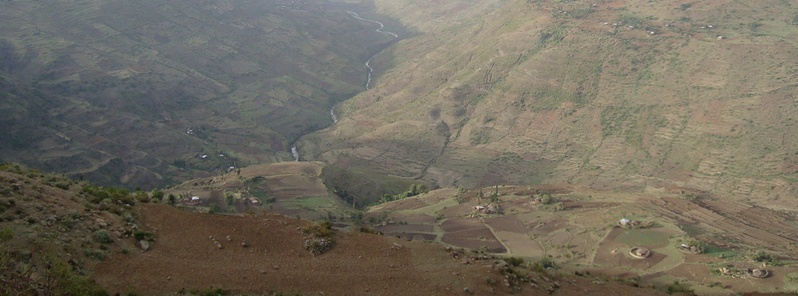
• World is losing 2 000 hectares of farm soil daily to salt damage

    Salt-spoiled soils worldwide: 20% of all irrigated lands — an area equal to size of France. Extensive costs include $27 billion+ in lost crop value/year. UNU study identifies ways to reverse damage, says every hectare needed to feed world’s fast-growing popu

  • Impossible “neutron star” shatters theory

    What is a neutron star? Astronomers tell us that these tiny yet massively dense objects form by gravitational collapse from the remnants of a massive star that has exploded. The theoretical neutron star was invented to try to explain highly intense bursts of energy from

  • Partial solar eclipse on October 23, 2014

    The final eclipse event of 2014 occurs at the Moon's ascending node in southern Virgo on Thursday, October 23, 2014. This will be a partial solar eclipse almost exclusively visible from Canada and the USA. Except for the far northeast, a sunset eclipse will be visib

  • Observing Comet Siding Spring flyby Mars – Sunday, October 19, 2014

    Comet Siding Spring will make its historic approach to Mars around 18:27 UTC on Sunday, October 19, 2014, and pass within 139 500 km (88 000 miles) away from planet's surface. That is less than half the distance between Earth and its moon and less than one-tenth

  • Hydraulic fracturing linked to 400 earthquakes in Ohio, study

    Hydraulic fracturing triggered a series of small earthquakes in 2013 on a previously unmapped fault in Harrison County, Ohio, according to a study published in the journal Seismological Research Letters (SRL) on October 14, 2014. Nearly 400 small earthquakes occurred be

  • Icebergs drifted to Florida during last ice age

    Using a first-of-its-kind, high-resolution numerical model to describe ocean circulation during the last ice age about 21 000 years ago, oceanographer Alan Condron of the University of Massachusetts Amherst has shown that icebergs and meltwater from the North American i

  • Drones and robots to monitor active volcanoes

    A professor at Tohoku University in Japan, Keiji Nagatani, has spent last 10 years developing robotic systems specifically designed to operate in harsh conditions near active volcanoes. Nagatani's aim is to design robots which can go where humans can't and effec