The Watchers team and our contributors bring the latest on extreme weather, earthquakes, volcanic eruptions, space weather, and all things science. We're all about making sense of the natural world and keeping you informed on what’s happening. Got a tip or a question? Hit us up using the form at newstips!

  • Largest object ever jettisoned from ISS to make uncontrolled re-entry this week

    The International Space Station’s (ISS) largest-ever discarded object, a hefty equipment pallet weighing 2.9 tons, is anticipated to make an uncontrolled descent back to Earth between March 8 and 9, 2024. Launched into space for a critical ISS power system upgrade, this pallet, loaded with nine old station batteries, will not fully disintegrate upon reentry, with predictions indicating about half a ton of debris could survive the descent and impact the planet’s surface.


  • Astronomers discover oceans of water vapor in planet-forming disc around young star

    Astronomers using the Atacama Large Millimeter/submillimeter Array (ALMA) have discovered vast reservoirs of water vapor in the disc around HL Tauri, a young star 450 light-years away from Earth, unveiling processes that may lead to the birth of planets rich in water and redefining our search for life in the universe.

  • First detailed images of near-Earth asteroid 2008 OS7

    On February 2, NASA utilized the Deep Space Network’s Goldstone Solar System Radar to capture the first detailed images of asteroid 2008 OS7 during its close approach to Earth. The asteroid, measuring between 150 to 200 m (500 – 650 feet) wide, passed at a safe distance of approximately 2.9 million km (1.8 million miles), allowing scientists to refine its size, rotation, and orbital path, improving predictions of its future trajectories.

  • England’s farms suffer as one of the wettest winters devastates crops

    England’s agricultural sector is facing a crisis as one of the wettest winters in decades leads to widespread flooding, destroying thousands of acres of crops and placing significant financial pressure on farmers. The National Farmers’ Union (NFU) conference has put flooding at the top of its agenda, with farmers across the country reporting catastrophic losses.

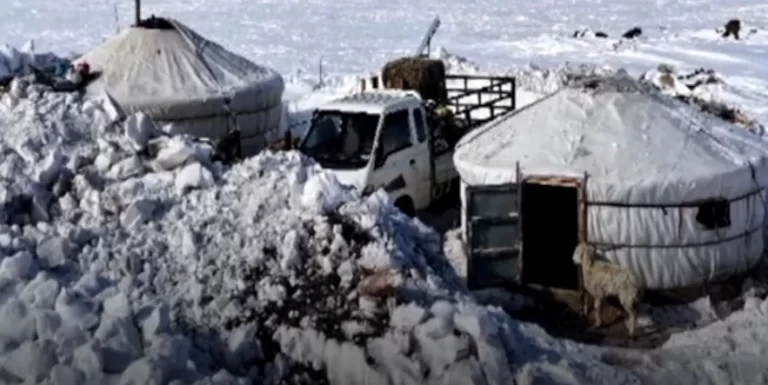
  • Largest winter snowfall since 1975 and severe cold leave nearly 668 000 livestock dead in Mongolia

    Mongolia has experienced its heaviest snowfall since 1975 this winter, with the government reporting one fatality and the loss of nearly 668 000 livestock due to severe cold and blizzards. Disaster relief efforts were initiated on February 19, focusing on providing essential aid, including food, fuel, and livestock feed, to affected communities.

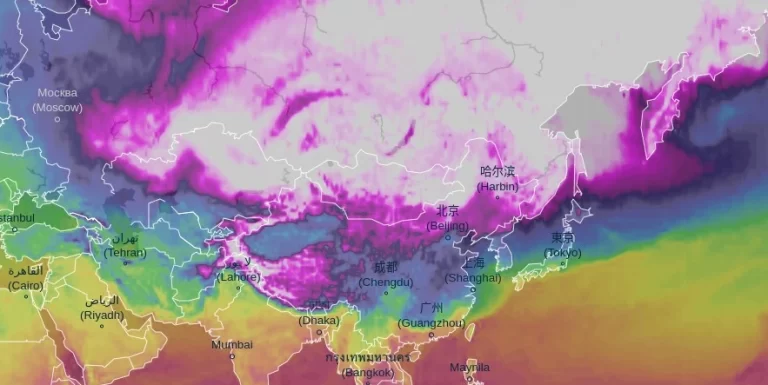
  • NMC issues Orange alert for severe cold, China

    Severe weather warnings have been issued across China, with temperatures set to plummet in the south and Beijing experiencing snowy conditions. The National Meteorological Center (NMC) has renewed an orange alert, indicating significant temperature drops of 6 to 12 °C (10.8 to 21.6 °F) in southern regions and more than 20 °C (36 °F) in some areas. Beijing saw up to 4.1 cm (1.6 inches) of snow, affecting traffic and pedestrian safety. In Xinjiang, a new record low of -52.3 °C (-62.14 °F) was set, breaking a 64-year-old record.

  • Severe sandstorms hit parts of NW China

    Severe sandstorms hit Ruoqiang County in China’s Xinjiang Uygur Autonomous Region on the morning of February 17, 2024, reducing visibility to less than 100 m (330 feet) and prompting authorities to implement traffic control measures on many roads. In Turpan, local rescue teams were deployed to assist those stranded by the sandstorms.