I’m a science journalist and researcher at The Watchers, contributing to the Epicenter edition, where I cover peer-reviewed scientific research and emerging discoveries across Earth and space sciences. With a background in astronomy and a passion for environmental science, I’ve worked in shark and coral conservation in Fiji, conducting reef and shark-behavior research, contributing to mangrove restoration, and earning PADI Open Water and Coral Reef Certifications. I bring a blend of scientific rigor and storytelling to illuminate the discoveries shaping our planet and beyond.

  • PHIVOLCS warns of possible lahars at Kanlaon volcano as heavy rain from Severe Tropical Storm Kalmaegi approaches

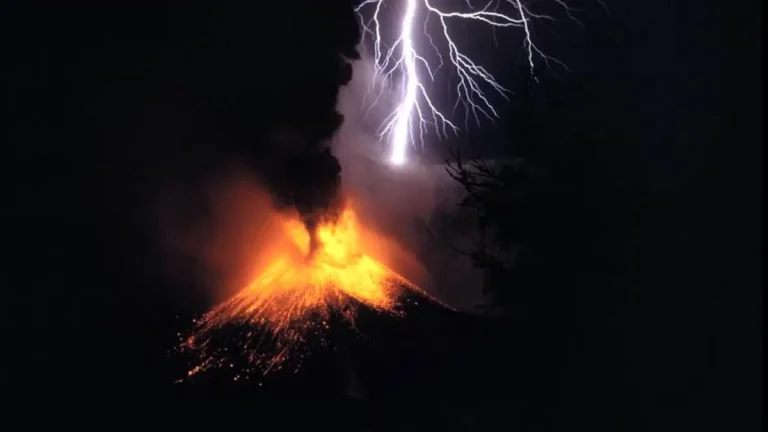
    The Philippine Institute of Volcanology and Seismology (PHIVOLCS) has issued a lahar advisory for Kanlaon Volcano on Negros Island, warning that heavy to intense rainfall from Severe Tropical Storm Tino (#TinoPH) may generate volcanic sediment flows on the volcano’s southern and western slopes while Alert Level 2 remains in effect.

  • Tornado damages over 112 houses in Malang Regency, East Java

    A damaging tornado accompanied by heavy rain struck Sumbersekar village, Dau sub-district, Malang Regency, East Java, Indonesia, on Sunday afternoon, November 2, 2025, damaging more than 112 houses and injuring one resident. The event occurred as the National Disaster Management Agency (BNPB) reported multiple hydrometeorological incidents across Java during the same weekend.

  • North American ice sheets drove the final surge in sea-level rise at the end of the last deglaciation

    Between about 9 000 and 7 000 years ago, global sea level climbed roughly 14 meters (46 feet), mostly from the collapse of North American ice sheets, according to new research in Nature Geoscience by Udita Mukherjee and colleagues.

  • Long-healed faults reveal why even stable regions can quake

    A new study from Utrecht University reveals that even in regions far from tectonic plate boundaries, dormant faults can still produce earthquakes. The research, published on October 15, 2025 in Nature Communications, explains how faults that have remained inactive for millions of years slowly “heal,” building up strength that is eventually released as a single induced earthquake.

  • Astronomers uncover Earth-sized planets in a compact binary system

    Astronomers have confirmed two Earth-sized planets and a third candidate orbiting both stars of the binary system TOI-2267 in the constellation Canis Minor, according to observations analyzed from NASA’s Transiting Exoplanet Survey Satellite (TESS) and ground telescopes between 2019 and 2025. The finding, published in Astronomy & Astrophysics, reveals that rocky worlds can form and persist in gravitational environments once thought too unstable for complex planetary systems.

  • Rare fragmented auroras and picket fence structures observed together, challenging long-held latitude boundary assumptions

    Fragmented aurora-like emissions and picket fence structures were simultaneously observed over northern Scandinavia during a geomagnetic storm on January 1, 2025, marking the first recorded coexistence of these two rare phenomena within auroral latitudes. The discovery adds to the growing understanding that Earth’s upper atmosphere is far more dynamic than once thought, with electric-field structures that can stretch over thousands of kilometres but reorganize in seconds.

  • Hidden magma pathway revealed by 2025 Santorini crisis

    An intense earthquake swarm shook the Santorini–Amorgos region of Greece beginning on January 27, 2025, lasting about 45 days and producing more than 16 000 tremors between 5–15 km (3–9 miles) below the seafloor. A joint seismological study has revealed that the 2025 Santorini crisis was not a typical tectonic swarm. It was the signature of magma moving through a hidden corridor connecting the Santorini and Kolumbo volcanoes, two of the most active systems in the eastern Mediterranean.