
Long-duration M5.0 solar flare erupts from the northeast limb
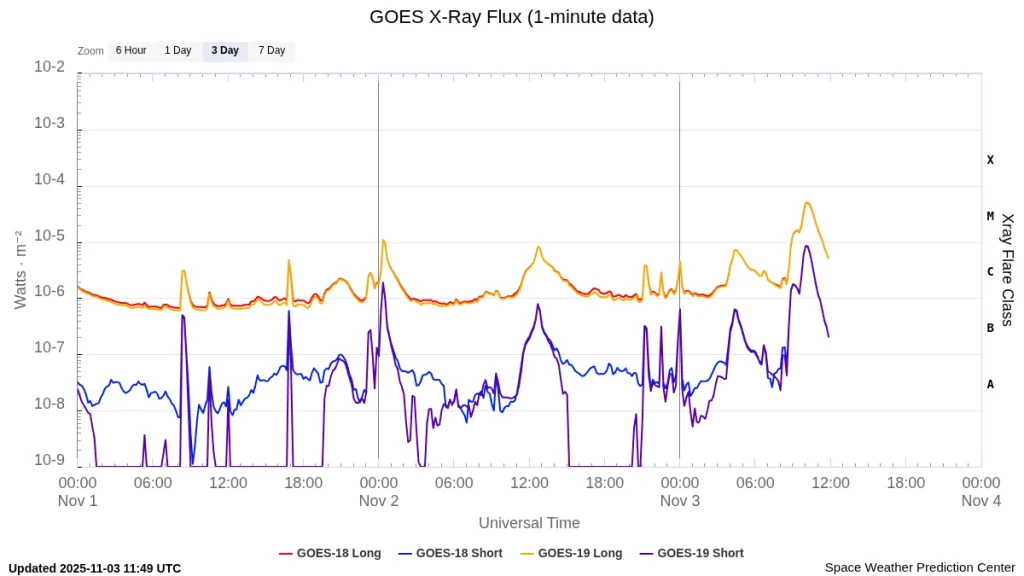
A long-duration solar flare measuring M5.0 erupted from an active region located at the NE limb of the Sun at 10:11 UTC on November 3, 2025. The event started at 09:38 and ended at 10:37 UTC.

CME lifting of the NE limb of the Sun at 09:31 UTC on November 3, 2025. Credit: NASA/SDO AIA/304, The Watchers
Coronagraph data indicate that a coronal mass ejection (CME) was already in progress before the flare peak, suggesting that the eruption and flare were part of the same magnetic event.
Multiple active regions currently rotating from the far side into Earth view have been associated with repeated large CMEs over the past 10 days. Their emergence onto the Earth-facing disk increases the likelihood of elevated solar activity and Earth-directed CMEs in the days ahead.
Solar activity in 24 hours to 00:30 UTC today was at moderate levels, with an M1.0 solar flare at 00:26 UTC and a long-duration C8.2 flare at 12:46 from region 4267.
A large CME was observed in LASCO C2 imagery beginning just after 11:00 UTC on November 2, but, given the source location just beyond the eastern limb, it is not expected to have an Earth-directed component.
Solar activity is expected to remain at low levels, with a chance for M-class flares through November 5, as old active regions are anticipated to return to the northwestern limb, according to NOAA Space Weather Prediction Center (SWPC).

The greater than 2 MeV electron flux reached high levels over the past 24 hours, with a maximum flux of 10 260 pfu at 16:50UTC on November 2 while the greater than 10 MeV proton flux remained near background levels.
The greater than 2 MeV electron flux is expected to remain at moderate to high levels as HSS influence wanes, while the greater than 10 MeV proton flux is expected to remain at background levels.
Solar wind parameters over the past 24 hours continued to be enhanced under a positive polarity coronal hole high speed stream (CH HSS) influence. Total field was 5-8 nT and the Bz component underwent a few southward deflections reaching -5 to -6 nT. Solar wind speeds varied between approximately 490 km/s and 620 km/s, but overall displayed a decreasing trend. Phi was predominantly positive.
Solar wind parameters near-Earth are expected to reflect the influence of a waning CH HSS, with a return of ambient-like conditions on November 5.

The geomagnetic field was at unsettled to active levels due to slowly diminishing CH HSS effects during the same period. Geomagnetic field activity is expected to range from unsettled to active levels, with a chance for an isolated G1 – Minor storming period on November 3.
Primarily quiet and unsettled levels are expected on November 4 as HSS influences draw to a close, with quiet conditions prevailing on November 5.
References:
1 Forecast Discussion – NOAA/SWPC – 00:30 UTC on November 3, 2025

I'm a dedicated researcher, journalist, and editor at The Watchers. With over 20 years of experience in the media industry, I specialize in hard science news, focusing on extreme weather, seismic and volcanic activity, space weather, and astronomy, including near-Earth objects and planetary defense strategies. You can reach me at teo /at/ watchers.news.

Commenting rules and guidelines
We value the thoughts and opinions of our readers and welcome healthy discussions on our website. In order to maintain a respectful and positive community, we ask that all commenters follow these rules.