
Storm Poly – Strongest summer storm on record hits the Netherlands

Featured image: Storm Poly at 04:30 UTC on July 5, 2023. Image credit: EUMETSAT/Meteosat-10, Zoom Earth, The Watchers
An exceptional summer storm named Poly by the German Weather Service wreaked havoc in the Netherlands on July 5, 2023. Recognized as the strongest summer storm ever and the overall strongest since January 2018, Poly brought record-breaking wind speeds to the country, causing widespread damage and claiming at least one life.
An extraordinarily powerful storm named Poly swept over the Netherlands on July 5, 2023, marking the most powerful summer storm ever recorded in the country and the most potent since January 2018, according to data from Weeronline meteorologists.
Poly’s intensity was underlined by a wind gust recorded in IJmuiden, hitting 146 km/h (90.7 mph), marking the strongest summer wind gust ever recorded in the Netherlands. This unprecedented event led to the issuance of a Code Red weather alarm in the provinces of Noord-Holland, Flevoland, and Friesland due to very strong wind gusts. The National Meteorology Institute urged people not to leave their homes and to reserve emergency service numbers for life-threatening situations only.

The Haarlem area was particularly hard-hit, with numerous reports of trees collapsing on homes and cars. Tragically, there was one fatality in Haarlem when a falling tree struck a car.
In Amsterdam, storm damages were extensive, and two individuals sustained serious injuries. In response to the harsh conditions, Amsterdam’s Schiphol airport, one of Europe’s busiest hubs, canceled over 400 flights. A spokesperson indicated traffic would be limited until at least 16:00 local time on July 4. Train operators NS and Arriva suspended all services in the country’s north, and a major highway north of Amsterdam was closed due to falling trees.
Rainfall was heaviest in the center and west of the country, with widespread measurements of 20 to 30 mm (0.8 – 1.2 inches). In localized areas, rainfall exceeded 40 mm (1.6 inches).
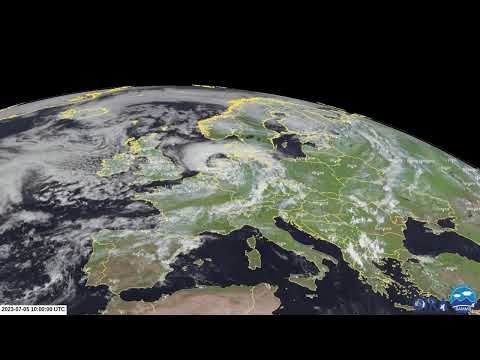

The intensity of the storm weakened in the Netherlands by the afternoon as its center continued its journey NNE over neighboring countries.


While strong storms in the Netherlands usually occur between October and April, Poly has redefined this norm. The previous severe storm that hit the country was on January 18, 2018, while less intense ones than Poly also hit the country during the summer months — on July 25, 2015, and August 26, 2020. Weeronline reports that the 2015 storm, the previous summer record-holder, produced wind gusts peaking at 122 km/h (75.8 mph), also measured in IJmuiden.
References:
1 Live-blog teruglezen: zeer zware storm Poly trok over ons land – Weeronline – July 4/5, 2023
2 One dead as rare summer storm hits Netherlands – Reuters – July 5, 2023

Teo Blašković founded The Watchers in 2011 and edited it until 2026, covering seismic and volcanic activity, extreme weather, space weather and near-Earth objects. Articles on this page are his archive.
Published in the last 24 hours
- The Leonid meteor shower peaks on the night of November 17, exactly 60 years after the 1966 storm, when some observers reported meteors falling at up to 40 a second, though this year’s show should be closer to 15 an hour
- When Arctic air reached South Florida in January 2020, Miami fell to 40°F and the National Weather Service warned residents to watch for cold-stunned iguanas dropping out of the trees Epicenter
- In May 2024, the strongest solar storm in 20 years put northern lights over the southern US, and across the Plains, GPS-guided tractors built to plant within an inch drifted about 10 feet off their rows Epicenter
- In 1943, a flight instructor in Texas flew a two-seat training plane into the eye of a hurricane because he was curious, then landed and took the base weatherman up for a second pass Epicenter
