
Pressure building up under Piparo mud volcano, Trinidad and Tobago

Featured image: Eruption of Piparo volcano on February 11, 1997. Credit: Jason Kanhai
Pressure is building up under Piparo mud volcano, Trinidad and Tobago, raising fears another eruption is imminent. Geologists said active changes have also been observed on the surface and subsurface of volcanic vents which erupted 22 years ago, killing livestock and birds.
Xavier Moonan, Senior geoscientist at Touchstone Exploration, said recent studies done over the past year at the Piparo volcano confirm that the volcano is showing active changes, the Trinidad and Tobago Guardian reports.
The volcano has a cyclicity of large eruptions every 25 to 30 years, Moonan said. "As such, one can interpret that an eruption can be imminent."
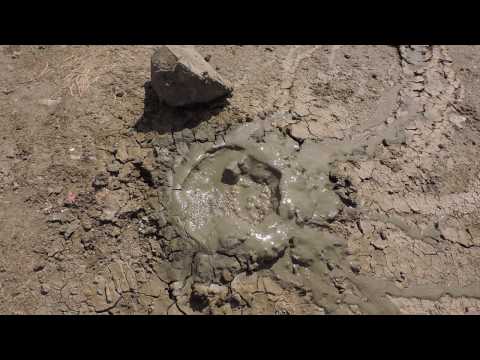
"We can confirm that the vent is rising but during the rainy season the muds are being eroded at a faster rate than it is rising," Moonan said."We can approximate that had there been no erosion of the mud volcano over the past couple years, the central vent area would have been at least ten feet higher," he said.
"While the data currently suggests that the mud volcano is 'swelling' as pressure builds at depth, our findings are still preliminary as trends over a longer term are needed to conclusively state the status of the mud volcano. Nevertheless, we need to prepare the community and all those that traverse the mud volcano daily to be vigilant and to inform the Regional Corporation for any signs of heightened activity," he said.
"By comparing the 2018 to 2019 survey we can note changes occurring within the main vent. The vent has become more constricted and has shifted to the east south-east. These changes occurring beneath the ground correspond to changes noted in the 3D elevation models from the drone surveys," Moonan said.



Teo Blašković founded The Watchers in 2011 and edited it until 2026, covering seismic and volcanic activity, extreme weather, space weather and near-Earth objects. Articles on this page are his archive.
Published in the last 24 hours
- A meteorite blew a crater beside a village near Lake Titicaca in 2007, and dozens of villagers who went to see it got headaches and nausea, though tests found nothing the rock had added to the water Epicenter
- The people who pay closest attention to the weather are the ones storms have already cost the most, a study of 946 students found, with one damaging storm making little difference to how much attention a student paid, but two or more making a clear one Epicenter
- The sea is falling in Juneau, Alaska, because land freed from melted glaciers is rising about 0.6 inches a year Epicenter
- A dam above Los Angeles collapsed just before midnight on March 12, 1928, and the flood killed more than 400 people, hours after the engineer who built it had spent two hours looking at a new leak and decided there was no danger Epicenter
