
Heavy rain results in flooding, above average crashes and high-water rescues around the Las Vegas Valley, Nevada

Featured image: High water rescue in the Durango Flood Channel on February 14, 2019. Credit: Clark County Nevada
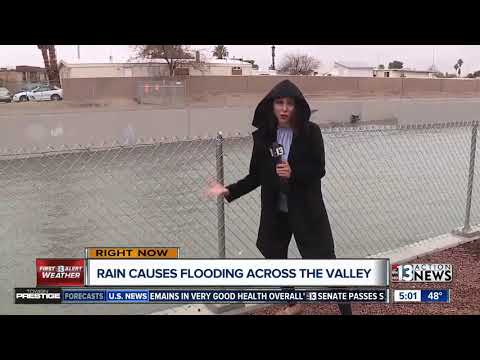
Heavy rain hit Nevada on February 14, 2019, resulting in widespread flooding across the Las Vegas Valley and above average freeway crashes.
Weather station at McCarran International Airport, official climate site for Las Vegas, registered 28.1 mm (1.11 inches) of rainfall in 24 hours of February 14, breaking the previous daily record of 18.7 mm (0.74 inches). This is the 20th highest 24-hour rainfall total for the city.
Clark County Fire Department responded to 4 swift water rescues throughout the day.
Four homeless men were rescued under the Carey Avenue Bridge in North Las Vegas around 09:20 PST.
Two other rescues were handled around 08:17 and 09:00 PST at S. Jones Boulevard and Tropicana Avenue and near E. Harmon Avenue and Koval Lane, respectively.
The fourth rescue took place in the Durango Flood Channel around 08:40 PST:

The Nevada Highway Patrol said their troopers handled 24 property damage crashes before 11:30 local time, along with 8 injury crashes and one hit-and-run collision, KTNV reports. This number was as high as 97 total freeway crashes by 17:00 LT – well above average.


Teo Blašković founded The Watchers in 2011 and edited it until 2026, covering seismic and volcanic activity, extreme weather, space weather and near-Earth objects. Articles on this page are his archive.
Published in the last 24 hours
- In September 1859, a solar storm lit up the night sky so brightly that gold miners in the Rocky Mountains woke up after midnight and started cooking breakfast, convinced the aurora glowing over their camp was the sunrise Epicenter
- A patch of warm Pacific water that could become the strongest El Niño in more than 70 years sits thousands of miles from any American town, yet it is already the main reason NOAA expects a wetter winter across the South and a milder one across the North
- A 19-year-old Nebraska teacher reportedly tied her pupils together with twine and led them to safety through a blizzard in January 1888 Epicenter
- NASA built the Opportunity rover to last 90 days on Mars, and Martian winds helped keep it alive for nearly 15 years by blowing dust off its solar panels, until a planet-wide dust storm in 2018 blocked sunlight and silenced the rover Epicenter

Debreeze? And she said it twice. One would think a journalist would know how to pronounce DEBRIS correctly.
I saw a sign that read the temple of the true HEBREWS was here but it was sticking out of the water.
Chicoms did it!