
Large equatorial coronal hole causing major geomagnetic storming
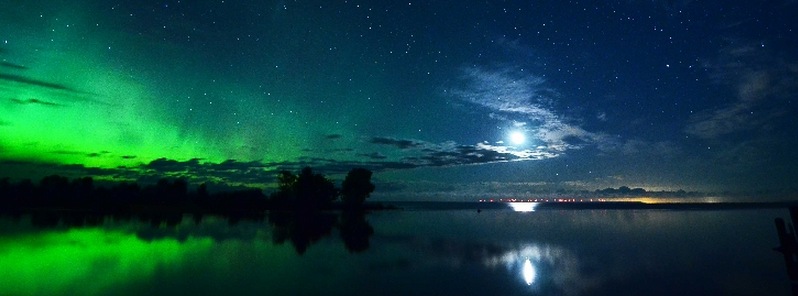
Image credit: Taken by Sarah DAngelo on October 7, 2015 @ Paradise Michigan (via SpaceWeather).
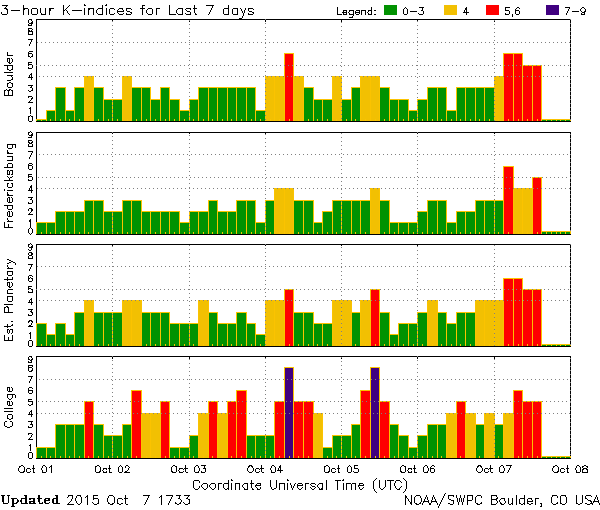
Our planet is under the influence of positive polarity coronal hole today which is causing enhanced geomagnetic conditions. Geomagnetic K-index of 6 (G2-Moderate geomagnetic storm) threshold was first reached at 05:17 UTC today. Geomagnetic K-index of 7 (G3 – Strong geomagnetic storm) was reached at 19:08 UTC.
Shortly after 02:00 UTC on October 7, Earth's magnetic field experienced an enhancement, as Bt increased to 14 nT initially, eventually seeing values near 20 nT.
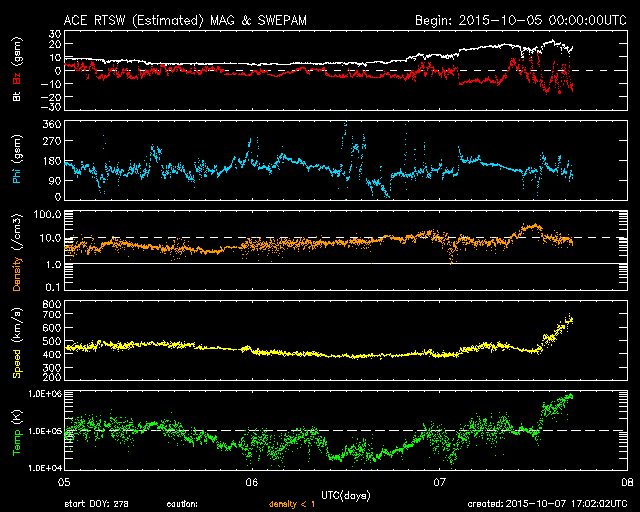
Image credit: NOAA/SWPC
Simultaneously, Bz component saw a southward deviation near -10 nT and wind speeds began climbing, eventually reaching a peak speed near 500 km/s. These enhancements are believed to be associated with the passage of the co-rotating interaction region (CIR), SWPC said.
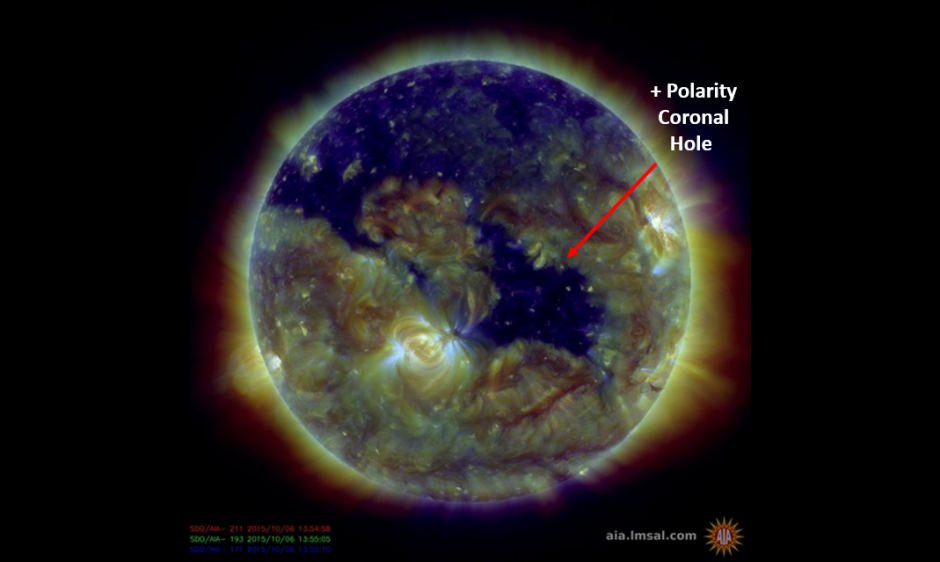
On it's previous transit 27 days ago, enhanced geomagnetic conditions were also experienced with this positive polarity CH HSS.
Image credit: NASA SDO/AIA 211/193/171
Solar wind parameters are expected to remain enhanced for the majority of October 7 as influence from positive polarity, equatorial coronal hole high speed stream (CH HSS) continues. SWPC forecasters expect CH HSS effect to begin waning near the end of October 7 into October 8. Early on October 8, an enhancement in solar wind parameters is possible due to prolonged southward Bz combined with night time sector effects. As CH HSS effects continue to wane, a decrease in activity is likely on October 9. However, an isolated period of substorming could cause another short-lived disturbance in the solar wind environment.
Space Weather Message Code: ALTK06
Serial Number: 374
Issue Time: 2015 Oct 07 0518 UTC
ALERT: Geomagnetic K-index of 6
Threshold Reached: 2015 Oct 07 0517 UTC
Synoptic Period: 0300-0600 UTC
Active Warning: Yes
NOAA Scale: G2 – Moderate
NOAA Space Weather Scale descriptions can be found at
www.swpc.noaa.gov/noaa-scales-explanation
Potential Impacts: Area of impact primarily poleward of 55 degrees Geomagnetic Latitude.
Induced Currents – Power grid fluctuations can occur. High-latitude power systems may experience voltage alarms.
Spacecraft – Satellite orientation irregularities may occur; increased drag on low Earth-orbit satellites is possible.
Radio – HF (high frequency) radio propagation can fade at higher latitudes.
Aurora – Aurora may be seen as low as New York to Wisconsin to Washington state.
***
Space Weather Message Code: ALTK06
Serial Number: 376
Issue Time: 2015 Oct 07 1700 UTC
ALERT: Geomagnetic K-index of 6
Threshold Reached: 2015 Oct 07 1659 UTC
Synoptic Period: 1500-1800 UTC
Active Warning: Yes
NOAA Scale: G2 – Moderate
NOAA Space Weather Scale descriptions can be found at
www.swpc.noaa.gov/noaa-scales-explanation
Potential Impacts: Area of impact primarily poleward of 55 degrees Geomagnetic Latitude.
Induced Currents – Power grid fluctuations can occur. High-latitude power systems may experience voltage alarms.
Spacecraft – Satellite orientation irregularities may occur; increased drag on low Earth-orbit satellites is possible.
Radio – HF (high frequency) radio propagation can fade at higher latitudes.
Aurora – Aurora may be seen as low as New York to Wisconsin to Washington state.
***
Space Weather Message Code: ALTK07
Serial Number: 100
Issue Time: 2015 Oct 07 1909 UTC
ALERT: Geomagnetic K-index of 7
Threshold Reached: 2015 Oct 07 1909 UTC
Synoptic Period: 1800-2100 UTC
Active Warning: Yes
NOAA Scale: G3 – Strong
NOAA Space Weather Scale descriptions can be found at
www.swpc.noaa.gov/noaa-scales-
Potential Impacts: Area of impact primarily poleward of 50 degrees Geomagnetic Latitude.
Induced Currents – Power system voltage irregularities possible, false alarms may be triggered on some protection devices.
Spacecraft – Systems may experience surface charging; increased drag on low Earth-orbit satellites and orientation problems may occur.
Navigation – Intermittent satellite navigation (GPS) problems, including loss-of-lock and increased range error may occur.
Radio – HF (high frequency) radio may be intermittent.
Aurora – Aurora may be seen as low as Pennsylvania to Iowa to Oregon.

I'm a dedicated researcher, journalist, and editor at The Watchers. With over 20 years of experience in the media industry, I specialize in hard science news, focusing on extreme weather, seismic and volcanic activity, space weather, and astronomy, including near-Earth objects and planetary defense strategies. You can reach me at teo /at/ watchers.news.

Commenting rules and guidelines
We value the thoughts and opinions of our readers and welcome healthy discussions on our website. In order to maintain a respectful and positive community, we ask that all commenters follow these rules.