
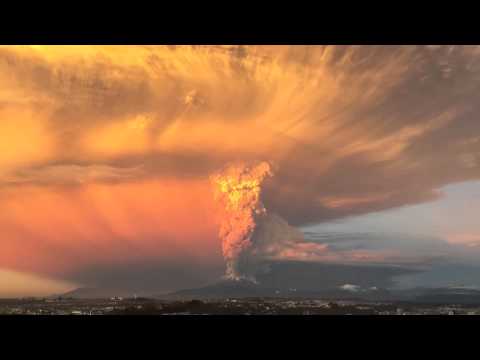
Massive eruption of Calbuco volcano after nearly 50 years of sleep, Chile

Image credit: Rodrigo Barrera
A major explosive eruption started at Chile's Calbuco volcano at 21:05 UTC on April 22, 2015 (18:05 local time). By 22:08 UTC, ash plume rose up to 12.1 km (40 000 feet), Buenos Aires VAAC reported. Aviation Color Code was raised to Red. The last eruption of this volcano took place in 1972.
There have been two eruptive pulses, pyroclastic flows, lava flows and ash columns, SERNAGEOMIN reported.
The eruption began after about 2 hours of major seismic activity. OVDAS said they recorded a swarm of volcano tectonic earthquakes, activity associated with rupture of rock in the earth's crust caused by magmatic flow. The first major event was M2.5, located 3.3 km west of the crater, at a depth of 7.4 km.
The national director of SERNAGEOMIN, Rodrigo Álvarez Seguel, said there were hundreds of earthquakes recorded during the two pulses, between 21:00 UTC on April 22 and 01:00 UTC on April 23 and around 04:00 UTC on April 23.

A 20 kilometer exclusion zone was established around the volcano. Over 4 000 people within this exclusion zone were evacuated during a heavy ashfall. The towns of Ensenada, Correntoso and Lago Chapo are completely evacuated.
Escenario de erupción subpliniana para el #VolcánCalbuco (Vía @Sernageomin). pic.twitter.com/KaUTZ1KWHK
— Sernageomin (Chile) (@Sernageomin) April 22, 2015
#Eruption 2 Volcan de #Calbuco 22 Abril Puerto Montt CHILE por: Jorge Nauto Fotografia @chematierra @infobencana pic.twitter.com/Ufam3TTtdA
— Leopold Kennedy Adam (@LeopoldAdam) April 23, 2015
#Eruption 3 Volcan de #Calbuco 22 Abril Puerto Montt CHILE por: Jorge Nauto Fotografia @chematierra @infobencana pic.twitter.com/PgrGLpESEz
— Leopold Kennedy Adam (@LeopoldAdam) April 23, 2015
#ERUPTION 6 #Calbuco volcano in Chile April 22 – 18:00 red alert and 4000 people evacuated @chematierra @infobencana pic.twitter.com/6urdtqqhSa
— Leopold Kennedy Adam (@LeopoldAdam) April 23, 2015
#Eruption 4 Volcan de #Calbuco 22 Abril Puerto Montt CHILE por: Jorge Nauto Fotografia @chematierra @infobencana pic.twitter.com/VslzPDVkU8
— Leopold Kennedy Adam (@LeopoldAdam) April 23, 2015
Erupción del #Calbuco se ha intensificado; tendencia a ser #Pliniana Gran altura, acidificación y colapso del cono pic.twitter.com/N9bHgXZABt
— SIMMSA México (@SIMMSAmex) April 23, 2015
Aviso: Segundo pulso del #Calbuco se ha intensificado; erupción con tendencia a ser Pliniana. pic.twitter.com/0u1w8XZbrz
— SkyAlert (@SkyAlertMx) April 23, 2015
Trabajando en la Erupcion del Volcán Calbuco… http://t.co/3sNEn1ovio Francisco Negroni/AGENCIAUNO. pic.twitter.com/Tsgkd4GQYh
— Francisco Negroni (@Negronifoto) April 23, 2015
#Calbuco volcano-CHILE Rays are product of the friction between the particles within the cloud of ashes @chematierra pic.twitter.com/IY9oLcF9PG
— Leopold Kennedy Adam (@LeopoldAdam) April 23, 2015
Interior and Security Minister Rodrigo Penailillo said this was clearly a much larger eruption than the one we saw with the Villarica some weeks ago and therefore we need to take bigger and faster measures.
He added that the government was sending water in case resources get contaminated by ash and that police and military officers had been deployed to ensure safety and help with evacuations.


Geologic summary
Along with its neighbor Osorno, Calbuco is one of the most active volcanoes of the southern Chilean Andes. The isolated late-Pleistocene to Holocene andesitic volcano rises to 2003 m south of Lake Llanquihué in the Chilean lake district. Guanahuca, Guenauca, Huanauca, and Huanaque, all listed as synonyms of Calbuco (Catalog of Active Volcanoes of the World), are actually synonyms of nearby Osorno volcano (Moreno 1985, pers. comm.).
The 2003-m-high Calbuco is elongated in a SW-NE direction and is capped by a 400-500 m wide summit crater. The complex evolution of Calbuco included edifice collapse of an intermediate edifice during the late Pleistocene that produced a 3 cu km debris avalanche that reached the lake. Calbuco has erupted frequently during the Holocene, and one of the largest historical eruptions in southern Chile took place from Calbuco in 1893-1894 and concluded with lava dome emplacement. Subsequent eruptions have enlarged the lava-dome complex in the summit crater.

Teo Blašković founded The Watchers in 2011 and edited it until 2026, covering seismic and volcanic activity, extreme weather, space weather and near-Earth objects. Articles on this page are his archive.
Published in the last 24 hours
- Male toads abandoned a pond in Italy five days before a deadly 2009 earthquake, while a scientist was counting them Epicenter
- An asteroid was spotted 19 hours before it exploded over Sudan in 2008, and students picked its pieces off the desert Epicenter
- A wave up to 3 m (10 feet) high rose out of Lake Michigan on a sunny June morning in 1954 and swept fishermen off Chicago’s piers, and when a second came 10 days later, warnings had cleared the shore Epicenter
- Just 12 inches of rushing water can carry away most cars, and more than half of US flood drownings happen to people who drive into flood water Epicenter
