
Strong solar flare reaching M6.5 erupted near the northeastern limb
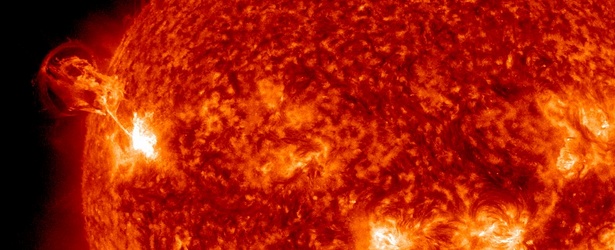
Image credit: NASA SDO AIA 304 at 16:18 UTC
A strong solar flare reaching M6.5 at its peak time erupted from region 2113 located in the northeastern quadrant on July 8, 2014. The event started at 16:06, peaked at 16:20, and ended at 16:30 UTC.
This event was associated with a Type IV radio emission. Type IV emissions occur in association with major eruptions on the sun and are typically associated with strong Coronal Mass Ejections (CMEs) and solar radiation storms.
CME is most likely directed away from Earth line. More information will be available after the analysis is complete.
NOAA SWPC forecasters estimate a 70% chance of M-class and a 15% chance of X-class solar flares in next two days. The likely sources are AR 2108 and 2109. They both have 'beta-gamma-delta' magnetic fields and harbor energy for strong eruptions.


***
Space Weather Message Code: ALTTP4
Serial Number: 467
Issue Time: 2014 Jul 08 1629 UTC
ALERT: Type IV Radio Emission
Begin Time: 2014 Jul 08 1604 UTC
Description: Type IV emissions occur in association with major eruptions on the sun and are typically associated with strong coronal mass ejections and solar radiation storms.
***
Space Weather Message Code: SUMXM5
Serial Number: 118
Issue Time: 2014 Jul 08 1653 UTC
SUMMARY: X-ray Event exceeded M5
Begin Time: 2014 Jul 08 1606 UTC
Maximum Time: 2014 Jul 08 1620 UTC
End Time: 2014 Jul 08 1630 UTC
X-ray Class: M6.5
Optical Class: 2b
Location: N10E54
NOAA Scale: R2 – Moderate
Potential Impacts: Area of impact centered primarily on sub-solar point on the sunlit side of Earth.
Radio – Limited blackout of HF (high frequency) radio communication for tens of minutes.
***
Sunspots
Region 2109 and Region 2108 (S08W12, Ekc/beta-gamma-delta) dominated the solar disk in size and complexity, although Region 2109 seemed to decay somewhat during the past 24 hours. Region 2108 is the largest group on the disk with an approximate area of 720 millionths in a complex EKC, beta-gamma-delta configuration. The Region showed overall growth, as well as rotational motion in the large leader portion combined with an apparent shearing motion between the northern and southern sections of the trailing portion of the spot group. Nonetheless only minor brightenings were observed from Region 2108.
Overall there are eleven numbered sunspot regions on the solar disk and some indication of additional small groups that are in the process of emerging.

Sunspots on July 8, 2014. Image credit: NASA SDO/HMI
2102 – Alpha
2103 – Beta
2104 – Beta-Gamma
2106 – Alpha
2107 – Beta
2108 – Beta-Gamma-Delta
2109 – Beta-Gamma-Delta
2110 – Beta
2111 – Alpha
2112 – Beta
2113 – Beta

Teo Blašković founded The Watchers in 2011 and edited it until 2026, covering seismic and volcanic activity, extreme weather, space weather and near-Earth objects. Articles on this page are his archive.
Published in the last 24 hours
- High Risk of excessive rainfall covers Florida’s Space Coast as St. Johns River near Cocoa reaches 5.67 m
- Four small asteroids will pass close to Earth from November 21 to 23
- Cyclone Akvan weakens after landfall near Gopalpur; more than 300 000 evacuated in Odisha, India
- A broad low over southeastern Florida and the northwestern Bahamas has a 30 percent chance of subtropical or tropical development within 48 hours and a 50 percent chance within 7 days, the National Hurricane Center says
