
Lunar Reconnaissance Orbiter’s view of Tycho Central Peak
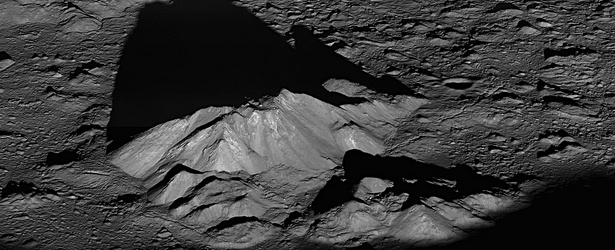
Image credit: NASA/Goddard/Arizona State University
Today, the Lunar Reconnaissance Orbiter (LRO) celebrates its fifth anniversary in space. LRO launched from Florida on June 18, 2009 and after a four-day journey, it successfully entered lunar orbit on June 23.
In the succeeding five years, LRO has continued to shape our view of our nearest celestial neighbor. LRO data has shown us the tracks and equipment left behind from the Apollo astronauts, created the most precise map of the lunar surface, discovered the coldest known temperatures in the solar system, mapped the distribution of hydrogen and possibly water mixed in the lunar soil, identified craters and many other exciting science discoveries
In honor of the fifth anniversary, the LRO project kicked off the Moon as Art Campaign. The public was asked to select a favorite orbiter image of the moon for the cover of a special image collection.

After two weeks of voting, the public has selected this image of Tycho Central Peak as its favorite moon image. The stunningly beautiful Tycho Central Peak rests inside an impact crater and has a boulder over 100 meters wide (about 328 feet) at its summit. It showcases a breathtaking view of the lunar landscape.

Image credit: NASA/Goddard/Arizona State University
Tycho crater's central peak complex, shown here, is about 9.3 miles (15 km) wide, left to right (southeast to northwest in this view). A very popular target with amateur astronomers, Tycho is about 51 miles (82 km) in diameter. The central peak's summit is 1.24 miles (2 km) above the crater floor.
Source: NASA

The Watchers team and our contributors bring the latest on extreme weather, earthquakes, volcanic eruptions, space weather, and all things science. We're all about making sense of the natural world and keeping you informed on what’s happening. Got a tip or a question? Hit us up using the form at newstips!
Earlier reporting
Nothing on Watchers was published in the last 24 hours. These are older articles.
- On October 22, 2017, a single flash of lightning stretched 515 miles from eastern Texas to near Kansas City, a distance that takes eight hours to drive, and nobody realized how far it had gone until scientists went back through the satellite data years later Epicenter
- CPC posts a slight risk of heavy rain from the Gulf Coast to the Northeast urban corridor November 25-29, and a moderate risk of West Coast wind and Sierra snow on November 25
- Florida's east coast faces a moderate flash flood risk Wednesday through Friday, with 4 to 8 inches of rain forecast and the St. Johns River near Cocoa already in major flood at 17.13 feet
- Cyclone Akvan to make landfall between Nellore and Visakhapatnam around noon on November 20, IMD forecasts 120-130 km/h winds gusting to 145
