
Full-halo Coronal Mass Ejection on farside of the Sun
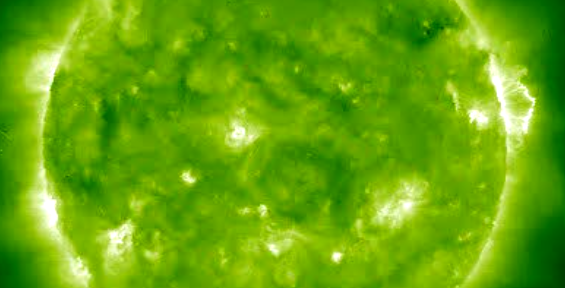
Image credit: STEREO Ahead EUVI 195 - NASA
Region 1678 erupted with massive, full-halo, Coronal Mass Ejection around 04:00 UTC on March 5, 2013. The CME will have no effect on Earth as Region 1678 is on farside of the Sun. This old and active region is about to rotate onto the eastern limb by this weekend.

March 5, 2013 – Full halo Coronal Mass Ejection (CME)
Couple of hours later, at 07:54 UTC, an impulsive M1.2 solar flare erupted from Beta classified Active Region 1686. A Type II Radio Emission was associated indicating a CME was generated.
Read more about that event here.

Sunspots
Currently, there are 6 regions with Beta magnetic configuration on Earth's side of the Sun. Old Region 1678 is returning into Earth view. Region 1682 is about to rotate onto the southwest limb, same as Region 1686 but we still might see some action from them. Regions 1683, 1685, 1687 and 1689 are becoming geoeffective and are visible on the image below:

Sunspots magnetic configuration on March 5, 2013

Teo Blašković founded The Watchers in 2011 and edited it until 2026, covering seismic and volcanic activity, extreme weather, space weather and near-Earth objects. Articles on this page are his archive.
Published in the last 24 hours
- High Risk of excessive rainfall covers Florida’s Space Coast as St. Johns River near Cocoa reaches 5.67 m
- Four small asteroids will pass close to Earth from November 21 to 23
- Cyclone Akvan weakens after landfall near Gopalpur; more than 300 000 evacuated in Odisha, India
- A broad low over southeastern Florida and the northwestern Bahamas has a 30 percent chance of subtropical or tropical development within 48 hours and a 50 percent chance within 7 days, the National Hurricane Center says
