
NASA’s twin GRAIL spacecraft successfully entered lunar orbit
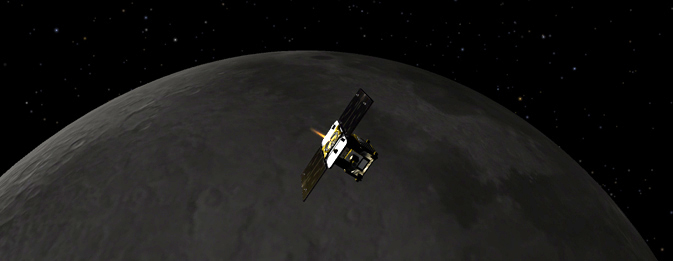
Featured image: Artist concept of GRAIL mission. Credit: NASA/JPL-Caltech
NASA’s twin spacecraft GRAIL successfully completed its entry to lunar orbit and is preparing to study the moon in unprecedented detail. It will allow scientists to understand what goes on below the lunar surface. In this particular case the name GRAIL stands for Gravity Recovery And Interior Laboratory.
GRAIL-A spacecraft successfully completed its planned main engine burn at 2 p.m. PST (5 p.m. EST) on saturday, Dec 31. As of 3 p.m. PST (6 p.m. EST), GRAIL-A is in an orbit of 90 kilometers by 8,363 kilometers around the moon that takes approximately 11.5 hours to complete.
GRAIL-B achieved lunar orbit at 2:43 p.m. PST (5:43 p.m. EST) on Sunday, Jan 1.

Once both spacecraft are operating, science work will begin in March. GRAIL spacecrafts will transmit radio signals precisely defining the distance between them. As they fly over areas of greater and lesser gravity caused by visible features such as mountains and craters, and masses hidden beneath the lunar surface, the distance between the two spacecraft will change slightly.
Scientists will translate this information into a high-resolution map of the moon’s gravitational field. The data will allow scientists to understand what goes on below the lunar surface. This information will increase knowledge of how Earth and its rocky neighbors in the inner solar system developed into the diverse worlds we see today.
“My resolution for the new year is to unlock lunar mysteries and understand how the moon, Earth and other rocky planets evolved,” said Maria Zuber, GRAIL principal investigator at the Massachusetts Institute of Technology in Cambridge.
Each spacecraft carries a small camera called GRAIL MoonKAM (Moon Knowledge Acquired by Middle school students) with the sole purpose of education and public outreach. The MoonKAM program is led by Sally Ride, America’s first woman in space, and her team at Sally Ride Science in collaboration with undergraduate students at the University of California in San Diego.
GRAIL MoonKAM will engage middle schools across the country in the GRAIL mission and lunar exploration. Thousands of fifth to eighth grade students will select target areas on the lunar surface and send requests to the GRAIL MoonKAM Mission Operations Center in San Diego. Photos of the target areas will be sent back by the GRAIL satellites for students to study.
A student contest that began in October 2011 also will choose new names for the spacecraft. The new names are scheduled to be announced in January 2012. Ride and Maria Zuber, the mission’s principal investigator at the Massachusetts Institute of Technology in Cambridge, chaired the final round of judging.
NASA’s Jet Propulsion Laboratory in Pasadena, Calif., manages the GRAIL mission for NASA’s Science Mission Directorate, Washington. The GRAIL mission is part of the Discovery Program managed at NASA’s Marshall Space Flight Center in Huntsville, Ala. Lockheed Martin Space Systems in Denver built the spacecraft. JPL is a division of the California Institute of Technology in Pasadena.
NASA – GRAIL.
Information about MoonKAM.

Teo Blašković founded The Watchers in 2011 and edited it until 2026, covering seismic and volcanic activity, extreme weather, space weather and near-Earth objects. Articles on this page are his archive.
Earlier reporting
Nothing on Watchers was published in the last 24 hours. These are older articles.
- Right about now, Voyager 1 is crossing a line no human-made object has ever reached, a full light-day from Earth, which means a message NASA sends tonight won't arrive until tomorrow night, and the spacecraft's answer won't make it home until the night after that
- On October 22, 2017, a single flash of lightning stretched 515 miles from eastern Texas to near Kansas City, a distance that takes eight hours to drive, and nobody realized how far it had gone until scientists went back through the satellite data years later Epicenter
- CPC posts a slight risk of heavy rain from the Gulf Coast to the Northeast urban corridor November 25-29, and a moderate risk of West Coast wind and Sierra snow on November 25
- Florida's east coast faces a moderate flash flood risk Wednesday through Friday, with 4 to 8 inches of rain forecast and the St. Johns River near Cocoa already in major flood at 17.13 feet
