• Cosmic ray intensification trend continues

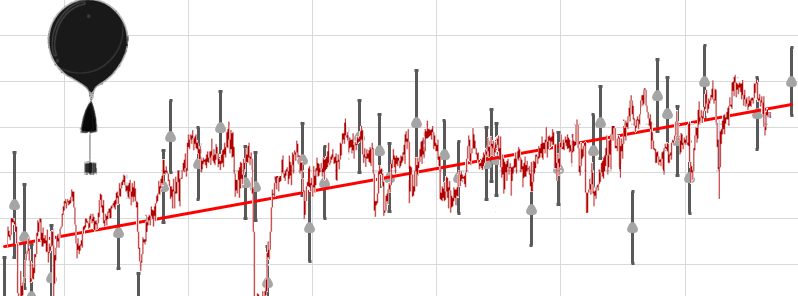
    An intensification trend of cosmic rays activity reported last month by SpaceWeather.com continues. The latest balloon flight over California on February 5 observed the highest value yet. The gathered data shows that cosmic rays in the mid-latitude stratosphere are…

  • Cosmic radiation intensifying as we enter another Solar Minimum

    An increased activity of cosmic rays has been observed around the Arctic Circle by the neutron monitors during the last year. The same trend was also noted in an independent measurement project carried out by the Spaceweather.com and the students of Earth to Sky…

  • A timelapse of the late October solar activity

    Awesome time-lapse video features show 15 days of solar action from October 14th to 30th, 2014, showing sunspot AR 2192, the largest sunspot of the last two solar cycles or more than two decades. During the transition time Sunspot 2192 produced six X-class and 37 M-clas

  • Increasing threat of strong solar flares, CME hit anticipated

    Solar activity has been low in last 24 hours, however, that might change today and in the coming days. New Active Region 2051 (S10W44, Dac/beta-gamma-delta) is growing rapidly and is now harboring energy for X-class solar flares. Eruptions from this regio

  • Video of New Year’s Eve solar blast

    An incredible swath of plasma erupted from the Sun on December 31st, 2012 over a four-hour period. NASA stated that a massive eruption on the surface of the Sun blasted out a wave of super-hot plasma so high that it could tower over 20 Earth. The length of the

  • 2012 In Review – Solar activity & space weather

    We are now in a period called Solar Cycle 24 which started on January 8, 2008 and it is the 24th solar cycle since 1755, when recording of solar sunspot activity began. The solar cycle is the periodic change in Sun's activity

  • Solar activity – September 1 – 30, 2012 (Video)

    The video by Solar Dynamics Observatory (SDO) combines three wavelengths with similar temperatures, highlighting different parts of the solar corona showing the Sun from September 1 through September 30, 2012. The start of the Fall Eclipse Season could be seen, when

  • Solar activity at low levels with possible Earth-directed CME…

    Solar activity was at low levels for the past 24 hours and X-Ray flux plot shown merely C-class threshold. However, a prominence eruption was observed north of Region 1600.A bright CME was observed in STEREO Ahead COR 2 imagery at 18:24 UTC on October 27. Latest

  • Solar activity at start of December

    With no strong flares this week, the sun’s x-ray output has nearly flatlined. The solar activity is quiet and is expected to continue for another 24+ hours. NOAA forecasters estimate a mere 20% chance of M-class solar flares.C-Class flares continue to be detected