Skip to content !– Comets and asteroids –>
watchers.news
  • EarthExpand
    • Earth system monitoring

      Earth

      Monitoring significant geologic, atmospheric, hydrological, and surface hazards worldwide.

      View Earth coverage →
      Geologic hazards
      • Earthquakes
      • Volcanoes
      • Tsunami
      • Landslides
      • Sinkholes
      Severe weather
      • Severe storms
      • Tropical cyclones
      • Tornadoes
      • Blizzards
      • Heat waves
      Surface hazards
      • Floods
      • Drought
      • Wildfires
      • Avalanches
      • Ice & snow
      Support Watchers
      Support our monitoring and reporting work.
      Subscribe →
      Newsletter
      Get curated updates on global hazards.
      Join newsletter →
      Report an event
      Share local event information with our editors.
      Send report →
      Article archive
      Browse the full article archive.
      View archive →
  • SpaceExpand
    • Space environment

      Space

      Monitoring near-Earth space, celestial objects and orbital activity.

      View Space coverage →
      Solar System objects
      • Comets and asteroids
      • Near-Earth Objects
      Sky observation
      • Meteor activity
      • Night Sky
      Support Watchers
      Support our monitoring and reporting work.
      Subscribe →
      Newsletter
      Get curated updates on global hazards.
      Join newsletter →
      Report an event
      Share local event information with our editors.
      Send report →
      Article archive
      Browse the full article archive.
      View archive →
  • Space weatherExpand
    • Solar-terrestrial monitoring

      Space weather

      Monitoring solar activity, geomagnetic storms, radiation events, and near-Earth space conditions.

      View Space weather coverage →
      Space weather
      • Solar activity
      • Geomagnetic storms
      • Solar radiation storms
      SWX monitor

      Track solar activity, geomagnetic conditions, radiation storms, and near-Earth space weather signals in one place.

      Open SWX monitor →
      Support Watchers
      Support our monitoring and reporting work.
      Subscribe →
      Newsletter
      Get curated updates on global hazards.
      Join newsletter →
      Report an event
      Share local event information with our editors.
      Send report →
      Article archive
      Browse the full article archive.
      View archive →
  • Epicenter
  • ToolsExpand
    • Watchers tools

      Monitoring tools

      Operational tools supporting Watchers reporting, monitoring, and situational awareness.

      watchers.LIVE

      Near real-time hazard monitoring and situational intelligence.

      Open platform →

      SWX

      Space weather, solar activity, and geomagnetic conditions.

      Open SWX →

      SAM

      Earthquake monitoring and seismic signal tracking.

      Open SAM →

      StormWall

      Curated stormchaser videos documenting severe weather.

      Open StormWall →
  • ConnectExpand
    • Connect

      Support, updates, and contact

      Ways to support Watchers, receive updates, send event reports, and reach the editorial team.

      Subscribe

      A daily email edition from The Watchers on earthquakes, eruptions, extreme weather and space weather.

      Get the newsletter

      Newsletter

      Get curated updates on global hazards.

      Join newsletter →

      Report an event

      Share local event information with our editors.

      Report an event →

      Feeds and contact

      Follow Watchers by RSS or contact our editorial team.

      RSS feeds → Contact →
watchers.news
Home / s2 storm

s2 storm

  • full halo cme produced by x1.9 solar flare january 18 2026

    Solar radiation storm in progress following long-duration X1.9 flare and Earth-directed CME

    ByTeo Blašković Monday, January 19, 2026Tuesday, November 3, 2026

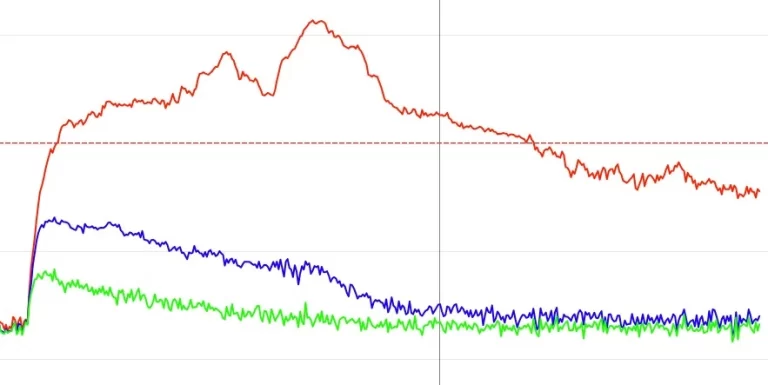
    Following an X1.9 flare and associated full-halo coronal mass ejection (CME) late on January 18, 2026, the ≥10 MeV proton flux rose above 100 pfu early on January 19. The event reached S2 – Moderate solar radiation storm levels, prompting extended warnings for continued elevated radiation conditions through the rest of the day.

  • m5.6 solar flare april 1 2025 f

    Solar radiation storm reaches S2 levels, strong M5.6 solar flare erupts from AR 4046

    ByTeo Blašković Tuesday, April 1, 2025Monday, May 4, 2026

    A strong M5.6 solar flare erupted from Active Region 4046 at 07:55 UTC on April 1, 2025, producing a 10cm radio burst but showing no signs of an associated coronal mass ejection (CME). Meanwhile, a solar radiation storm triggered by the X1.1 flare on March 28 reached the S2 – Moderate threshold at 02:05 UTC today.

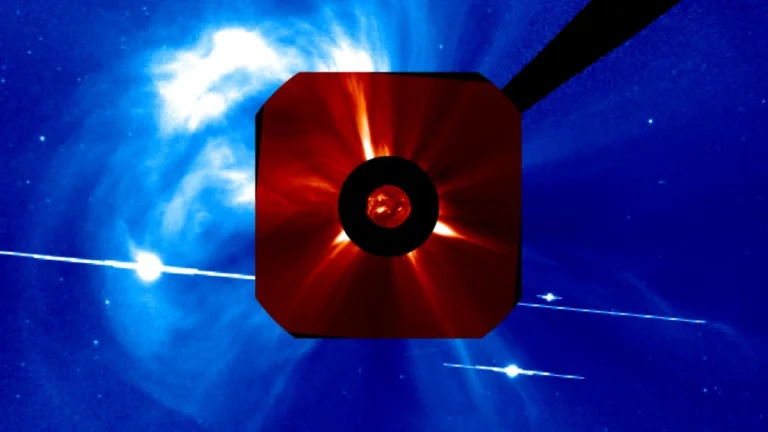
  • west limb eruption lasco c2 image 1912 utc and lasco c3 at 1906 utc november 21 2024

    Solar radiation storm reaches S2 – Moderate level following farside eruption

    ByTeo Blašković Friday, November 22, 2024Monday, May 4, 2026

    A strong solar flare erupted well beyond the west limb of the Sun at approximately 18:00 UTC on November 21, 2024. This event produced a large coronal mass ejection (CME) and sparked a solar radiation storm on Earth reaching S2 – Moderate levels on November 22.

  • X1.8 solar flare october 26 2024

    Solar radiation storm reaches S2 – Moderate levels following X1.8 flare on October 26

    ByTeo Blašković Sunday, October 27, 2024Monday, May 4, 2026

    A solar radiation storm reached S2 – Moderate levels on October 27, 2024, following a powerful X1.8 flare on October 26. Elevated levels of high-energy protons are expected to persist, potentially impacting high-altitude flights, satellite operations, and polar radio communications.

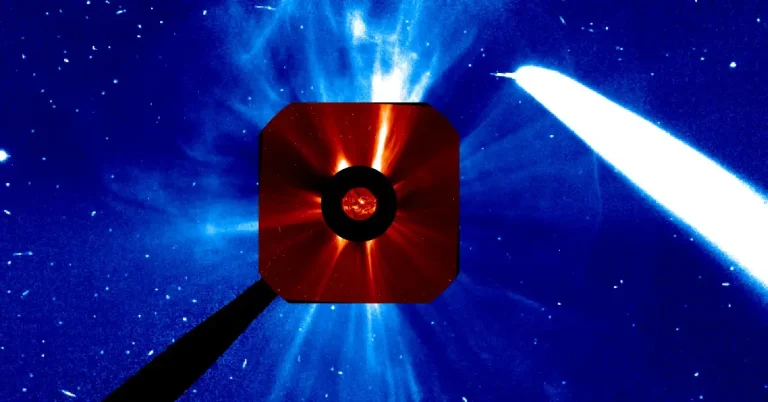
  • full halo cme produced by x1.8 solar flare on october 9 2024 with comet atlas

    Major X1.8 solar flare produces Earth-directed CME, impact expected late October 10

    ByTeo Blašković Wednesday, October 9, 2024Wednesday, October 9, 2024

    A major solar flare measuring X1.8 erupted from Earth-facing Active Region 3848 at 01:56 UTC on October 9, 2024. The event started at 01:25 and ended at 02:43 UTC. A fast-moving full halo coronal mass ejection (CME) was produced during the event, with the impact expected from late October 10 to early on October 11.

  • m9.7 solar flare cme june 8 2024 earth scale f

    Strong solar radiation storm in progress after M9.7 solar flare produced large CME

    ByTeo Blašković Saturday, June 8, 2024Monday, May 4, 2026

    A strong, long-duration solar flare measuring M9.7 erupted from Active Region 3697 at 01:49 UTC on June 8, 2024. The event started at 01:23 and ended at 02:19 UTC, producing a strong CME. Shortly after, solar radiation storming began on Earth, reaching the S3 – Strong threshold at 08:00 UTC.

  • S2 - Moderate solar radiation storm following M6.7 solar flare

    S2 – Moderate solar radiation storm following M6.7 solar flare

    ByTeo Blašković Tuesday, January 30, 2024Wednesday, September 25, 2024

    Following the M6.7 solar flare from Active Region 3559 on January 29, 2024, enhanced proton levels were recorded, with the greater than 10 MeV reaching the S2 – Moderate threshold and greater than 100 MeV peaking at 0.67 pfu.

  • The Watchers newsletter

    A daily email edition from The Watchers on earthquakes, eruptions, extreme weather and space weather.

    Sign up

    Latest articles

    On October 22, 2017, a single flash of lightning stretched 515 miles from eastern Texas to near Kansas City, a distance that takes eight hours to drive, and nobody realized how far it had gone until scientists went back through the satellite data years later

    November 19, 2026

    CPC posts a slight risk of heavy rain from the Gulf Coast to the Northeast urban corridor November 25-29, and a moderate risk of West Coast wind and Sierra snow on November 25

    November 18, 2026

    Florida’s east coast faces a moderate flash flood risk Wednesday through Friday, with 4 to 8 inches of rain forecast and the St. Johns River near Cocoa already in major flood at 17.13 feet

    November 18, 2026

    Cyclone Akvan to make landfall between Nellore and Visakhapatnam around noon on November 20, IMD forecasts 120-130 km/h winds gusting to 145

    November 18, 2026

    Radio pulses every 7.9 minutes reveal binary with white dwarf and Sun-like star

    November 18, 2026

    Hera begins close survey to explain why DART deflected Dimorphos so strongly

    November 18, 2026

    NASA’s STRIVE mission targets long-standing 3D observing gap in the upper atmosphere

    November 18, 2026

    From the same category

    Geomagnetic storms

    G1 geomagnetic storm watch remains in effect as NOAA forecasts Kp 4.67 late on November 17 and early on November 18

    November 17, 2026
    Space weather

    A tangled sunspot cluster about 93 million miles away doubled in size in a single weekend earlier this month and fired 20 solar flares in one day, and forecasters gave it a small chance of producing an X-class flare, the most powerful kind the Sun is known to unleash

    November 14, 2026
    Geomagnetic storms

    Northern lights are possible at high latitudes on November 17 and 18 as NOAA forecasts minor (G1) geomagnetic storms from coronal hole wind

    November 11, 2026
    Editors' picksGeomagnetic storms

    G2 geomagnetic storm forecast for October 9 as CME approaches Earth

    October 9, 2026

    Most read

    • 24 hours
    • 7 days
    • 30 days

    2 atmospheric rivers to bring heavy Sierra snow and California flood risk

    November 16, 2026

    US flights resume after FAA lifts nationwide ground stop that lasted more than four hours

    November 14, 2026

    Huge waves pummel California coast during strong El Niño, flooding streets and closing piers from Pacifica to San Diego

    November 16, 2026

    Florida’s east coast faces a moderate flash flood risk Wednesday through Friday, with 4 to 8 inches of rain forecast and the St. Johns River near Cocoa already in major flood at 17.13 feet

    November 18, 2026

    G1 geomagnetic storm watch remains in effect as NOAA forecasts Kp 4.67 late on November 17 and early on November 18

    November 17, 2026

    Kīlauea’s north vent threw lava about 660 feet (200 m) high for six hours on 5 November 2026; the summit is now reinflating, with the next episode forecast for 16 to 21 November.

    November 14, 2026

    Cyclone Akvan to make landfall between Nellore and Visakhapatnam around noon on November 20, IMD forecasts 120-130 km/h winds gusting to 145

    November 18, 2026

    Record tides flood California coast as Huntington Beach declares emergency and warnings persist

    October 30, 2026

    AI cyclone model gains at least a day of forecast lead time against leading operational models

    November 5, 2026

    2 atmospheric rivers to bring heavy Sierra snow and California flood risk

    November 16, 2026

    Flood watches cover the Southwest ahead of a Four Corners heavy-rainfall event, U.S.

    October 30, 2026

    Florida declares emergency after catastrophic flooding in southern Brevard County

    November 3, 2026

    US flights resume after FAA lifts nationwide ground stop that lasted more than four hours

    November 14, 2026

    Kīlauea episode 56 ends abruptly after nearly 6 hours of lava fountaining, Hawaii

    November 6, 2026

    • About us
    • Contact us
    • Updates & announcements
    • Terms & conditions
    • Privacy policy
    • Cookie policy
    • Editorial policy
    • Advertise
    • Support
    RSS X Facebook Telegram YouTube

    The Watchers — Watching the world evolve and transform

    Except where otherwise noted, content on this site is licensed under a Creative Commons Attribution-NonCommercial 4.0 International License - 2026

    Lost your password?


    Don't have an account yet? Sign up


    The Watchers
    Categories
    Earth
    Earthquakes Volcanoes Tsunami Landslides SinkholesSevere storms Tropical cyclones Tornadoes Blizzards Heat wavesFloods Drought Wildfires Avalanches Ice & snowView all Earth →
    Space
    Comets and asteroids Near-Earth Objects Meteor activity Night SkyView all Space →
    Space weather
    Solar activity Geomagnetic storms Solar radiation stormsView all Space weather →
    Epicenter
    Monitoring tools
    watchers.LIVE Near real-time hazard monitoring SWX Space weather monitoring SAM Seismic activity monitoring StormWall Severe weather video layer
    Get involved
    Report an event Report an event Share local event information with our editors. › Support Watchers Support Watchers Support our monitoring and reporting work. ›
    Email RSS X Facebook Telegram YouTube
    Search