Hawai’i’s two most active volcanoes share a common magma source
Volcanologists reporting in Oxford’s Academic Journal of Petrology have confirmed that the Kīlauea and Mauna Loa volcanoes share a deep magma source within the Hawaiian plume.


Volcanologists reporting in Oxford’s Academic Journal of Petrology have confirmed that the Kīlauea and Mauna Loa volcanoes share a deep magma source within the Hawaiian plume.

The eruption at Kilauea volcano’s summit resumed at 09:15 LT (19:15 UTC) on January 15, 2025, with lava flowing from the 2 north vents at Halema’uma’u summit. It marks the fourth eruptive episode since December 23, 2024.
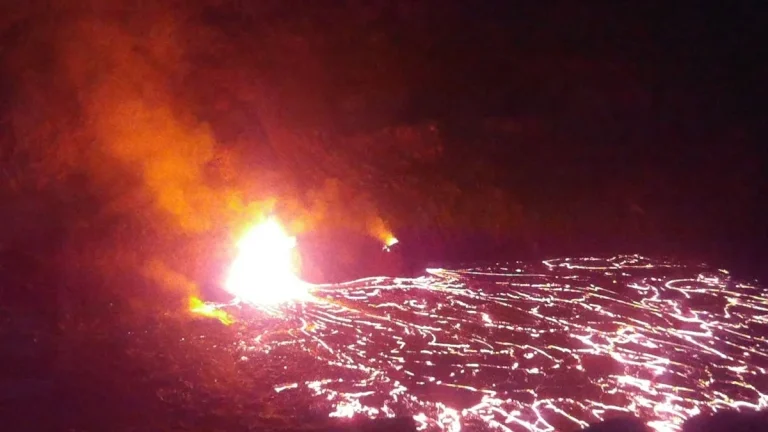
Volcanic activity at Kilauea transitioned to a more vigorous phase at 04:00 UTC on December 29, 2024, with lava fountains rising 20 to 30 m (60 to 100 feet) high and covering 20% of the Halema’uma’u floor.
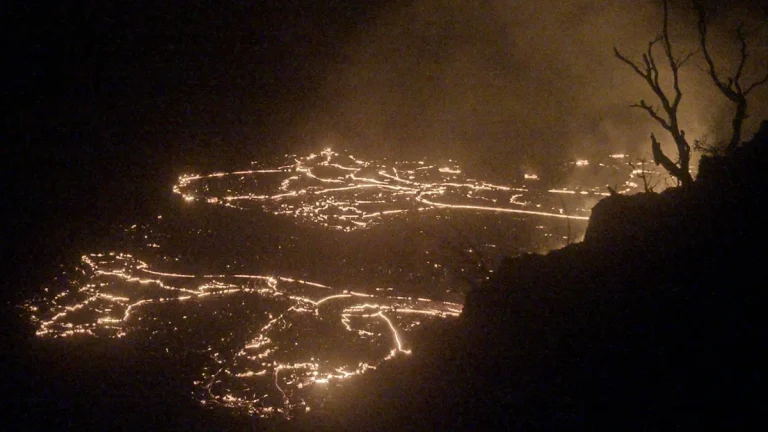
Kilauea volcano in Hawai’i has resumed its eruptive activity after a second pause on December 26, 2024, with lava flows confined to the Halema’uma’u region. Park officials urged caution after a toddler narrowly avoided a fatal fall from a 120 m (400 feet) cliff while visiting the site on December 23.

A new eruption at Kilauea volcano led the USGS to raise the Aviation Color Code to Red and the Volcano Alert Level to Warning on Monday, December 23, 2024. The eruption is occurring within a closed area of Hawai’i Volcanoes National Park.

Increased seismic activity has been recorded at Kilauea volcano over the past week, with an increase from 10 located events per day to 20 per day.

A new volcanic eruption is taking place in a remote and closed area of Hawai’i Volcanoes National Park, west of Kilauea’s Nāpau Crater in the middle East Rift Zone.

Magma intrusion began in Kīlauea’s Middle East Rift Zone on September 15, 2024, increasing the potential for an eruption in this region. As a result, the USGS Hawaiian Volcano Observatory raised the Volcano Alert Level from Advisory to Watch and the Aviation Color Code from Yellow to Orange on September 16.

Earthquake activity has increased in Kīlauea’s middle East Rift Zone, near Makaopuhi rater at around 02:00 UTC, on Sunday, September 15, 2024. At the same time, ground deformation patterns west (uprift) of Puʻuʻōʻō suggest that another intrusive event could be occurring in this region.

Increased earthquake activity and ground deformation at Kīlauea’s upper East Rift Zone began at approximately 13:30 UTC (03:30 HST) on July 23, 2024, indicating likely magma movement in the subsurface. This activity has prompted Hawaiʻi Volcanoes National Park to close areas that could put visitors and staff at risk if the volcano erupts.
