
Preseismic electromagnetic signals recorded before Nepal earthquake on November 3, 2023
Electromagnetic signals lasting up to 70 seconds were detected before an M6.4 earthquake struck western Nepal on November 3, 2023. Researchers operating magnetotelluric stations in the Ganga Basin have described this as an important observation in earthquake precursor studies.
Image credit: The Watchers
- Researchers detected preseismic electromagnetic signals 70 seconds and 43 seconds before the M6.4 Nepal earthquake on November 3, 2023, using magnetotelluric systems in the Ganga Basin.
- Amplified surface wave-induced electromagnetic fields were observed within the Sharda Depression due to its thick sedimentary layers, revealing the influence of geological heterogeneities.
- The study marks the first reporting of consistent preseismic electromagnetic signals in time series data, offering the potential for advancements in earthquake precursor research.
Researchers from CSIR-National Geophysical Research Institute (CSIR-NGRI) in Hyderabad, India, studying electromagnetic (EM) signals in seismically active zones reported preseismic electromagnetic signals preceding the M6.4 earthquake in western Nepal on November 3, 2023.
The signals were detected by long-period magnetotelluric (LMT) systems stationed in the Ganga Basin, approximately 150 to 250 km (93 to 155 miles) from the epicenter. The findings also encompass the coseismic electromagnetic perturbations recorded during the earthquake and its main aftershock on November 6.
“This is probably the first reporting of such preseismic electromagnetic signals in MT time series,” according to the researchers.
Electromagnetic signals before the earthquake
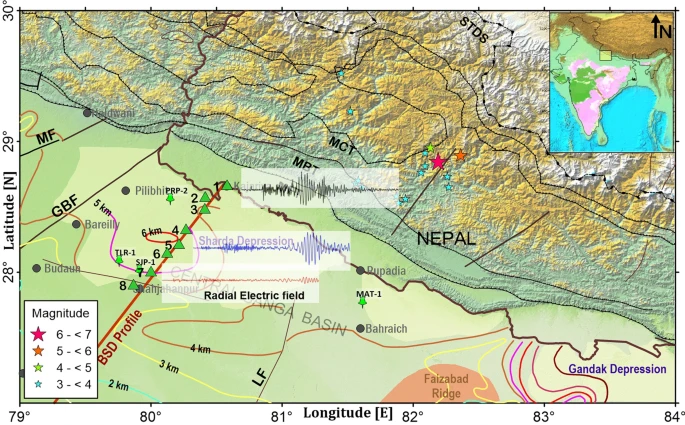
The LMT stations recorded 2 distinct peaks in the electric field 70 seconds and 43 seconds before the earthquake’s origin time of 18:02:54 UTC.
The signals characterized by amplitudes ranging from −0.07 to +0.11 µV/m and −0.04 to +0.07 µV/m were detected consistently across 6 stations. The signals were absent from magnetic field records likely because of background noise.
Researchers inferred that these signals likely originated from fast-propagating EM waves during the final stages of fault zone preparation. The simultaneous detection at multiple stations indicates their probable association with the source zone.
Coseismic electromagnetic perturbations
During the main earthquake and the subsequent M5.6 aftershock on November 6, researchers observed distinct coseismic electromagnetic (CoSEM) perturbations. The electric field signals mimicked seismic wave patterns, displaying clear P, S, and surface wave arrivals. The maximum amplitudes recorded for the electric field during the main event ranged from ±1 µV/m at sites approximately 150 km (93 miles) from the epicenter.
Surface wave amplification was observed at stations located within the Sharda Depression, a region characterized by thick sedimentary layers. Stations at the southern edge of the depression recorded reduced amplitudes.
Role of geological heterogeneities
Geological variations along the Ganga Basin influenced the recorded EM signals. The Sharda Depression, with sedimentary layers extending to depths of 36 km (22 miles), amplified surface wave-induced electric fields. The findings align with earlier geoelectric models indicating high conductivity in the region.
“The amplification and decrease in the surface wave amplitudes within and at the edge of the Sharda Depression highlight the role of geological heterogeneities in controlling the CoSEM induction,” researchers noted.
Data collection and analysis
The LMT systems deployed in the Ganga Basin consisted of advanced data acquisition units, fluxgate magnetometers, and non-polarizing electrodes. Time series data were recorded at an 8 Hz sampling frequency and processed using detrending, bandpass filtering, and rotation into radial and transverse components. The rotation enabled the identification of seismic wave arrivals in EM signals.
Spectrogram analysis revealed distinct power spectral density (PSD) patterns corresponding to the seismic phases. Researchers observed the dispersion effect of surface waves at stations further from the epicenter, attributed to the thick sedimentary layers of the Ganga Basin.
Aftershock observations
The M5.6 aftershock on November 6 generated weaker CoSEM signals compared to the main earthquake. Electric field amplitudes were approximately five times lower, consistent with the reduction in earthquake magnitude. Magnetic field signals were not discernible above the background noise.
The detection of preseismic EM signals offers the potential for advancing earthquake precursor studies. While these signals were prominent in the electric field data, their absence in magnetic records shows the need for improved noise reduction techniques. The researchers propose exploring advanced statistical and wavelet-based methods to enhance signal extraction from magnetic time series.
“This study opens new avenues for understanding the physical processes leading to earthquake nucleation and exploring their potential for earthquake prediction,” the researchers concluded.
References:
1 Pre- and coseismic electromagnetic signals of the Nepal earthquake of 03 november 2023, Ajay Manglik, M. Suresh, M. Demudu Babu & G. Pavankumar, Springer Open – December 26, 2024 – https://doi.org/10.1186/s40623-024-02108-2 – OPEN ACCESS

Rishika holds a Master’s in International Studies from Stella Maris College, Chennai, India, where she earned a gold medal, and an MCA from the University of Mysore, Karnataka, India. Previously, she served as a Research Assistant at the National Institute of Advanced Studies, Indian Institute of Science, Bengaluru, India. During her tenure, she contributed as a Junior Writer for Europe Monitor on the Global Politics website and as an Assistant Editor for The World This Week. Her work has also been published in The Hindu newspaper, showing her expertise in global affairs. Rishika is also a recipient of the Women Empowerment Award at the district level in Haryana, India, in 2022.

Commenting rules and guidelines
We value the thoughts and opinions of our readers and welcome healthy discussions on our website. In order to maintain a respectful and positive community, we ask that all commenters follow these rules.