
Hear the sound of BepiColombo flying past Mercury
ESA/JAXA BepiColombo mission’s 6th and final Mercury flyby took place at 05:59 UTC on January 8, 2025, passing just 295 km (183 miles) above the planet’s surface.
While space is silent, instruments aboard the spacecraft recorded data that mission teams converted into audible frequencies, allowing us to “hear” the flyby in a newly released recording. This encounter adjusted the spacecraft’s speed and trajectory in preparation for orbital insertion in late 2026, while also capturing new data on Mercury’s surface and environment.
The BepiColombo mission of the European Space Agency (ESA) and Japan Aerospace Exploration Agency (JAXA) has completed its 6th and final Mercury flyby, passing just 295 km (183 miles) above the planet’s surface at 05:59 UTC on January 8. The maneuver adjusted the spacecraft’s speed and trajectory and positioned it for orbital insertion in late 2026.
The spacecraft captured detailed images of Mercury’s surface and focused on shadowed polar craters and volcanic plains. Josef Aschbacher, ESA Director General, presented the 1st image from the flyby during the Annual Press Briefing on January 9.
Final gravity assist and imaging of Mercury’s surface
BepiColombo, a collaboration between ESA and JAXA, is on an eight-year journey to Mercury. It has conducted 9 planetary flybys, one at Earth, 2 at Venus, and 6 at Mercury.
The latest flyby notes the last close approach before the spacecraft’s transfer module separates from its scientific orbiters.
“We can’t wait to see what BepiColombo will reveal during this sixth and final flyby of Mercury. While we’re still two years away from the mission’s main science phase, we expect this encounter to provide us with beautiful images and important scientific insights into the least-explored terrestrial planet,” Geraint Jones, ESA’s BepiColombo Project Scientist, said.
BepiColombo passed over Mercury’s night side before emerging into the sunlight at (06:06 UTC). Its cameras captured images of polar craters including Prokofiev, Kandinsky, Tolkien, and Gordimer. The regions are some of the coldest in the Solar System, with temperatures dropping to -190 °C (-310 °F) despite Mercury being the closest planet to the Sun.
Previous studies suggest that frozen water may exist in these permanently shadowed regions which remains a hypothesis that BepiColombo will investigate further once in orbit.
Navigating through Mercury’s shadow and extreme temperatures
Mercury’s shadow poses operational challenges because of the lack of sunlight.
BepiColombo remained in complete darkness for 23 minutes and relied solely on its batteries. ESA’s European Space Operations Centre (ESOC) mission controllers preheated the spacecraft to conserve power during this eclipse.
“This is the first time BepiColombo stays in the shadow of Mercury for so long. We have fully charged its batteries and raised the temperature of all components. From ESA’s mission control center, we will keep a close watch on the battery status and the temperature of all systems during the flyby,” Ignacio Clerigo, BepiColombo’s Spacecraft Operations Manager said.
During the eclipse, the Italian Spring Accelerometer (ISA) recorded changes in acceleration because of Mercury’s gravity, solar radiation, and thermal shifts. The data collected will help refine models of Mercury’s gravitational environment.
Investigating Mercury’s surface and geological features
The spacecraft’s monitoring camera 1 (M-CAM 1) captured images of Borealis Planitia, a vast volcanic plain formed by lava flows approximately 3.7 billion years ago. Surface features such as the Henri and Lismer craters shaped by lava floods were observed.
The Caloris Basin, Mercury’s largest impact crater at over 1 500 km (932 miles) in diameter was also imaged.
A bright lava deposit within the basin raises questions about its origin and movement which will be explored in BepiColombo’s primary mission phase.
Monitoring Camera 2 (M-CAM 2) provided images of the Nathair Facula which is a bright deposit spanning 300 km (186 miles) and is linked to a volcanic explosion. The nearby Fonteyn crater, formed about 300 million years ago, was also observed.
These features contribute to understanding Mercury’s geological history and its formation processes.
Exploring Mercury’s magnetosphere and plasma environment
BepiColombo’s flyby provided a unique opportunity to study Mercury’s magnetosphere.
The spacecraft traversed unexplored regions including the planet’s magnetic tail and northern cusp where charged particles from the Sun interact with Mercury’s magnetic field.
2 particle analyzers, Search for Exospheric Refilling and Emitted Natural Abundances (SERENA) and Mercury Plasma Particle Experiment (MPPE), measured the composition and distribution of charged particles in these regions.
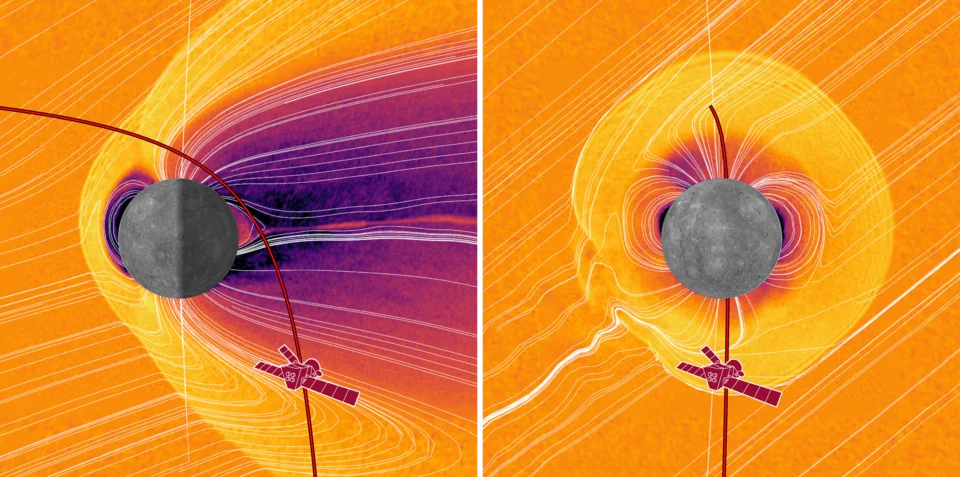
The Mercury Planetary Orbiter Magnetometer (MPO-MAG) and Mercury Magnetospheric Orbiter Magnetometer (MMO-MGF) magnetometers recorded fluctuations in Mercury’s magnetic field while the dust monitor (MDM) detected micrometeoroid impacts.
Mission overview and plans
BepiColombo was launched on October 20, 2018, aboard an Ariane 5 rocket from Europe’s Spaceport.
The mission consists of ESA’s Mercury Planetary Orbiter (MPO) and JAXA’s Mercury Magnetospheric Orbiter (Mio), both carried by the European-built Mercury Transfer Module (MTM).
The spacecraft is scheduled to enter Mercury’s orbit in late 2026 with science operations beginning in early 2027. The mission will last at least one year with a potential extension.
The flyby history includes Earth on April 10, 2020. The Venus flybys occurred on October 15, 2020, and August 10, 2021. The Mercury flybys occurred on October 1, 2021, June 23, 2022, June 19, 2023, September 4, 2024, December 1, 2024, and January 8, 2025.
The scientific goals include investigating Mercury’s polar craters for evidence of water ice and studying its magnetic field along with interactions with solar wind. The mission aims to analyze the planet’s surface composition and geological history. It also seeks to examine Mercury’s internal structure and core properties.
References:
1 Top three images from BepiColombo’s sixth Mercury flyby – ESA – January 9, 2025
2 BepiColombo – ESA – Accessed on January 24, 2025
3 BepiColombo to swing by Mercury for the sixth time – ESA – January 6, 2025
Featured image: BepiColombo’s flyby on January 8, 2025. Credit: ESA

Rishika holds a Master’s in International Studies from Stella Maris College, Chennai, India, where she earned a gold medal, and an MCA from the University of Mysore, Karnataka, India. Previously, she served as a Research Assistant at the National Institute of Advanced Studies, Indian Institute of Science, Bengaluru, India. During her tenure, she contributed as a Junior Writer for Europe Monitor on the Global Politics website and as an Assistant Editor for The World This Week. Her work has also been published in The Hindu newspaper, showing her expertise in global affairs. Rishika is also a recipient of the Women Empowerment Award at the district level in Haryana, India, in 2022.

Commenting rules and guidelines
We value the thoughts and opinions of our readers and welcome healthy discussions on our website. In order to maintain a respectful and positive community, we ask that all commenters follow these rules.