
First evidence of helical magnetic field in HH 80-81 protostellar jets
Scientists reported the first-ever evidence of a helical magnetic field within HH 80-81 protostellar jet, using data from the Karl G. Jansky Very Large Array (VLA). It is the first time a Rotation Measure (RM) analysis has been performed on a protostellar jet.
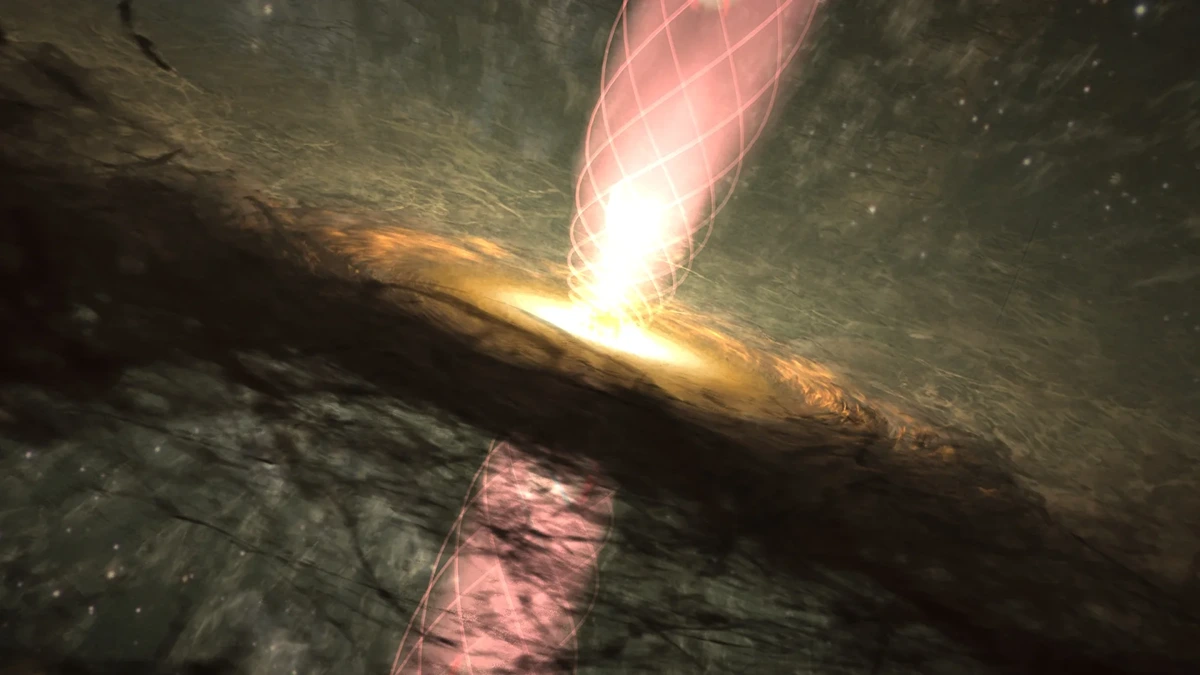
Artistic view of a protostar driving a bipolar jet within a helical magnetic field. Image credit: Wolfgang Steffen, UNAM
- Researchers using the National Science Foundation’s Karl G. Jansky Very Large Array (NSF VLA) have provided the first-ever 3D visualization of a magnetic field in the HH 80-81 protostellar jet showing its helical structure.
- The study confirms that helical magnetic fields play an important role in collimating jets by reinforcing their universality across different astrophysical systems.
- Advanced RM analysis enabled a detailed understanding of the jet’s magnetic field and revealed both toroidal and poloidal components intrinsic to the jet disk system.
The first 3D visualization of a magnetic field within an HH 80-81 protostellar jet has been provided by a team of astronomers led by Adriana Rodríguez-Kamenetzky and Alice Pasetto. The study was conducted at the Institute of Theoretical and Experimental Astronomy (IATE), the Argentinian National Scientific and Technical Research Council, and the National University of Cordoba (CONICET-UNC).
Protostellar jets are powerful streams of matter and energy and are common in systems involving accretion around central objects such as young stars and supermassive black holes. The collimation mechanism for these jets has remained elusive despite being observed at different scales.
The observations of an HH 80-81 jet are powered by a massive protostar and provide conclusive evidence of a helical magnetic field which is a phenomenon previously observed in jets from galaxies with supermassive black holes.
“This is the first solid evidence that helical magnetic fields can explain astrophysical jets at different scales, supporting universality of the collimation mechanism,” Adriana Rodriguez-Kamenetzky, the lead researcher of the study said.
The research was conducted using the upgraded NSF VLA with observations going up to 4 sessions in November and December 2018. The researchers observed the HH 80-81 jet at centimeter wavelengths (4 to 8 GHz) in full polarization mode and accumulated 20 hours of data. The HH 80-81 jet is a highly collimated outflow powered by a massive young star located approximately 1 200 to 1 400 parsecs (3 900 to 4 570 light years) away in the Milky Way.
A detailed Rotation Measure (RM) analysis was applied to reveal the 3D magnetic field structure within the jet.
Study design and observational techniques
The HH 80-81 jet is associated with the massive protostar Infrared Astronomical Satellite (IRAS 18162-2048) and was observed for 20 hours using the NSF VLA.
Data was collected in November and December 2018 and focused on the 4 to 8 Gigahertz (GHz) frequency range. Researchers employed advanced Rotation Measure (RM) analysis to correct for Faraday rotation effects and allowed them to map the jet’s true magnetic field configuration.
The observational process involved calibrating data with the Common Astronomy Software Applications (CASA) software package which incorporated polarization calibration.
Imaging was conducted to capture the jet’s polarized emission and derive Stokes parameters (I, Q, and U) for each spectral window. Researchers performed a rotation measure analysis to determine the intrinsic polarization vectors and magnetic field orientation by examining wavelength-dependent variations in polarization angle and intensity.
Evidence of a helical magnetic field
The analysis revealed a helical magnetic field structure in the HH 80-81 jet. Such fields result from the interplay of poloidal and toroidal magnetic components generated by the rotation of the protostar’s accretion disk.
Observed RM gradients
The team observed transverse RM gradients across the jet and its counterjet.
The gradients show the existence of a toroidal magnetic field which aligns with theoretical models explaining how jets are focused and guided.
Magnetic field strength and configuration
The researchers estimated a line-of-sight magnetic field strength of approximately 0.1 milligauss (mG) using RM values ranging from 200 to 500 radians per square meter (rad m-2). The value aligns with the plane-of-sky magnetic field strength derived from energy equipartition and further supports the helical configuration.
“For the first time, we were able to study the 3D configuration of the magnetic field in a protostellar jet,” Alice Pasetto, professional astronomer and researcher specializing in astrophysics from Institute of Radio Astronomy and Astrophysics (IRyA) at the National Autonomous University of Mexico (UNAM) said.
Comparison with extragalactic jets
Jets from active galactic nuclie (AGNs) often show faint counterjets because of Doppler boosting but protostellar jets like HH 80-81 make it possible to observe both the jet and counterjet at the same time. It allowed the researchers to verify that the helical magnetic field originates within the jet-disk system itself and is not affected by the surrounding medium.
“Back in 2010, we used VLA to detect non-thermal emission and the presence of a magnetic field, but we couldn’t study its 3D structure,” Carlos Carrasco-González, a co-author of the study, remarked.
Implications for universal jet collimation
The findings strongly suggest that helical magnetic fields play a universal role in the collimation of astrophysical jets across different scales.
Similar structures have been observed in jets from supermassive black holes which indicates a common underlying mechanism.

The study shows the potential of next-generation instruments like the Square Kilometre Array (SKA) and the Next Generation Very Large Array (ngVLA) to further investigate magnetic fields in jets.
Such advancements will enable higher-resolution studies of smaller-scale magnetic fields near protostars and other jet-producing objects.
References:
1 Helical Magnetic Field in a Massive Protostellar Jet – A. Rodríguez-Kamenetzky, A. Pasetto, C. Carrasco-González, et. al., The Astrophysical Journal Letters, January 7, 2025 – https://doi.org/10.3847/2041-8213/ad9b26 – OPEN ACCESS

Rishika holds a Master’s in International Studies from Stella Maris College, Chennai, India, where she earned a gold medal, and an MCA from the University of Mysore, Karnataka, India. Previously, she served as a Research Assistant at the National Institute of Advanced Studies, Indian Institute of Science, Bengaluru, India. During her tenure, she contributed as a Junior Writer for Europe Monitor on the Global Politics website and as an Assistant Editor for The World This Week. Her work has also been published in The Hindu newspaper, showing her expertise in global affairs. Rishika is also a recipient of the Women Empowerment Award at the district level in Haryana, India, in 2022.

Commenting rules and guidelines
We value the thoughts and opinions of our readers and welcome healthy discussions on our website. In order to maintain a respectful and positive community, we ask that all commenters follow these rules.