
Detection of most energetic neutrino ever indicates new type of high-energy astrophysical source
The most energetic neutrino ever observed was detected by the KM3NeT neutrino observatory in the Mediterranean Sea, estimated at 220 PeV (220 x 1015 electron volts or 220 million billion electron volts). The event, designated KM3-230213A, challenges existing cosmic ray models and may indicate a new type of high-energy astrophysical source.
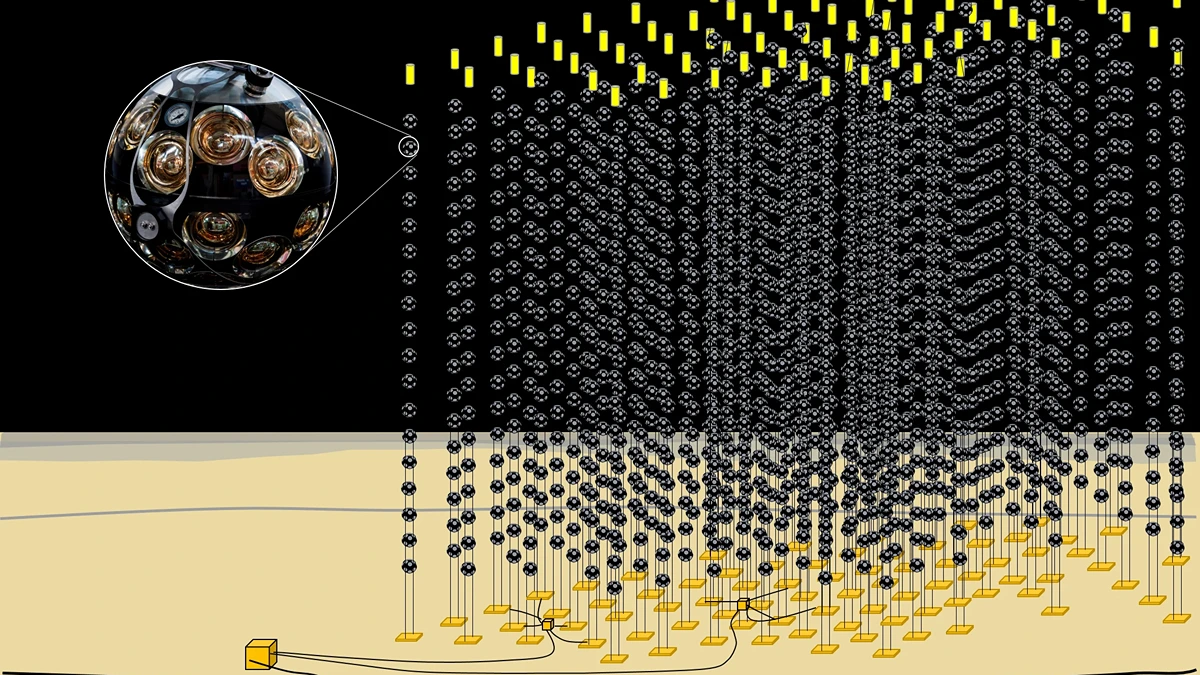
An artist's impression of the KM3NeT deep-sea neutrino observatory, located in the Mediterranean. The vertical detection lines, equipped with digital optical modules (DOMs), capture Cherenkov radiation emitted by high-energy neutrinos interacting with water molecules. Image credit: KM3NeT Collaboration
- KM3NeT detected the most energetic neutrino ever observed, with an estimated energy of 220 PeV, surpassing all previous detections in high-energy neutrino astrophysics.
- No known gamma-ray or optical sources were identified in the region of origin, raising questions about whether this neutrino came from an extreme cosmic accelerator or an entirely new astrophysical process.
- Ongoing improvements to KM3NeT’s detector calibration and coordination with gamma-ray, radio, and gravitational wave observatories aim to refine energy estimates and pinpoint the source of ultra-high-energy neutrinos.
KM3-230213A, the highest-energy neutrino ever recorded, was detected on February 13, 2023, by the ARCA detector of the KM3NeT observatory, located offshore Sicily, Italy. This neutrino had an estimated energy of 220 petaelectronvolts (PeV), or 220 x 1015 electron volts. This surpasses previous records and provides new insights into high-energy cosmic events.
“The detection of this neutrino represents a breakthrough in our understanding of ultra-high-energy particles and their cosmic origins,” said the research team from KM3NeT, the deep-sea neutrino observatory in the Mediterranean Sea.
KM3NeT (Cubic Kilometer Neutrino Telescope) consists of two primary detector arrays, ARCA, optimized for high-energy cosmic neutrino detection, and ORCA, dedicated to neutrino oscillation studies.
The ARCA detector is located 3 450 m (11 320 feet) underwater near Portopalo di Capo Passero, Sicily, while ORCA operates at a depth of 2 450 m (8 038 feet) offshore Toulon, France.
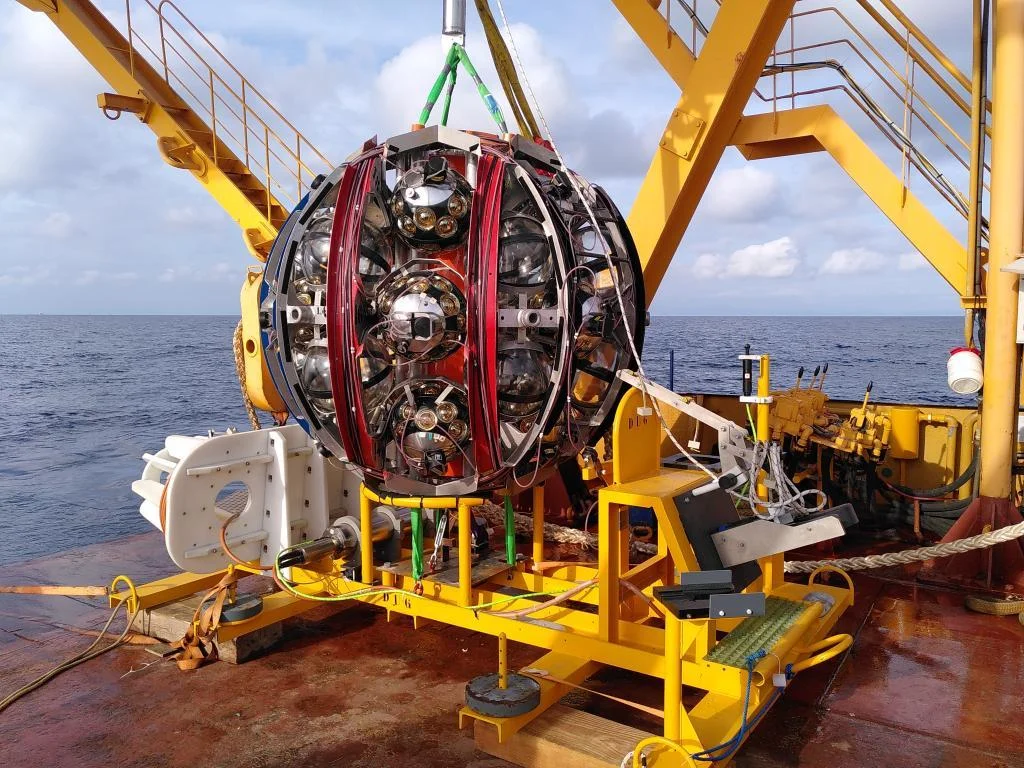
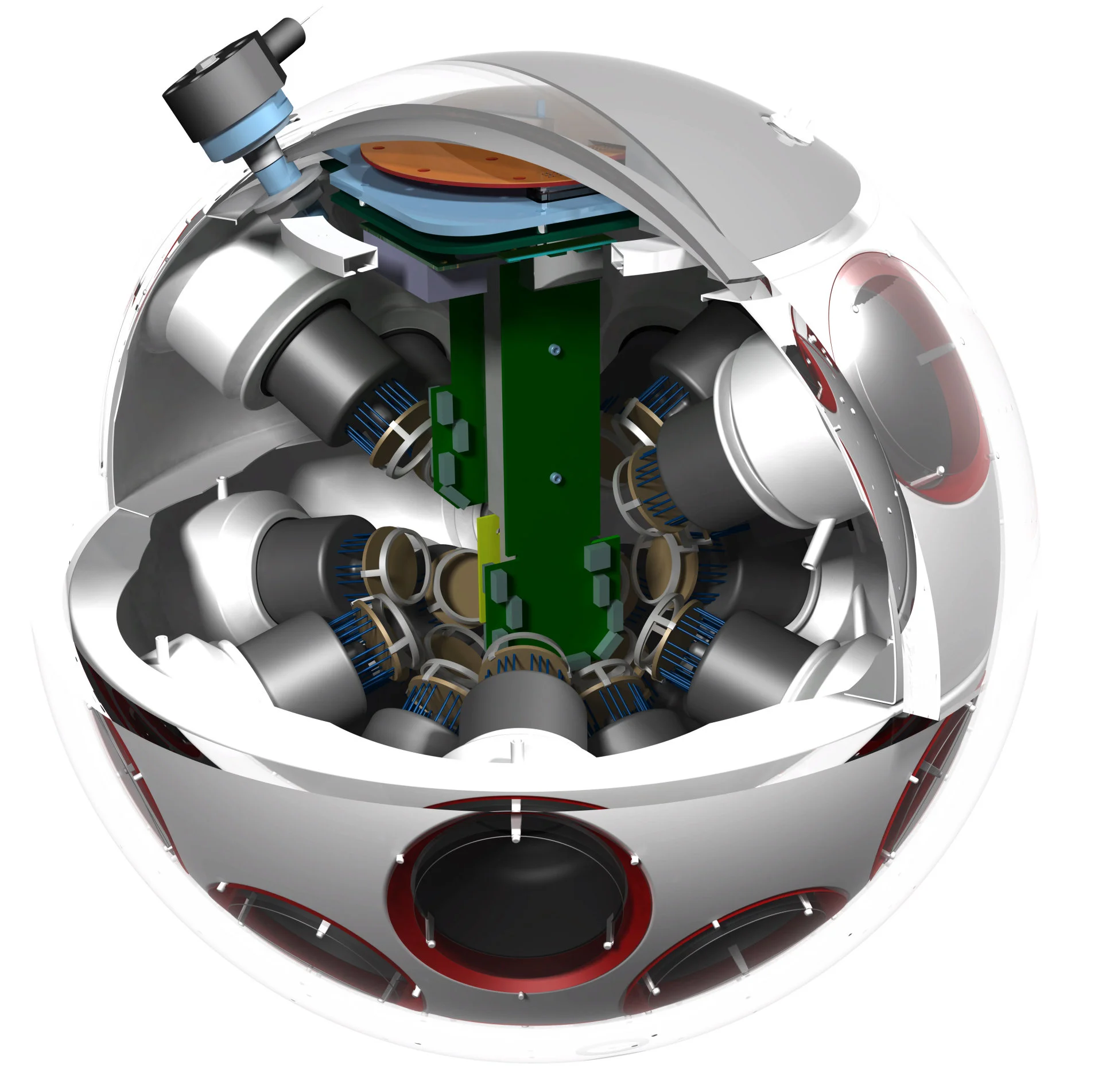
When fully operational, KM3NeT will comprise 345 vertical detection lines, each containing 18 optical modules equipped with 31 photomultiplier tubes (PMTs), ensuring near-complete 4π coverage.
KM3-230213A event
A total of 28 086 hits were recorded by 21 active detection lines at the time, with the trajectory estimated at 0.6° above the horizon and an azimuth of 259.8°.
The high-energy muon traveled several hundred meters through the detector, losing energy through bremsstrahlung, pair production, and photonuclear reactions. The interactions generated electromagnetic cascades, producing Cherenkov radiation detected by KM3NeT’s photomultiplier tubes (PMTs).
“KM3NeT has begun to probe a range of energy and sensitivity where detected neutrinos may originate from extreme astrophysical phenomena. This first-ever detection of a neutrino of hundreds of PeV opens a new chapter in neutrino astronomy and a new observational window on the Universe,” said Paschal Coyle, KM3NeT Spokesperson at the time of the detection, and researcher at CNRS Centre National de la Recherche Scientifique – Centre de Physique des Particules de Marseille, France.
Muon energy estimation, based on PMT triggers and Monte Carlo simulations, suggested an energy range of 35 to 380 PeV, with a median of 220 PeV. The parent neutrino’s energy likely exceeded this, estimated between 72 PeV and 2.6 exaelectronvolts (EeV).
Cosmic neutrino or atmospheric background?
Identifying the origin of KM3-230213A required distinguishing between cosmic and atmospheric neutrinos.
“To determine the direction and energy of this neutrino required a precise calibration of the telescope and sophisticated track reconstruction algorithms. Furthermore, this remarkable detection was achieved with only one-tenth of the final configuration of the detector, demonstrating the great potential of our experiment for the study of neutrinos and for neutrino astronomy,” said Aart Heijboer, KM3NeT Physics and Software Manager at the time of the detection, and researcher at Nikhef National Institute for Subatomic Physics, The Netherlands.
Cosmic neutrinos result from interactions of ultra-relativistic cosmic-ray protons or nuclei with interstellar material or photons, while atmospheric neutrinos emerge from cosmic-ray interactions in Earth’s upper atmosphere.
Given that an atmospheric muon would have needed to traverse approximately 300 km (186.4 miles) of rock, far exceeding the known range of 60 km (37.28 miles), it was deemed improbable that the observed event originated from an atmospheric source.
The expected flux of atmospheric neutrinos at PeV energies is extremely low, with statistical modeling suggesting a negligible probability of an atmospheric origin.
The potential source of the neutrino
The arrival direction of KM3-230213A places it near the Orion molecular clouds, but no known gamma-ray or TeV sources have been identified in its vicinity. Searches in major astronomical catalogs, including Fermi-LAT and TeVCat, found no clear counterpart.
Possible astrophysical sources include active galactic nuclei (AGNs), gamma-ray bursts (GRBs), and tidal disruption events (TDEs).
“Neutrinos are one of the most mysterious of elementary particles. They have no electric charge, almost no mass and interact only weakly with matter. They are special cosmic messengers, bringing us unique information on the mechanisms involved in the most energetic phenomena and allowing us to explore the farthest reaches of the Universe,” explains Rosa Coniglione, KM3NeT Deputy-Spokesperson at the time of the detection, researcher at the INFN National Institute for Nuclear Physics, Italy.
AGNs, with their supermassive black holes and powerful jets, are known to accelerate particles to extreme energies. GRBs, though transient, are capable of producing high-energy neutrinos. TDEs, occurring when a star is disrupted by a black hole, could also generate ultra-high-energy neutrinos.
Another intriguing hypothesis is that KM3-230213A is a cosmogenic neutrino produced when ultra-high-energy cosmic rays interact with background photons such as the cosmic microwave background (CMB). If confirmed, this event would provide evidence of cosmic-ray interactions beyond our local universe.
Comparison with previous observations
The highest-energy neutrinos before this detection were observed by the IceCube Neutrino Observatory in Antarctica, with its most energetic event reaching 6.05 ± 0.72 PeV.
The detection of KM3-230213A surpasses previous records indicating either a new class of cosmic accelerator or gaps in existing models of high-energy neutrino production.
KM3NeT uses deep-sea water as its detection medium, unlike IceCube, which operates within Antarctic ice. The superior optical clarity of seawater allows for enhanced angular resolution, improving the ability to pinpoint neutrino sources.
Future investigations
Efforts to refine the trajectory and energy estimations of KM3-230213A are ongoing, with upgrades to KM3NeT’s orientation and positioning systems expected to improve accuracy. Multi-messenger studies, integrating gamma-ray, X-ray, and gravitational wave observations, may provide further data into its origin.
If more ultra-high-energy neutrinos are detected in the future, it could confirm the existence of previously unknown cosmic accelerators or validate theories about cosmogenic neutrinos.
As KM3NeT expands, its increasing sensitivity will enhance our ability to study the most energetic astrophysical events, further advancing our understanding of the extreme physics governing the universe.
“The scale of KM3NeT, eventually encompassing a volume of about one cubic kilometer with a total of about 200 000 photomultipliers, along with its extreme location in the abyss of the Mediterranean Sea, demonstrates the extraordinary efforts required to advance neutrino astronomy and particle physics,” said Miles Lindsey Clark, KM3NeT Technical Project Manager at the time of the detection, and research engineer at the CNRS – Astroparticle and Cosmology laboratory, France.
“The detection of this event is the result of a tremendous collaborative effort between many international teams of engineers, technicians and scientists.”
References:
1 Observation of an ultra-high-energy cosmic neutrino with KM3NeT, The KM3NeT Collaboration, nature – February 12, 2025 – https://doi.org/10.1038/s41586-024-08543-1 – OPEN ACCESS
2 KM3NeT detects the highest energy neutrino ever observed – KM3NeT – February 12, 2025

Rishika holds a Master’s in International Studies from Stella Maris College, Chennai, India, where she earned a gold medal, and an MCA from the University of Mysore, Karnataka, India. Previously, she served as a Research Assistant at the National Institute of Advanced Studies, Indian Institute of Science, Bengaluru, India. During her tenure, she contributed as a Junior Writer for Europe Monitor on the Global Politics website and as an Assistant Editor for The World This Week. Her work has also been published in The Hindu newspaper, showing her expertise in global affairs. Rishika is also a recipient of the Women Empowerment Award at the district level in Haryana, India, in 2022.

Commenting rules and guidelines
We value the thoughts and opinions of our readers and welcome healthy discussions on our website. In order to maintain a respectful and positive community, we ask that all commenters follow these rules.