I'm a dedicated researcher, journalist, and editor at The Watchers. With over 20 years of experience in the media industry, I specialize in hard science news, focusing on extreme weather, seismic and volcanic activity, space weather, and astronomy, including near-Earth objects and planetary defense strategies. You can reach me at teo /at/ watchers.news.

  • Shallow M5.6 earthquake hits Gilgit-Baltistan region, Pakistan

    A shallow earthquake registered by the USGS as M5.6 (downgraded from M5.9) struck near Barishal, Gilgit-Baltistan, Pakistan at 06:21 UTC on January 19, 2026. The agency is reporting a depth of 35 km (21.7 miles). EMSC is reporting M5.7 at a depth of 31 km (19.3 miles).

  • Long-duration X1.9 solar flare erupts from Region 4341, Earth-directed CME produced

    A long-duration X1.9 solar flare erupted from Active Region 4341 at 18:09 UTC on January 18, 2026. The event began at 17:27 and ended at 18:51 UTC. Coronagraph imagery indicates that a full halo coronal mass ejection (CME) was produced during the eruption. Given the location of the source region on the solar disk, the CME is considered likely to be at least partially Earth-directed, pending further analysis of its speed and magnetic structure.

  • Pavlof volcano alert raised after rise in long-period earthquakes, Alaska

    A notable increase in seismic activity was detected at Pavlof volcano on the Alaska Peninsula on January 14, 2026, prompting the Alaska Volcano Observatory (AVO) to raise the alert level to Advisory and the Aviation Color Code to Yellow. No surface activity or eruptive changes were observed, and seismicity has since declined to background levels.

  • Weak La Niña supports wet north-dry south pattern across the western U.S. through March 2026

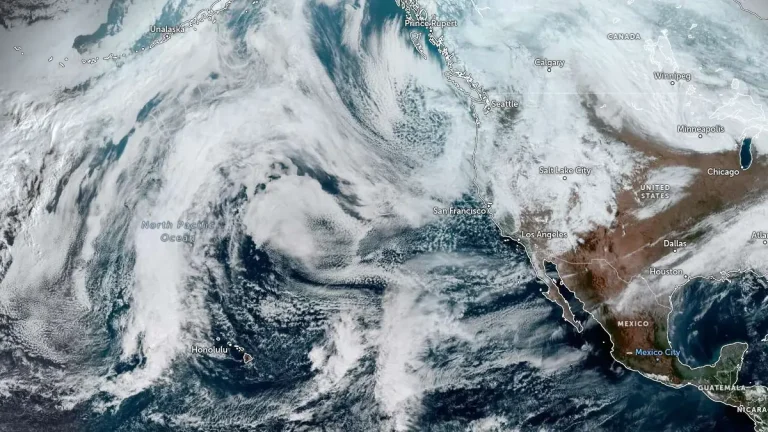
    Experimental seasonal forecasts from the Center for Western Weather and Water Extremes (CW3E) suggest that a weak La Niña is reinforcing a wet–north, dry–south precipitation pattern across the western United States during January–March 2026. The outlook shows high-confidence signals for below-normal precipitation in Southern California, while model uncertainty remains higher across central and northern California.

  • Strong and shallow M6.0 earthquake hits off the coast of Oregon

    A strong and shallow earthquake registered by the USGS as M6.0 struck off the coast of Oregon, United States, at 03:25 UTC on January 16, 2026 (19:25 LT, January 15). The agency is reporting a depth of 10 km (6.2 miles). EMSC is reporting the same magnitude and depth.

  • HVO reports increased earthquake activity beneath Halemaʻumaʻu, first notable summit unrest since December 2024

    A series of three small earthquake swarms occurred beneath Halemaʻumaʻu crater at the summit of Kīlauea Volcano, Hawaii, between January 13 and 14, 2026, marking the most notable shallow seismic unrest since the eruption’s onset in December 2024. The U.S. Geological Survey’s Hawaiian Volcano Observatory (HVO) reports all events were below magnitude 2 and located 1.5–4 km (0.9–2.5 miles) beneath the surface. The activity follows the high fountain eruption of episode 40 on January 12, which produced 5.5 million m³ (7.2 million yd³) of lava within less than 10 hours.

  • Persistent drought and La Niña conditions sustain widespread wildfires in Chile

    Widespread wildfires have been burning across central and southern Chile since early December 2025, affecting seven regions and destroying at least 3 839 ha (9 480 acres) of land. As of January 15, 2026, two people have died, 10 were injured, and more than 2 100 are displaced, according to the International Federation of Red Cross and Red Crescent Societies (IFRC).