
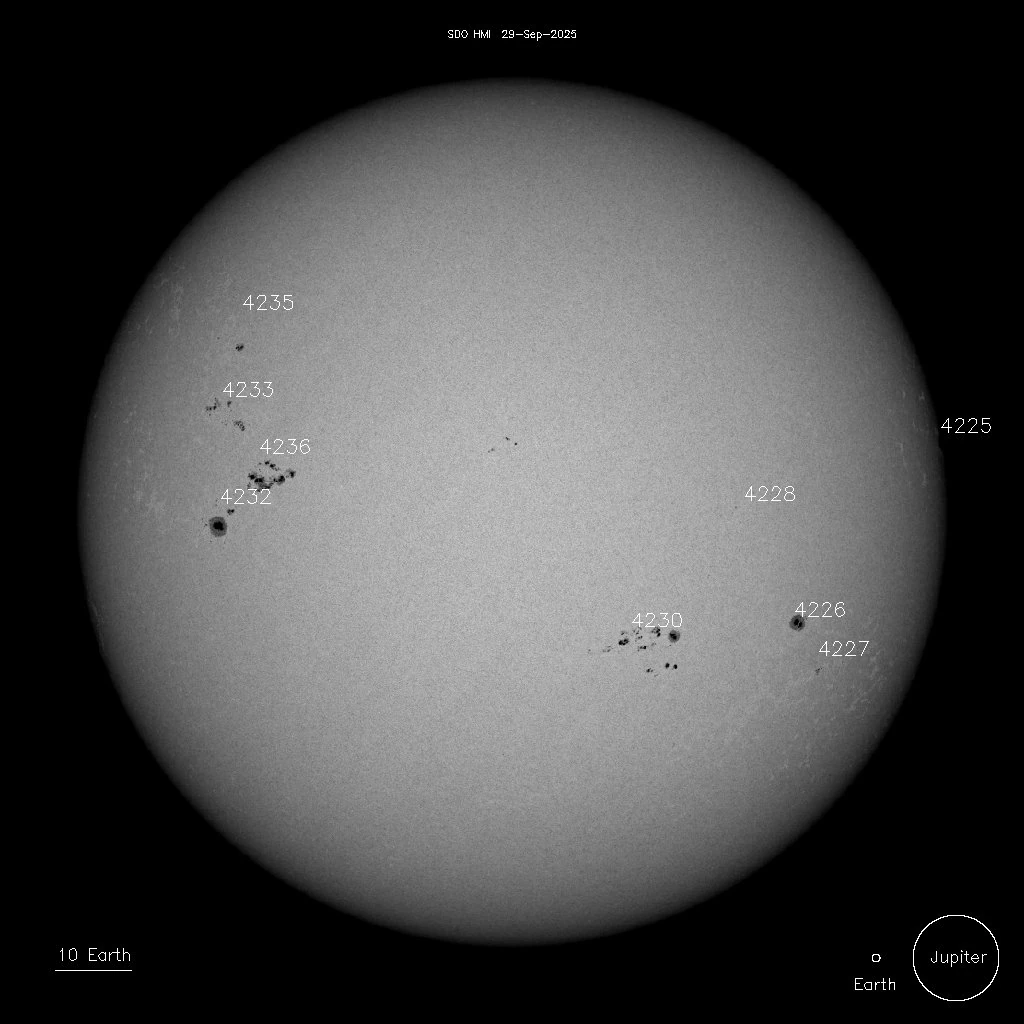
Region 4232 produces multiple M-class flares with CMEs, unsettled to active geomagnetic field expected
Region 4232 produced two CME-associated M-class flares on September 28 and 29, 2025 — an M6.4 at 08:43 UTC on September 28 and an M3.6 at 01:45 UTC today. Forecast calls for unsettled to isolated G1 – Minor geomagnetic storm conditions on September 29, with mostly quiet levels returning by October 1.
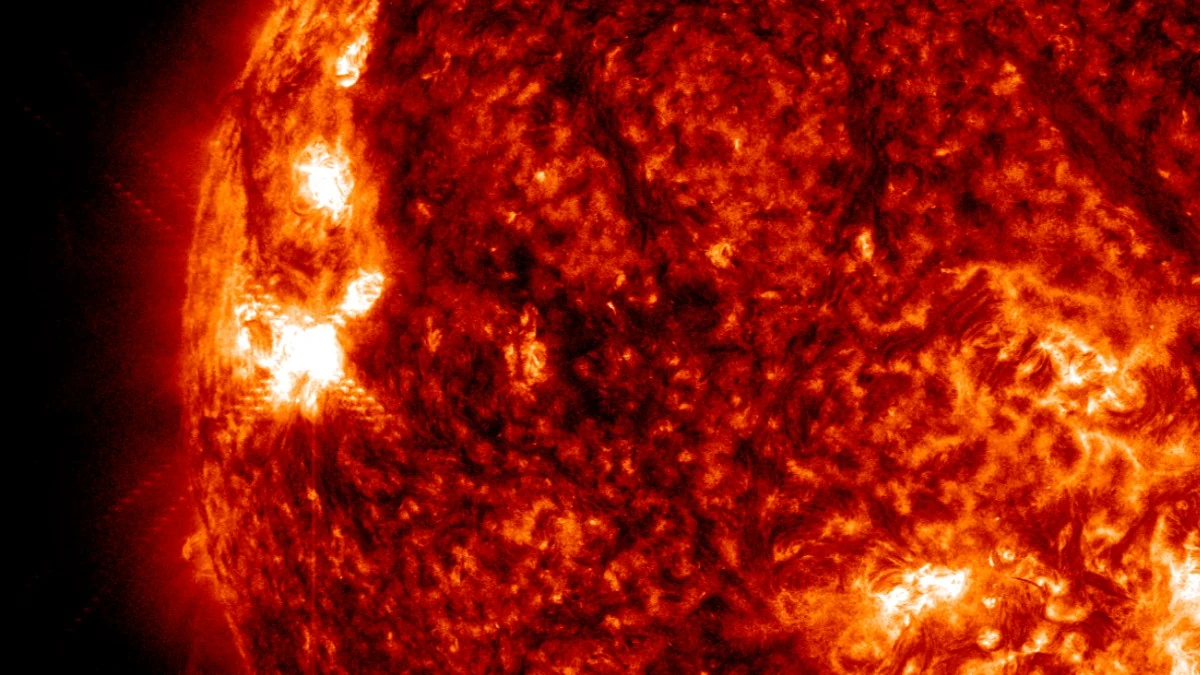
Impulsive M6.4 solar flare at 08:43 UTC on September 28, 2025. Credit: NASA SDO/AIA 304
Solar activity reached high levels on September 28, with multiple M-class flares from Region 4232. An impulsive M6.4 flare erupted from Region 4232 at 08:43 UTC on September 28, launching a non-Earth-directed CME. Later that day, the same region also produced a C7.4 flare.
Region 4232 generated another CME-producing flare at 01:45 UTC on September 29, an impulsive M3.6 event. The associated CME was observed in SOHO LASCO coronagraph imagery beginning at 02:12 UTC, with trajectory modeling still in progress.
NOAA’s Space Weather Prediction Center (SWPC) forecasts solar activity to stay at moderate levels, with about a 55% chance for additional M-class flares through October 1 and a 10% chance for an X-class flare.
Energetic particle flux was stable in 24 hours to 12:30 UTC on September 29. The greater than 2 MeV electron flux was at moderate levels, while the greater than 10 MeV proton flux remained at background. Both are forecast to persist at same levels through October 1.
Solar wind parameters reflected weak influence from a negative polarity coronal hole high-speed stream (CH HSS). Total magnetic field strength peaked at 15 nT, with the Bz component turning southward after 20:00 UTC on September 28 and reaching −13 nT.
Wind speeds ranged from 375 to 450 km/s, with the interplanetary magnetic field oriented in the negative sector.

The geomagnetic field was at quiet to active levels. Forecasts indicate unsettled to isolated G1 – Minor storm conditions on September 29 under continued CH HSS influence, followed by mostly quiet conditions on September 30 and October 1.
References:
1 Forecast Discussion – NOAA/SWPC – September 29, 2025 at 00:30 UTC
2 Forecast Discussion – NOAA/SWPC – September 29, 2025 at 12:30 UTC

Teo Blašković founded The Watchers in 2011 and edited it until 2026, covering seismic and volcanic activity, extreme weather, space weather and near-Earth objects. Articles on this page are his archive.
Published in the last 24 hours
- Hawaii's largest freshwater lake was 200 feet deep at 10 a.m. on June 2, 2018. By that afternoon, lava from Kilauea had boiled it away Epicenter
- Flying glass cut a teacher in Russia but none of her 44 pupils, because when a meteor flashed across the sky in 2013, she told them to get under their desks Epicenter
- A South Dakota man put the widest and heaviest hailstone on US record in his freezer, and a power cut melted part of it before NOAA measured it at 8 inches across and nearly 2 pounds in 2010 Epicenter
- Black kites and brown falcons in northern Australia have been seen snatching smoldering sticks from wildfires, flying them into unburned grass and dropping them, starting new fires that send lizards, rodents and insects running straight toward the waiting birds Epicenter
