
Major eruption at Mount Lewotobi Laki-laki sends ash to 19.6 km, triggers ashfall in nearby villages, Indonesia
A major explosive eruption occurred at Mount Lewotobi Laki-laki, Indonesia, on July 7, 2025, producing an ash column that rose to over 19 km (63 000 feet) above sea level (a.s.l.). The Aviation Color Code was raised to Red, resulting in the cancellation of multiple flights to and from Bali. Heavy ashfall is falling over the nearby villages.
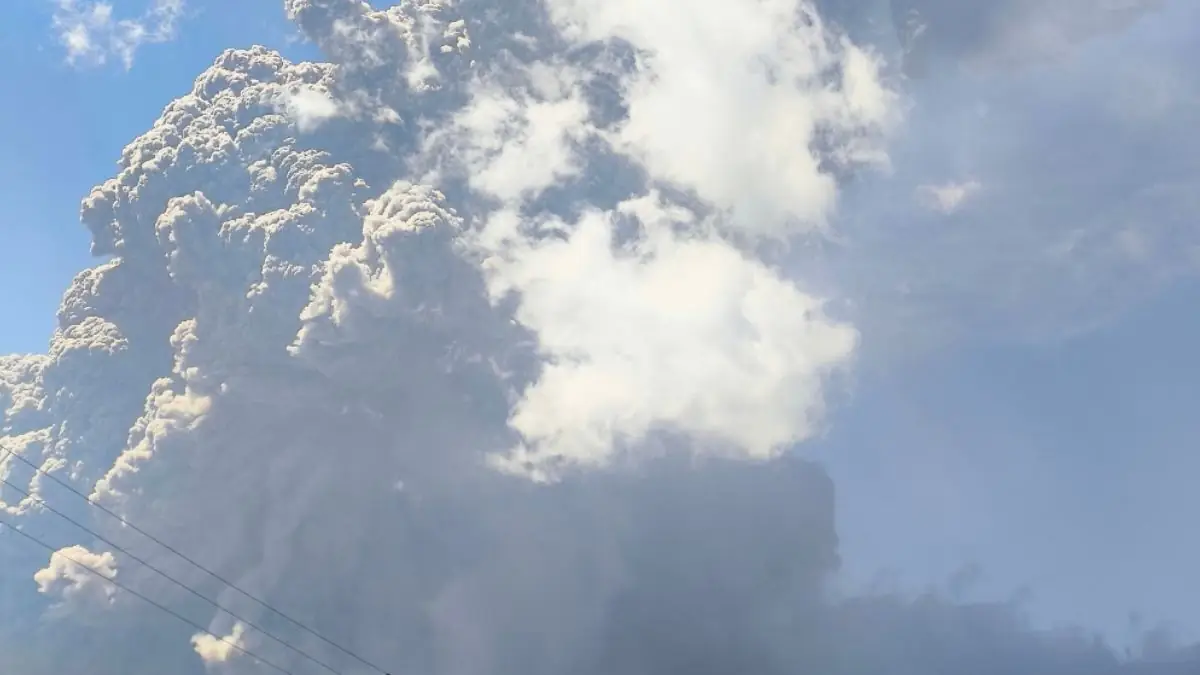
Lewotobi Laki-laki eruption on July 7, 2025. Credit: PVBGM
- Mount Lewotobi Laki-laki erupted explosively on July 7, 2025, producing pyroclastic flows up to 5 km (3 miles) down its slopes and an ash column reaching 19.6 km (63 000 feet) above sea level—the highest since its deadly November 2024 eruption.
- Thick ashfall was reported across downwind villages, including Boru, prompting health warnings and mask advisories. The eruption also disrupted aviation with multiple flight cancellations between Australia and Indonesia.
- This marks the third major eruptive phase at Lewotobi Laki-laki in 2025, with the volcano remaining at the highest alert level and a 7 km (4.3 miles) exclusion zone still in effect due to continued risk of lahars and seismic activity.
A major explosive eruption occurred at Mount Lewotobi Laki-laki, located on Flores Island, Indonesia, at 11:05 WITA (03:05 UTC) on July 7.
Indonesia’s Geological Agency (Badan Geologi) reported that pyroclastic flows, an avalanche of hot gas clouds, mixed with rocks and lava, traveled up to 5 km (3 miles) down the slopes of the volcano during the eruption. Pyroclastic flows pose extreme hazards due to their speed, heat, and force, and can destroy anything in their path.
The Volcanology and Geological Hazard Mitigation Center (PVMBG) reported an ash column height of approximately 18 km (59 000 feet) above the summit or about 19.6 km (63 000 feet) a.s.l. This is the highest ash column at Laki-laki since the November 2024 eruption, which killed nine people and injured dozens.

The ash plume was observed as gray to black in color with thick intensity, spreading toward the north, northeast, and northwest, affecting villages downwind. Residents are being warned to wear masks or cover their mouths due to ash exposure.
Gunung Lewotobi Laki-laki kembali meletus disertai gemuruh kuat, Senin, 7 Juli 2025. pic.twitter.com/3cuHSDUEk6
— FPMKI (@InfoFPMKI) July 7, 2025
Residents in Boru village are moving outside from the danger zone. The ashfall is just everywhere now. This village lies below the Lewotobi Volcano and has been notably affected by ashfall during the eruptions. https://t.co/Ia2UbQfKTI pic.twitter.com/GtRwwNYwFd
— RenderNature (@RenderNature) July 7, 2025
This marks the volcano’s third major eruptive phase in 2025, following events in March and May. The current eruption prompted aviation warnings and the cancellation of multiple flights between Australia and Indonesia. Airlines, including Virgin Australia, Jetstar, and Qantas, suspended routes to and from Bali due to the high-altitude ash hazard.
Authorities have maintained the highest alert level (Level IV) since the May eruption and continue to enforce a 7 km (4.3 miles) exclusion zone around the crater.
No casualties or infrastructure damage have been reported as of the latest updates. However, residents and local officials were advised to remain vigilant due to the potential for secondary hazards such as lahars, especially during periods of heavy rainfall.
Today’s eruption at Laki-laki ranks among Indonesia’s largest volcanic events since the 2010 eruption of Mount Merapi on Java Island, which killed 353 people and forced more than 350 000 to evacuate.
Previous activity at Laki-laki in late 2024 resulted in fatalities and extensive ashfall across East Flores Regency. The twin-peaked Lewotobi system, comprising the male (“Laki-laki”) and female (“Perempuan”) cones, is part of Indonesia’s seismically active Ring of Fire, home to over 120 active volcanoes.

Teo Blašković founded The Watchers in 2011 and edited it until 2026, covering seismic and volcanic activity, extreme weather, space weather and near-Earth objects. Articles on this page are his archive.
Published in the last 24 hours
- In September 1859, a solar storm lit up the night sky so brightly that gold miners in the Rocky Mountains woke up after midnight and started cooking breakfast, convinced the aurora glowing over their camp was the sunrise Epicenter
- A patch of warm Pacific water that could become the strongest El Niño in more than 70 years sits thousands of miles from any American town, yet it is already the main reason NOAA expects a wetter winter across the South and a milder one across the North
- A 19-year-old Nebraska teacher reportedly tied her pupils together with twine and led them to safety through a blizzard in January 1888 Epicenter
- NASA built the Opportunity rover to last 90 days on Mars, and Martian winds helped keep it alive for nearly 15 years by blowing dust off its solar panels, until a planet-wide dust storm in 2018 blocked sunlight and silenced the rover Epicenter

Without a doubt the geological activities and the severe weather patterns will increase in the second half of this year. The reasons are do to the increase in the activity of the Sun combined with a further weakening in earth’s magnetic field.