
Smokehouse Creek Fire becomes largest wildfire in Texas history and second-largest in U.S.
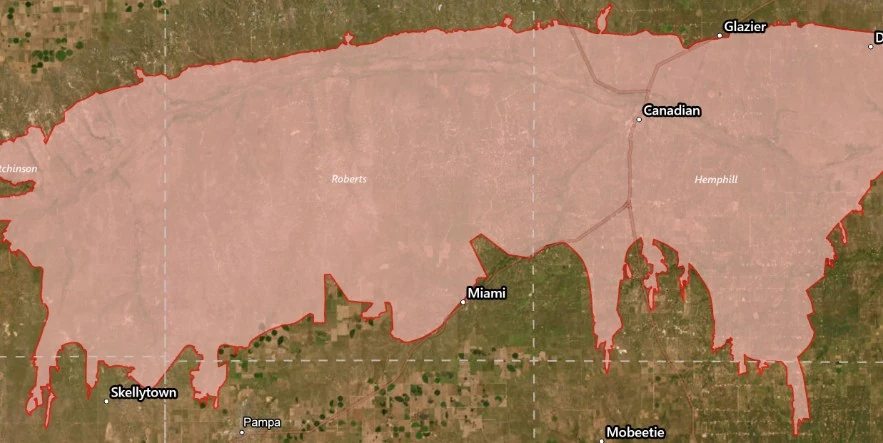
Image credit: Texas A&M Forest Service
On Thursday, February 29, 2024, the Smokehouse Creek Fire expanded beyond 404 686 ha (1 million acres) in Texas, marking it as the largest wildfire in the state’s history and the second-largest in U.S. history. The blaze, which also extended into Oklahoma, has claimed the lives of at least two individuals and continues to pose a significant threat to homes, cattle, and livelihoods in the Texas Panhandle.
The Texas Panhandle is currently facing a catastrophic situation as the Smokehouse Creek Fire, with a sudden wind shift on Tuesday, has grown to over 404 686 ha (1 million acres) in Texas, becoming the largest recorded wildfire in the state’s history by Thursday. Additionally, the fire has spread to Oklahoma, affecting more than 12 748 ha (31 500 acres) there.
This event has led to the deaths of two individuals, including 83-year-old Joyce Blankenship in Hutchinson County, and significant losses in terms of property, livestock, and acreage in both states.
“This is now both the largest and most destructive fire in Texas history,” the West Odessa Volunteer Fire Department said. “It is also the second largest wildfire in U.S. history.”
The previous largest wildfire in Texas was the East Amarillo Complex fire in 2006, which consumed more than 367 223 ha (907 000 acres).
Currently, the largest wildfire in U.S. history is the 1825 Miramichi Fire which burned through 1.2 million ha ha (3 million acres) of land and claimed at least 160 lives.

Despite the adverse conditions, the fire’s growth was temporarily slowed on Thursday due to snowfall and a dip in temperatures and winds. However, the forecast indicates a return to dry conditions and strong winds, which may fuel the fire further.
The Smokehouse Creek Fire has destroyed or damaged scores of homes and caused significant damage to the historic Turkey Track Ranch in Texas, a site of considerable historical importance due to its connections to major events like a significant battle near the end of the Civil War and the Red River War beginning in 1874. The ranch, one of the oldest in Texas and spanning approximately 32 370 ha (80 000 acres), has suffered extensive damage with an estimated 80% of its land, including pastures, plains, and creek bottoms, being consumed by the fire. The loss encompasses not only the land but also livestock, crops, wildlife, ranch fencing, and infrastructure. This event is described by the ranch’s owners as unprecedented in their history,
In Hemphill County, the fire’s devastation was particularly acute, with approximately 40 homes burned and significant agricultural losses, including thousands of cattle, a critical blow to a region where more than 85% of Texas’ cattle are raised.
Emergency services are stretched thin, with the fires burning vast areas of land, destroying homes, and causing significant agricultural damage, particularly to the cattle industry in the Panhandle, where over 85% of Texas’ cattle are raised.


Teo Blašković founded The Watchers in 2011 and edited it until 2026, covering seismic and volcanic activity, extreme weather, space weather and near-Earth objects. Articles on this page are his archive.
Earlier reporting
Nothing on Watchers was published in the last 24 hours. These are older articles.
- 2 atmospheric rivers to bring heavy Sierra snow and California flood risk
- On October 22, 2017, a single flash of lightning stretched 515 miles from eastern Texas to near Kansas City, a distance that takes eight hours to drive, and nobody realized how far it had gone until scientists went back through the satellite data years later Epicenter
- CPC posts a slight risk of heavy rain from the Gulf Coast to the Northeast urban corridor November 25-29, and a moderate risk of West Coast wind and Sierra snow on November 25
- Florida's east coast faces a moderate flash flood risk Wednesday through Friday, with 4 to 8 inches of rain forecast and the St. Johns River near Cocoa already in major flood at 17.13 feet
