
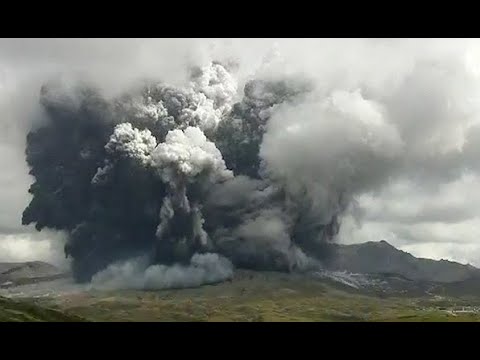
Powerful phreatic explosion at Mount Asosan, Alert Level raised, Japan

Image credit: Jiji Press (stillshot)
A powerful phreatic explosion took place at Asosan’s Nakadake crater at 02:43 UTC (14:43 JST) on October 20, 2021, prompting the Japan Meteorological Agency (JMA) to raise the Alert Level from 2 to 3 at 02:48 UTC. The eruption came one week after volcanic tremors detected under the volcano suggested hot water and magma are moving underground.
While there were no reports of injuries, the eruption produced pyroclastic flows that streamed about 1.3 km (0.8 miles) west of the crater and ejected large volcanic rocks nearly 1 km (0.62 miles) to the south.1
Ash cloud reached a height of 3.5 km (11 500 feet) above the crater.
阿蘇山噴火を20倍速にしてみた。
真っ黒な噴煙が恐ろしい広がり方をしている… pic.twitter.com/yJdJV2Xzih— 走る人参(気象予報士) (@Runninzin) October 20, 2021
Local police have confirmed that 11 people who were climbing the volcano have come down and are safe.
JMA is urging people to refrain from entering the danger zone in Aso City, Takamori Town, and Minamioso Village.
Geological summary
The 24 km (14.9 miles) wide Asosan caldera was formed during four major explosive eruptions from 300 000 to 90 000 years ago. These produced voluminous pyroclastic flows that covered much of Kyushu.
The last of these, the Aso-4 eruption, produced more than 600 km3 (144 mi3) of airfall tephra and pyroclastic-flow deposits.
A group of 17 central cones was constructed in the middle of the caldera, one of which, Nakadake, is one of Japan’s most active volcanoes. It was the location of Japan’s first documented historical eruption in 553 AD.
The Nakadake complex has remained active throughout the Holocene. Several other cones have been active during the Holocene, including the Kometsuka scoria cone as recently as about 210 CE.
Historical eruptions have largely consisted of basaltic to basaltic-andesite ash emission with periodic strombolian and phreatomagmatic activity.
The summit crater of Nakadake is accessible by toll road and cable car, and is one of Kyushu’s most popular tourist destinations.2
References:
1 Japan’s Moun Aso erupts, warning issued – NHK
2 Asosan – Geological summary – GVP

Teo Blašković founded The Watchers in 2011 and edited it until 2026, covering seismic and volcanic activity, extreme weather, space weather and near-Earth objects. Articles on this page are his archive.
Published in the last 24 hours
- In September 1859, a solar storm lit up the night sky so brightly that gold miners in the Rocky Mountains woke up after midnight and started cooking breakfast, convinced the aurora glowing over their camp was the sunrise Epicenter
- A patch of warm Pacific water that could become the strongest El Niño in more than 70 years sits thousands of miles from any American town, yet it is already the main reason NOAA expects a wetter winter across the South and a milder one across the North
- A 19-year-old Nebraska teacher reportedly tied her pupils together with twine and led them to safety through a blizzard in January 1888 Epicenter
- NASA built the Opportunity rover to last 90 days on Mars, and Martian winds helped keep it alive for nearly 15 years by blowing dust off its solar panels, until a planet-wide dust storm in 2018 blocked sunlight and silenced the rover Epicenter

Holy Fire
This volcano was already giving signs, but watching on the first camera of the news, there were many people nearby, they are flirting with danger, they need a class with the Spaniards to avoid predictable tragedies. In these cases there may not be a second chance.