
Strong explosive eruption at Etna volcano, Italy

Image credit: Boris Behncke
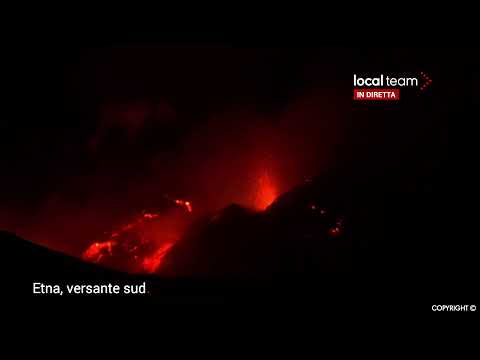
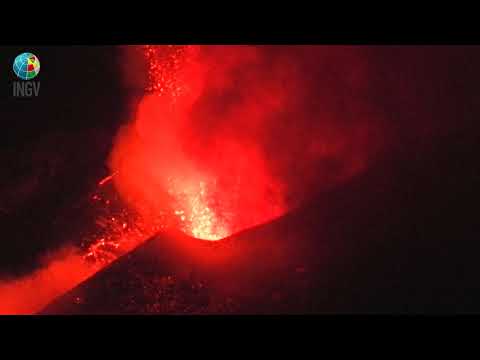
A strong explosive eruption started at Etna volcano on December 13, 2020, ejecting volcanic ash up to 4.8 km (16 000 feet) above sea level by 23:00 UTC. The Aviation Color Code was raised to Red.
Monitoring networks observed increased strombolian activity at the SE Crater starting at 19:20 UTC on December 13, INGV's Etna Observatory reported.
At the same time, there was a sudden increase in the magnitude of the volcanic tremor that has risen from average to high levels, the observatory said at 22:22 UTC, adding that the amplitude is still growing.
In addition, an increase in infrasonic activity has been observed both in the number and amplitude of infrasonic events.
Two eruptive fissures opened on the southeastern side of the SE Crater, producing two lava flows propagating towards the S and SW, whose fronts remained confined to an altitude of about 2 850 m (9 350 feet) a.s.l. Three pyroclastic flows were observed at 22:15 and 22:16 UTC.
Surveillance cameras showed a significant decrease in explosive activity at 22:50 UTC, with variable levels over the next 4 hours.
Explosive activity decreased by 07:05 UTC on December 14, with weak ash emissions still ongoing. The Aviation Color Code was lowered to Orange at 07:06 UTC.
A few moments of the second short episode of Strombolian activity culminating in lava fountaining at #Etna's Southeast Crater during the night of 13-14 December 2020. pic.twitter.com/XjVNdvIjJT
— Boris Behncke (@etnaboris) December 14, 2020
#volcan #volcano #Etna La phase paroxysmale de cette nuit (fontaines+coulées) vue de puis Paterno (sud)/The paroxysmal activity (lava fountains+flows) of the last night seen from Paterno (south) pic.twitter.com/J2iNuYNso4
— CultureVolcan (@CultureVolcan) December 14, 2020
#Etna – 14 Dicembre 2020 | Appena concluso il secondo “mini episodio” di forte attività esplosiva al cratere di sudest. In foto l’acme dell’episodio visto da Acicatena. #sicily #volcanoes #eruption
©️Photo Credit: Fabrizio Zuccarello | Tutti i diritti sono riservati pic.twitter.com/TXI7OQazeN
— EtNative (@EtNativo) December 14, 2020
La sera eruzione, la mattina bestemmione.#Etna pic.twitter.com/wgQsM8MfZ6
— Perìto "Xmas with the yours" Perària (@aedan83) December 14, 2020
Geological summary
Mount Etna, towering above Catania, Sicily's second-largest city, has one of the world's longest documented records of historical volcanism, dating back to 1500 BCE. Historical lava flows of basaltic composition cover much of the surface of this massive volcano, whose edifice is the highest and most voluminous in Italy.
The Mongibello stratovolcano, truncated by several small calderas, was constructed during the late Pleistocene and Holocene over an older shield volcano. The most prominent morphological feature of Etna is the Valle del Bove, a 5 x 10 km (5.1 x 6.2 miles) horseshoe-shaped caldera open to the east.
Two styles of eruptive activity typically occur at Etna. Persistent explosive eruptions, sometimes with minor lava emissions, take place from one or more of the three prominent summit craters, the Central Crater, NE Crater, and SE Crater (the latter formed in 1978). Flank vents, typically with higher effusion rates, are less frequently active and originate from fissures that open progressively downward from near the summit (usually accompanied by strombolian eruptions at the upper end).
Cinder cones are commonly constructed over the vents of lower-flank lava flows. Lava flows extend to the foot of the volcano on all sides and have reached the sea over a broad area on the SE flank. (GVP)

Teo Blašković founded The Watchers in 2011 and edited it until 2026, covering seismic and volcanic activity, extreme weather, space weather and near-Earth objects. Articles on this page are his archive.
Published in the last 24 hours
- Northern lights are possible at high latitudes on November 17 and 18 as NOAA forecasts minor (G1) geomagnetic storms from coronal hole wind
- In February 2022, SpaceX launched 49 Starlink satellites into a solar storm so mild that forecasters rated it minor, and within days 38 of them had fallen back and burned up, because the storm had swollen the thin air they were flying through Epicenter
- On a Friday night in October 1992, a fireball over the eastern US was filmed by fans at high school football games before it punched through the trunk of a teenager’s $400 Chevy Malibu in Peekskill, New York, and she sold the wrecked car for $10,000 Epicenter
- Green Lake, Hawaii's largest freshwater lake, was gone by the afternoon of June 2, 2018, after lava from Kilauea filled its basin. The water was about 20 feet deep, not the 200 feet often claimed. Epicenter
