
Solar storm hits Earth, sparking active geomagnetic conditions

Image credit: Dustin Ginetz. Taken on July 13, 2020 at Seebe, Alberta, Canada. Via SpaceWeatherGallery
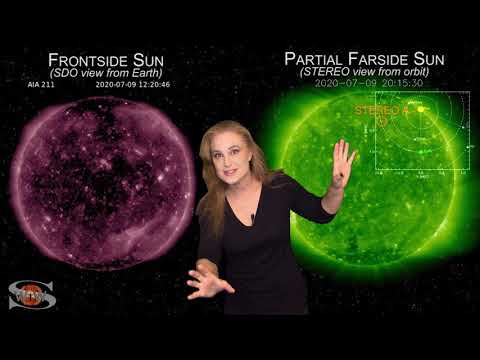
Our Sun launched two solar storms this week, one of which was Earth-directed, Space Weather Physicist Dr. Tamitha Skov reports in her latest space weather forecast released July 14, 2020.
The storm has hit, right on time, and all through the night people have been getting some amazing aurora shots down to mid-latitudes along with comet NEOWISE, as far south as Michigan in the USA.
This solar storm is now waning, but should continue over the next day or so before things return to quiet.

As for our star, it continues to be spotless, which means the solar flux is in the high 60s and radio propagation on Earth's dayside continues to be poor.
However, this low solar flux means GPS reception on the dayside should be pretty good– just be careful on Earth's nightside with the ongoing solar storm.
Especially if you are near aurora or near dawn or dusk, your GPS reception will likely be unreliable.
What a Stellar night! (No pun intended) Quick edit of:OMG! #Aurora and #cometNEOWISE! 1rst time using this type of lens! Can't wait to look at the rest! Mind blowing night on the #manitobaprairies! 30Mins N. of #winnipeg @TamithaSkov @StormHour @AuroraNotify pic.twitter.com/b9gDh07KRJ
— KimHines/SuperNatu☈e (@KimHinesSN) July 14, 2020
Here a photo of me some northern lights and comet #NEOWISE
Photography has always been my biggest hobby and i love being able to share my photographs with everyone
Im excited to continue to improve and travel across canada!Fun fact i failed photography class in highschool pic.twitter.com/eZBLPC8vjW
— Mitch Langlois (@MitchLangPhotos) July 14, 2020
"Celestial Magic" // #NorthernLights + #Neowise aligned last night for an epic interstellar display of pure wonder & awe over the Range #Lighthouse where the #SaugeenRiver meets #LakeHuron in #Southampton, #Ontario #Canada -//- Captured July 13, 2020 #SaugeenShores #comet pic.twitter.com/ac15e9qCAZ
— Scott Rock Photography (@scottrockphoto) July 14, 2020

The Watchers team and our contributors bring the latest on extreme weather, earthquakes, volcanic eruptions, space weather, and all things science. We're all about making sense of the natural world and keeping you informed on what’s happening. Got a tip or a question? Hit us up using the form at newstips!
Published in the last 24 hours
- In September 1859, a solar storm lit up the night sky so brightly that gold miners in the Rocky Mountains woke up after midnight and started cooking breakfast, convinced the aurora glowing over their camp was the sunrise Epicenter
- A patch of warm Pacific water that could become the strongest El Niño in more than 70 years sits thousands of miles from any American town, yet it is already the main reason NOAA expects a wetter winter across the South and a milder one across the North
- A 19-year-old Nebraska teacher reportedly tied her pupils together with twine and led them to safety through a blizzard in January 1888 Epicenter
