
Shinmoedake volcano eruption ejects ash up to 7.6 km (25 000 feet), Japan

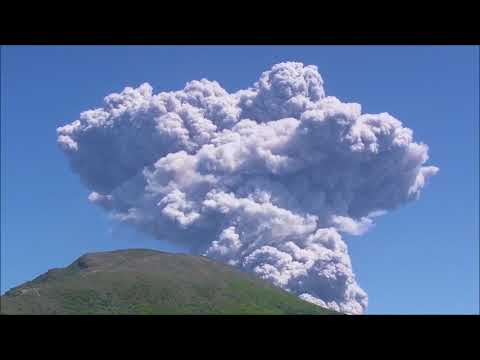
Featured image: Shinmoedake erupting on May 14, 2018. Credit: Fobos Planet
A brief but strong explosive eruption, the first since April 6, took place at Mount Shinmoedake in southern Kyushu at 05:44 UTC on May 14, 2018.
The eruption sent ash up to 7.6 km (25 000 feet) above sea level, making it nearly 1 km higher than April 4th eruption and the highest since a series of eruptions began on March 1, 2018.
The Japan Meteorological Agency (JMA) has maintained the alert level at 3, meaning people should stay away from the mountain and remain cautious of falling large rocks within a 3-km (1.8 miles) radius of the crater.
According to Tokyo VAAC, the volcanic ash was continually observed up until 11:20 UTC on May 15.

Geological summary
Kirishimayama is a large group of more than 20 Quaternary volcanoes located north of Kagoshima Bay. The late-Pleistocene to Holocene dominantly andesitic group consists of stratovolcanoes, pyroclastic cones, maars, and underlying shield volcanoes located over an area of 20 x 30 km (12.4 – 18.6 miles).
The larger stratovolcanoes are scattered throughout the field, with the centrally located, 1700-m-high (5 577 feet) Karakunidake being the highest.
Onamiike and Miike, the two largest maars, are located SW of Karakunidake and at its far eastern end, respectively.
Holocene eruptions have been concentrated along an E-W line of vents from Miike to Ohachi, and at Shinmoedake to the NE. Frequent small-to-moderate explosive eruptions have been recorded since the 8th century. (GVP)

Teo Blašković founded The Watchers in 2011 and edited it until 2026, covering seismic and volcanic activity, extreme weather, space weather and near-Earth objects. Articles on this page are his archive.
Published in the last 24 hours
- In September 1859, a solar storm lit up the night sky so brightly that gold miners in the Rocky Mountains woke up after midnight and started cooking breakfast, convinced the aurora glowing over their camp was the sunrise Epicenter
- A patch of warm Pacific water that could become the strongest El Niño in more than 70 years sits thousands of miles from any American town, yet it is already the main reason NOAA expects a wetter winter across the South and a milder one across the North
- A 19-year-old Nebraska teacher reportedly tied her pupils together with twine and led them to safety through a blizzard in January 1888 Epicenter
- NASA built the Opportunity rover to last 90 days on Mars, and Martian winds helped keep it alive for nearly 15 years by blowing dust off its solar panels, until a planet-wide dust storm in 2018 blocked sunlight and silenced the rover Epicenter
