
More than 130 quakes after M4.6 NE of Gonzales, California
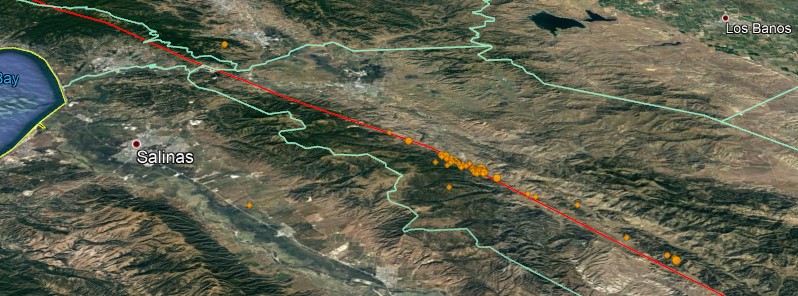
Image credit: Google, USGS
Following a M4.6 earthquake that hit just NE of Gonzales, California on November 13, 2017, the USGS has registered more than 130 aftershocks within the 5 km (3.1 miles) of the epicenter. Although most of those aftershocks weren't felt by the Central Coast, the aftershock sequence is raising fears a large earthquake is about to strike the region.
This one has been a quite productive aftershock sequence, but only 17 were stronger than M2.5 and six were greater than 3.0, USGS seismologist Ole Kaven said. "We suspect there will be aftershocks in the 2 to 3 magnitude range for at least a few more weeks, but smaller shakers could continue for even longer."
"Last Monday's quake occurred on a "creeping section" of the San Andreas Fault, so seismic activity in the area is normal," Kaven said. "It's a reminder that we are living in earthquake country."

Similarly sized earthquakes were recorded in the same spot in 2001, 2004 and 2011. In each case, the USGS observed a pattern of aftershocks like the region is seeing now.
"The San Andreas fault in southern California last had a major quake in 1857 (M7.9)," Robert Graves, a research geophysicist at USGS, recently said.
"Studies that have dated previous major offsets along the fault trace show that there have been about 10 major quakes over the past 1 000 – 2 000 years, with the average time between these quakes about 100 – 150 years."
This suggests the region is overdue for another major earthquake by 10 years.

Teo Blašković founded The Watchers in 2011 and edited it until 2026, covering seismic and volcanic activity, extreme weather, space weather and near-Earth objects. Articles on this page are his archive.
Published in the last 24 hours
- High Risk of excessive rainfall covers Florida’s Space Coast as St. Johns River near Cocoa reaches 5.67 m
- Asteroid 2026 WJ to pass Earth at 1.7 lunar distances at 04:20 UTC on November 22, with 2026 WD following at 4.4 lunar distances on November 23
- Cyclone Akvan crossed the north Andhra Pradesh and south Odisha coasts close to Gopalpur on November 20 with 70-80 km/h winds gusting to 90, and has weakened into a deep depression
- A broad low over southeastern Florida and the northwestern Bahamas has a 30 percent chance of subtropical or tropical development within 48 hours and a 50 percent chance within 7 days, the National Hurricane Center says
