
Asteroid 2017 DS109 to flyby Earth at 0.90 LD
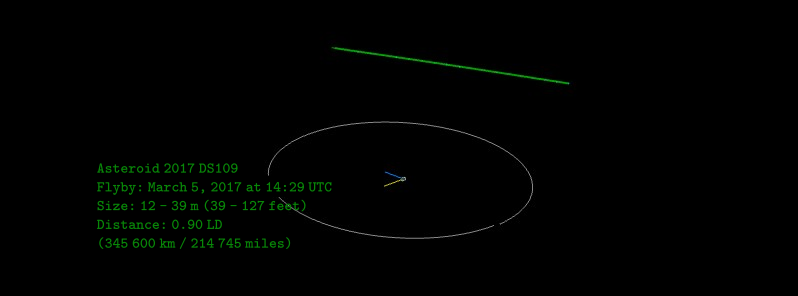
Featured image: The green line indicates the object's apparent motion relative to the Earth, and the bright green marks are the object's location at approximately one hour intervals. The Moon's orbit is gray. The blue arrow points in the direction of Earth's motion and the yellow arrow points toward the Sun. Credit: Minor Planet Center. Edit: TW
Asteroid 2017 DS109 will flyby Earth at a distance of 0.90 LD (345 600 km / 214 745 miles) from the surface of our planet at 14:29 UTC on March 5, 2017.
This asteroid belongs to the Apollo group of asteroids. It was first observed by Pan-STARRS 1, Haleakala on February 27, 2017.
Asteroid 2017 DS109 has an estimated diameter between 12 and 39 m (39 – 127 feet) and will flyby us at a speed (relative to the Earth) of 11.38 km/s.
[ Ephemeris | Orbit Diagram | Orbital Elements | Physical Parameters | Close-Approach Data ]
This is the 8th known asteroid to flyby Earth within 1 lunar distance this year (according to data available at CNEOS on September 20, 2017):
Asteroid 2017 EA – Distance: 0.05 LD – March 2
Asteroid 2017 DR34 – Distance: 0.57 LD – February 25
Asteroid 2017 DG16 – Distance: 0.34 LD – February 23
Asteroid 2017 BS32 – Distance: at 0.41 LD – February 2
Asteroid 2017 BH30 – Distance: 0.17 LD – January 30
Asteroid 2017 BX – Distance: 0.68 LD – January 25
Asteroid 2017 AG13 – Distance: 0.53 LD – January 9
As of March 4, 2017, we know for a total of 381 near-Earth objects that already flew past Earth within 1 lunar distance since 1910 or will over the next 172 years. This number is constantly growing as new objects get discovered.
In 2016, there were 52 such objects and the closest was 2016 DY30 on February 25. Its size is between 2.1 and 4.7 m (6.8 – 15.4 feet) and if flew past us at 0.04 LD (15 360 km / 9 544 miles). In 2015, there were 26 such objects.
References:
Asteroid 2017 DS109 at Minor Planet Center, CNEOS

Teo Blašković founded The Watchers in 2011 and edited it until 2026, covering seismic and volcanic activity, extreme weather, space weather and near-Earth objects. Articles on this page are his archive.
Published in the last 24 hours
- Asteroid 2026 WA passed Earth at 126,400 km, about a third of the Moon's distance, at 07:59 UTC on November 17
- The storms drenching California this week are fed by a river in the sky, a band of water vapor that can carry up to 15 times the flow of the Mississippi River, and this winter’s near-record El Niño could keep aiming more of them at the West Coast
- Malawi continues Bris AI weather forecasting tests ahead of operational integration Epicenter
- Right about now, Voyager 1 is crossing a line no human-made object has ever reached, a full light-day from Earth, which means a message NASA sends tonight won't arrive until tomorrow night, and the spacecraft's answer won't make it home until the night after that

Thanks you are doing a good job.
Thanks, Phil.