
Moderate M1.7 solar flare erupted from geoeffective AR 1865
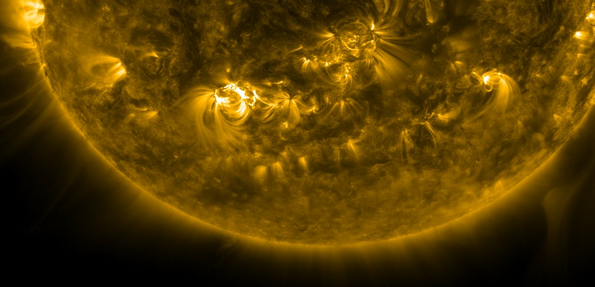
Image credit: TW
A moderate solar flare measuring M1.7 erupted on Sunday, October 13, 2013. The event peaked at 00:43 UTC and a Type II Radio Emission was associated. Type II emissions occur in association with eruptions on the Sun and typically indicate a Coronal Mass Ejection is associated with a flare event.
The eruption was centered around geoeffective Active Region 1865 located in southeastern quadrant and current forecast warns there could be a slightly Earth directed component. The material is expected to arrive on October 15.

M1.7 solar flare – October 13, 2013. Image credits: NOAA SWPC X-ray graph/SDO AIA 304/SAM EVE. Edit: The Watchers
Space Weather Message Code: ALTTP2
Serial Number: 871
Issue Time: 2013 Oct 13 0151 UTC
ALERT: Type II Radio Emission
Begin Time: 2013 Oct 13 0035 UTC
Estimated Velocity: 798 km/s
Description: Type II emissions occur in association with eruptions on the sun and typically indicate a coronal mass ejection is associated with a flare event.
Sunspots
There are currently 6 numbered sunspot regions on the disk. AR 1865, the source of today's M1.7 event, is located almost at the center of the disk and has beta-gamma-delta magnetic configuration, capable of producing strong solar flares. It is geoeffective so any future eruption from this region would most likely be Earth directed.

Sunspots – October 13, 2013. Image courtesy of NASA/SDO and the AIA, EVE, and HMI science teams
1857 – Alpha
1861 – Beta-Gamma
1863 – Beta
1864 – Alpha
1865 – Beta-Gamma-Delta
1867 – Beta
NOAA SWPC forecasters estimated 40% chance for an M-class, and 15% chance for an X-class event today.

Featured image courtesy of NASA/SDO and the AIA, EVE, and HMI science teams

Teo Blašković founded The Watchers in 2011 and edited it until 2026, covering seismic and volcanic activity, extreme weather, space weather and near-Earth objects. Articles on this page are his archive.
Published in the last 24 hours
- High Risk of excessive rainfall covers Florida’s Space Coast as St. Johns River near Cocoa reaches 5.67 m
- Asteroid 2026 WJ to pass Earth at 1.7 lunar distances at 04:20 UTC on November 22, with 2026 WD following at 4.4 lunar distances on November 23
- Cyclone Akvan crossed the north Andhra Pradesh and south Odisha coasts close to Gopalpur on November 20 with 70-80 km/h winds gusting to 90, and has weakened into a deep depression
- A broad low over southeastern Florida and the northwestern Bahamas has a 30 percent chance of subtropical or tropical development within 48 hours and a 50 percent chance within 7 days, the National Hurricane Center says
