
250 000 people displaced due to severe flooding in Assam, India
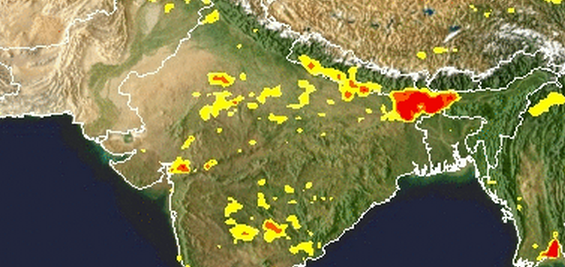
Image credit: NASA TRMM (July 9, 2013)
Official reports today mention nearly 250 000 people have been forced to leave their homes due to flooding in the north-eastern Indian state of Assam. About 400 villages have been hit by floods since Friday, July 5, 2013 after the Jiadhol and Kumatia rivers, fed by monsoon rains, started creating havoc.
On Saturday (July 6, 2013) – Dhemaji, Golaghat, Jorhat, Kamrup, Karimganj, Lakhimpur, Morigaon, Nagaon, Sivasagar, Tinsukia and Chirang districts have all been affected by the flood. Dhemaji district, located at the easternmost part of the state on northern bank of Brahmaputra, is the worst-hit district every year.
The situation further deteriorated on Monday when heavy monsoon rain caused major rivers in Assam to burst their banks. Brahmaputra river also burst its bank.
More than 35 villages in Dhemaji have been completely submerged. Many roads and bridges have been washed away, affecting road links between the district and the rest of the state.
This is second wave of flood to hit India this year.


Locations with highest flood potential on July 9, 2013 (Credit: NASA TRMM)
Last month, floods left more than 800 people dead and thousands missing in Uttarakhand.
Last year, due to significant monsoon rains in India, 124 people died and over five million were displaced.
During the monsoon season (June–October), floods are a common occurrence in India. Occasionally, massive flooding causes huge losses to crops, life and property.
Deforestation in the Brahmaputra watershed has resulted in increased siltation levels, flash floods, and soil erosion in critical downstream habitat, such as the Kaziranga National Park in middle Assam.

Rainfall anomalies map for the last 30 days (Credit: NASA TRMM)

Teo Blašković founded The Watchers in 2011 and edited it until 2026, covering seismic and volcanic activity, extreme weather, space weather and near-Earth objects. Articles on this page are his archive.
Published in the last 24 hours
- High Risk of excessive rainfall covers Florida’s Space Coast as St. Johns River near Cocoa reaches 5.67 m
- A broad low over southeastern Florida and the northwestern Bahamas has a 30 percent chance of subtropical or tropical development within 48 hours and a 50 percent chance within 7 days, the National Hurricane Center says
- Asteroid 2026 WJ to pass Earth at 1.7 lunar distances at 04:20 UTC on November 22, with 2026 WD following at 4.4 lunar distances on November 23
- Cyclone Akvan crossed the north Andhra Pradesh and south Odisha coasts close to Gopalpur on November 20 with 70-80 km/h winds gusting to 90, and has weakened into a deep depression

Those not affected of these storms should count our blessings