
M-class solar flare measuring M2.3 erupted today – G2 class geomagnetic storm in progress
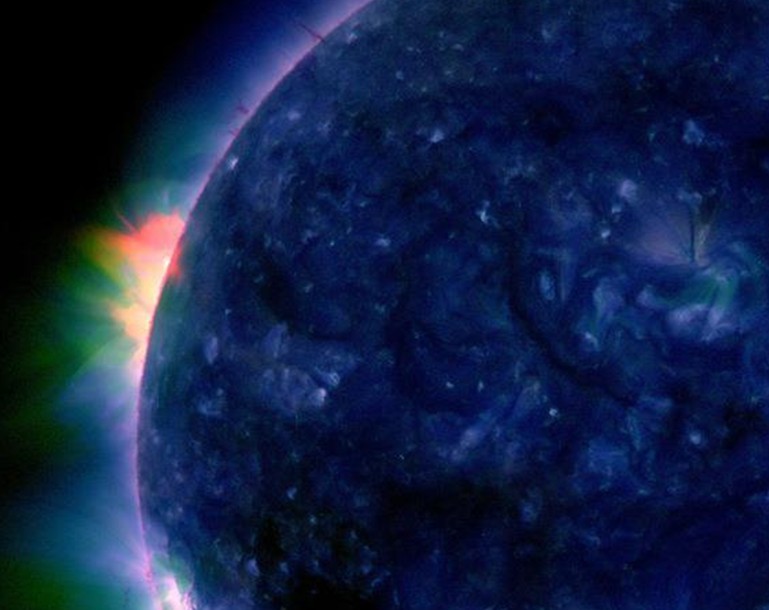
Image credit: TW
An M-class solar flare erupted on October 8, 2012 at 11:17 UTC. The event started at 11:05, peaked at 11:17 and ended at 11:23 UTC. The source of this flare is probably a new region on Sun’s northeastern limb rotating into Earth’s view. Coronal Mass Ejection (CME) was observed but it is directed to the east and away from Earth. There is 5% chance for another M-class event and 1% chance for an X-class. We’ll most likely see more Earth directed activity in the coming days.


Meanwhile, there is Geomagnetic storming here on Earth caused by incoming CME from October 5 eruption. Solar wind conditions in the wake of the CME are favorable for polar geomagnetic activity. High-latitude sky watchers should be alert for auroras, especially during the hours around local midnight.
Latest report for Geomagnetic activity issued at 11:44 UTC states Geomagnetic K-index of 6:
Space Weather Message Code: ALTK06
Serial Number: 296
Issue Time: 2012 Oct 08 1144 UTC
ALERT: Geomagnetic K-index of 6
Threshold Reached: 2012 Oct 08 1138 UTC
Synoptic Period: 0900-1200 UTC
Active Warning: Yes
NOAA Scale: G2 – Moderate
Potential Impacts: Area of impact primarily poleward of 55 degrees Geomagnetic Latitude.
Induced Currents – Power grid fluctuations can occur. High-latitude power systems may experience voltage alarms.
Spacecraft – Satellite orientation irregularities may occur; increased drag on low Earth-orbit satellites is possible.
Radio – HF (high frequency) radio propagation can fade at higher latitudes. Aurora – Aurora may be seen as low as New York to Wisconsin to Washington state.

Space weather overview look – SWS

Coronal mass ejection impact forecast

New region rotating into view
An approaching and flare producing region is rotating into view off the Sun’s northeastern limb.

Teo Blašković founded The Watchers in 2011 and edited it until 2026, covering seismic and volcanic activity, extreme weather, space weather and near-Earth objects. Articles on this page are his archive.
Published in the last 24 hours
- High Risk of excessive rainfall covers Florida’s Space Coast as St. Johns River near Cocoa reaches 5.67 m
- Asteroid 2026 WJ to pass Earth at 1.7 lunar distances at 04:20 UTC on November 22, with 2026 WD following at 4.4 lunar distances on November 23
- Cyclone Akvan crossed the north Andhra Pradesh and south Odisha coasts close to Gopalpur on November 20 with 70-80 km/h winds gusting to 90, and has weakened into a deep depression
- A broad low over southeastern Florida and the northwestern Bahamas has a 30 percent chance of subtropical or tropical development within 48 hours and a 50 percent chance within 7 days, the National Hurricane Center says

[…] The Watchers – M-class solar flare measuring M2.3 erupted today … […]